 AI Infrastructure
The Backbone of America's Intelligence Revolution
Go To: Hardware | Architecture | Software | Storage | Economics | Geopolitics | Environment } Future | Governance | Conclusion
In appearance, AI may seem to be powered by algorithms, models, and data. In reality, AI runs on infrastructure. And not ordinary infrastructure, but the most expensive, compute-intensive, energy-hungry, high-precision technological backbone ever built. Behind every chatbot answer, medical AI diagnosis or autonomous vehicle decision lies a vast chain of data centers, high-performance chips, fiber-optic networks, cooling systems, high-voltage power lines, and orchestration layers that make AI possible at scale.
This chapter explores the invisible but essential infrastructure enabling America's AI revolution, from the early research labs of the 1950s to the hyperscale data centers of 2025. AI infrastructure is no longer a technical curiosity, it is the next great industrial buildout, a geopolitical asset, and one of the grandest undertakings of the 21st century.
One of the largest infrastructure projects in US history was begun in 1956, the year of the birth of Artificial Intelligence at the Dartmouth Conference. That project was the Interstate Highway System, the creation of a vast network of highways across America. The system of highways, spearheaded by President Eisenhower, was a monumental national endeavor with the goal to connect raw materials to factories, cities to suburbs, and military bases across the continent.
This infrastructure was about reducing friction in movement, cutting the time it took for a truck to haul goods from New York to San Francisco, from Detroit to Miami. It reshaped the geography of commerce in America. Now, seven decades later, the world is engaged in an equally ambitious infrastructure project: the construction of an AI Data Center Network. If the Interstate was the concrete spine of the industrial age, the data center is the silicon synapse of the intelligence age. The purpose, however, remains the same: reducing friction in transmission. We are building colossal, fortified, and power-hungry structures, not to move goods, but to move, process, and train petabytes of data. These facilities, often situated in geographically concentrated, low-risk areas are the modern junction points.
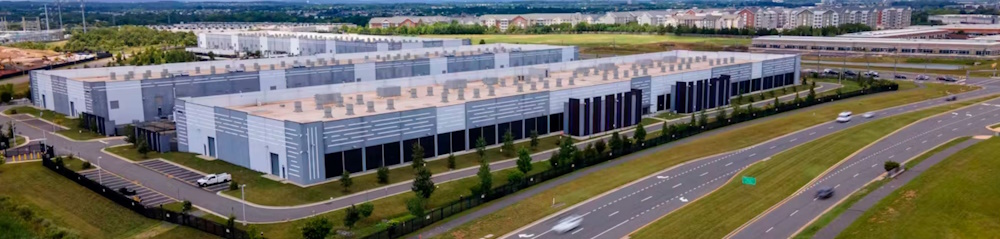
The data center pictured here is enormous. Look at how small the cars and trucks appear compared to the building.
The Vault of Riverwood: A Data Center Story
Riverwood, Maine, was a town built on paper and patience. For over a century, the Great Northern Mill had been the town's heartbeat, its smoke plume a sign of life, its payroll the foundation of nearly every family. When the mill shuttered in 2008, the patience faded, leaving behind boarded-up storefronts and a population that shrunk with every high-school graduating class.
By 2020, Riverwood was desperate. So when a proposal came from out of the blue the town's reaction was mixed. A massive, anonymous entity named 'Aegis Corporation' wanted to build a data center the size of six football fields on the decommissioned mill site. The Mayor, Sarah Thompson, saw a lifeline. The old guard saw otherwise. They viewed it as a metallic tombstone for the soul of their town.
The construction phase was the first sign of life. Local concrete suppliers, plumbers, and electricians--some of whom hadn't seen steady work in a decade--were hired for the enormous, two-year build-out of "The Vault." But the true test came when the construction crews left and the automated cooling systems powered up.
"It's going to be a giant vault of blinking lights run by three people in California," groused Old Man Fitz down at the diner. "What did it change?"
Mayor Thompson knew the fear was legitimate. A data center, unlike a factory, employs few hands directly. But she saw the deeper, lasting benefits that were carefully negotiated in the initial contract.
First: The Fiber Spine. To connect The Vault's servers to the global internet, Aegis had to run a brand-new, high-capacity fiber-optic line directly through Riverwood. The agreement stipulated that a portion of this fiber infrastructure must be branched off to service the community. Within six months of the center going live, Riverwood went from struggling with slow, expensive DSL to having gigabit-speed internet. It was the kind of connectivity only major metropolitan areas could boast.
The impact was immediate. Sarah Jenkins, who had moved away to Boston to work in graphic design, moved back home. She started a successful remote studio, hired two local college students, and paid rent on the boarded-up pharmacist's building downtown. A dozen other small, internet-dependent businesses followed, realizing they could operate globally while enjoying Riverwood's quiet pace and low cost of living.
Second: The Technical Investment. Aegis needed skilled, hyper-local talent for 24/7 security, network monitoring, and preventative maintenance; jobs that couldn't be outsourced or automated away entirely. In partnership with the local community college, the company funded a new Network Operations and HVAC certification program. They guaranteed interviews to every Riverwood student who completed the rigorous course.
Suddenly, the high school graduates who used to leave for good were staying. They were earning technical certifications and stepping into careers that paid six figures, salaries unheard of in the old mill town economy. The town's average household income stabilized and began to rise.
Third: The Tax Revenue Stream. Because The Vault was a massive piece of commercial property requiring constant cooling and maintenance, it generated a significant property tax base. The revenue was channeled back into the town coffers. It didn't just plug budget holes; it funded a revolution. Mayor Thompson unveiled a completely revitalized, geothermal-heated Riverwood High School, complete with a new technical wing powered by the same energy infrastructure built to serve the data center.
The Vault remained anonymous; a massive, humming black box of climate controlled servers on the edge of town, guarded by high fences. It never provided coffee shops or offered public tours. Yet, its presence was felt everywhere: in the smooth, high-speed connection that let Mrs. Peterson video chat with her grandkids, in the vibrant glow of the new technical college sign, and in the confidence of the young men and women who stayed in Riverwood because they finally saw a future there.
The mill was gone, but the patience had returned. Riverwood had swapped the smoke plume of industry for the invisible pulse of global data, and in doing so, had found a quiet, prosperous place in the 21st century.
Introduction: Infrastructure as AI Foundation
AI infrastructure constitutes the physical, computational, and organizational systems enabling AI development, deployment, and operation at scale. This infrastructure encompasses data centers and cloud computing platforms, specialized hardware including GPUs and AI accelerators, networking and interconnect technologies, data storage and management systems, software frameworks and development tools, energy and cooling systems, and the human expertise required to build and operate these systems. As AI transitions from research curiosity to foundational technology, the infrastructure supporting it has become strategically critical and very expensive.
AI infrastructure is characterized by massive capital requirements, rapid technological evolution, significant energy consumption, geographic concentration, and strategic importance. The infrastructure layer is dominated by a small number of hyperscale companies, primarily American firms including Google, Microsoft, Amazon, and Nvidia. Competition is intensifying from Chinese companies with specialized startups and traditional technology firms. Investment in AI infrastructure has reached hundreds of billions of dollars annually and continues to accelerate.
Every transformative technology requires supporting infrastructure enabling its development and deployment. Electricity needed generation plants, transmission grids, and distribution systems before it could power industrial revolution. Automobiles required roads, fuel distribution, and maintenance networks. The internet needed fiber optic cables, data centers, routing equipment, and protocols. Similarly, despite its reputation as purely software innovation, AI depends fundamentally on physical and organizational infrastructure operating at unprecedented scales.
AI infrastructure differs from its predecessors in several respects. The computational requirements are extraordinary, with leading AI models requiring compute that would have been impossible a decade ago and unimaginable two decades ago. Training GPT-4, for example, reportedly consumed tens of thousands of specialized processors and the process took many months to complete. This is a computational effort exceeding most scientific computing projects. The rate of growth is exceptional, with computational requirements for frontier AI models doubling every six to ten months, far exceeding Moore's Law's historical pace.
Energy consumption is staggering and the need is accelerating. Training and running AI models at data centers consume electricity at rates comparable to small cities. Some projections suggest AI could account for several percent of global electricity consumption within a decade. This raises sustainability questions and creates practical constraints on AI deployment since few locations have the electricity infrastructure necessary to support massive AI data centers.
The capital requirements are huge. Building cutting-edge AI infrastructure requires billions of dollars in investment for facilities, equipment, and operations. A single advanced data center optimized for AI training might cost several billion dollars. The largest projects on today's drawing boards are measured in hundreds of billions of dollars. Nvidia's latest AI accelerators cost tens of thousands of dollars each, and training clusters contain thousands of units. The scale creates barriers to entry and concentrates capabilities among organizations able to raise such capital.
The complexity of AI infrastructure is increasing. Early AI research could occur on individual workstations or small clusters. Modern AI requires orchestrating thousands of processors with high-speed interconnects, sophisticated cooling, redundant power, advanced networking, and petabytes of storage. Managing this complexity requires specialized expertise from infrastructure engineers, systems architects, network designers, and operations teams that are scarce and expensive.
The computing power necessary to build the next generation of AI currently operates in a limited number of geographic locations. Advanced semiconductor manufacturing occurs in a handful of facilities, primarily in Taiwan, although Nvidia has recently opened a manufacturing facility for their advanced, Blackwell chip in Arizona. These facilities tend to cluster in regions with favorable electricity costs, climate, and connectivity.
Understanding AI infrastructure is essential for assessing AI's trajectory and implications. Infrastructure determines which organizations can develop cutting-edge AI, what applications are feasible, where AI capabilities concentrate, and who controls the technology. Infrastructure bottlenecks constrain progress, while infrastructure breakthroughs enable rapid advances. The massive investments in AI infrastructure reflect recognition of its strategic importance.
 Computational Hardware: The Engine of AI
The modern breakthrough in Artificial Intelligence, often called the AI "renaissance," really took off around 2012 because of hardware originally designed for a completely different purpose: video game graphics. Graphics Processing Units (GPUs) proved to be remarkably effective for training the complex mathematical structures known as neural networks. The key is the GPU's parallel architecture. Instead of using a few powerful cores to solve tasks one after the other (like a traditional CPU), the GPU utilizes thousands of smaller cores that can perform the exact same simple operation simultaneously. This setup perfectly matches how neural networks learn, which is by running the same calculation across millions of data points over and over. This lucky compatibility gave AI researchers fast, affordable hardware, which was the final piece needed to rapidly experiment and train the enormous, advanced AI models we rely on today.
Nvidia recognized this opportunity early, adapting its GPUs for AI workloads and developing CUDA software enabling programmers to harness GPU capabilities. The company's successive GPU generations from the K80 through V100, A100, H100, and now B100/B200 have provided exponential performance improvements for AI workloads. Each generation has been optimized increasingly for AI rather than graphics, with features like Tensor Cores specifically accelerating neural network operations.
The dominance Nvidia achieved is extraordinary. The company controls an estimated 80-90% of the AI accelerator market, with its latest H100 chips in such high demand that availability constrains many organizations' AI ambitions. This market power has made Nvidia one of the world's most valuable companies and provided it enormous influence over AI development directions. However, Nvidia faces increasing competition from companies like Alphabet (Google). Google developed Tensor Processing Units (TPUs), custom chips optimized specifically for its AI workloads. TPUs reportedly provide better performance-per-watt and offer cost advantages for Google's applications, demonstrating that specialized hardware can outperform general-purpose GPUs. Google Cloud offers TPU access commercially, though primarily for inference rather than training.
Amazon Web Services developed its own AI chips including Inferentia for inference and Trainium for training. Microsoft is reportedly developing custom AI hardware, too. These hyperscalers have scale justifying custom silicon and they want to reduce their dependence on Nvidia. Meta has designed chips for its AI infrastructure as well. Apple's neural engine used in its processors enables on-device AI. The vertical integration trend with cloud providers and major users developing custom chips represents significant competition for Nvidia. Startups including Cerebras, Graphcore, SambaNova, and Groq have developed novel AI chip architectures. Cerebras created wafer-scale chips with hundreds of thousands of cores and massive on-chip memory, avoiding off-chip memory bottlenecks. Graphcore's Intelligence Processing Units use fundamentally different architectures optimized for sparse computations common in neural networks. Whether these alternatives can overcome Nvidia's ecosystem advantages and achieve commercial success remains uncertain, but they represent innovation expanding beyond GPU-centric approaches.
China's semiconductor firms Huawei, Alibaba, and numerous startups have developed AI chips partly in response to US export controls limiting Chinese access to advanced Nvidia GPUs. Huawei's Ascend processors reportedly provide competitive performance, though they lag cutting-edge Nvidia offerings. China's massive domestic market provides volume justifying custom chip development. However, China's semiconductor manufacturing capabilities lag, constraining its ability to produce chips matching American cutting-edge performance.
The trend toward specialized hardware continues. While GPUs remain dominant for training, inference (running trained models) has different computational characteristics that may be better served by specialized chips. Inference requires lower precision arithmetic than training, involves different memory access patterns, and happens at much larger scales (millions of inference requests versus one-time training). This has prompted development of inference-specific chips from numerous companies.
Semiconductor Manufacturing
AI chip performance depends not just on architecture but on sophisticate manufacturing process technology reducing the size and density of transistors on chips. Leading chips use "process nodes" at 5 nanometers or below, with 3nm production ramping and 2nm development underway. These advanced nodes pack more transistors into the same space, reducing power consumption and improving performance. To comprehend the size, a nanometer is a unit of length that is one billionth of a meter. For comparison, a human hair is about 100,000 nanometers!
Advanced semiconductor manufacturing is extraordinarily concentrated. Taiwan Semiconductor Manufacturing Company (TSMC) produces the overwhelming majority of cutting-edge chips, including Nvidia's AI GPUs, although that is changing as Nvidia has committed to building chips in America. Samsung produces some advanced chips, and Intel is investing to re-establish advanced manufacturing capabilities. This concentration creates strategic vulnerabilities because conflict affecting Taiwan or natural disasters disrupting TSMC facilities could cripple global AI chip supply.
The manufacturing technology required is remarkably complex and expensive. Extreme ultraviolet (EUV) lithography machines, essential for advanced nodes, are produced only by Netherlands-based ASML and cost over $200 million each. The facilities housing these machines, called "fabs," cost billions of dollars to construct. The expertise required to operate fabs at cutting-edge nodes exists in only a handful of organizations globally. This condition creates high barriers to entry and explains why new semiconductor manufacturing capacity develops slowly despite enormous demand.
US export controls restricting China's access to advanced manufacturing equipment and chips aim to limit Chinese AI capabilities by denying cutting-edge hardware. These controls have been progressively tightened, restricting not just the most advanced chips but also the equipment needed to manufacture them domestically. China's semiconductor industry has mobilized to develop alternatives, but catching up to leading-edge manufacturing is extremely difficult given the technical challenges of process development.
The semiconductor supply chain's complexity extends beyond manufacturing. Chip design tools from Synopsys, Cadence, and others are essential. Manufacturing requires hundreds of specialized chemicals, gases, and materials from suppliers worldwide. Testing and packaging occur in different facilities. This distributed supply chain creates dependencies and vulnerabilities but also makes self-sufficiency nearly impossible. Even China's efforts at semiconductor self-sufficiency face challenges from reliance on foreign equipment and materials.
Memory and Storage
AI systems require not just computational throughput but also fast access to enormous datasets. High-bandwidth memory (HBM) has become critical for AI accelerators, providing dramatically faster data transfer between memory and processors than traditional memory architectures. HBM is expensive and difficult to manufacture, creating supply constraints that have sometimes limited AI chip availability even when the chips themselves are producible.
Storage for AI workloads involves multiple tiers. Training requires accessing massive datasets, sometimes petabytes of data, with sufficient speed to keep processors fed. This often involves all-flash storage arrays with parallel access capabilities. Checkpointing during training (saving model state periodically to enable recovery from failures) requires writing hundreds of gigabytes or terabytes quickly. Inference serving requires loading model parameters, which for large models might exceed available memory necessitating storage access.
Emerging memory technologies including compute-in-memory and processing-in-memory architectures attempt to reduce the data movement bottleneck between memory and processors. These approaches perform computation where data resides rather than moving data to separate processing units. While still early-stage, such technologies could provide dramatic efficiency improvements for AI workloads if technical challenges are overcome.
 Data Center Architecture
Traditional data centers were designed for general-purpose computing using web servers, databases, and enterprise applications, with relatively modest power requirements per rack and cooling needs. AI workloads have transformed data center design. Modern AI training clusters concentrate extraordinary power density in small spaces, generate tremendous heat, and require specialized infrastructure.
A rack of AI accelerators can consume 50-100 kilowatts or more, compared to 5-15 kilowatts typical for general-purpose servers. An AI data center with tens of thousands of GPUs might consume 50-150 megawatts total, which is equivalent to a small city's electricity consumption. This requires different electrical infrastructure including direct connection to high-voltage power sources, massive transformers and distribution systems, and redundancy ensuring uninterrupted power despite equipment failures.
Cooling represents a critical challenge. Air cooling, standard for traditional data centers, struggles with AI's power density. Many AI data centers employ liquid cooling, circulating water or specialized fluids through cold plates mounted directly on processors. This removes heat more efficiently than air, but adds complexity and special maintenance requirements. Some experimental designs use immersion cooling, submerging entire servers in dielectric fluids that don't conduct electricity, enabling even higher power densities.
Physical design differs substantially where AI training clusters require processors in close physical proximity to minimize interconnect latency. This leads to dense configurations that are very different from typical data center layouts. Networking infrastructure within AI data centers is critical. Thousands of processors must communicate with minimal latency, requiring specialized network topologies and switching fabrics.
Selecting a ocation for AI data centers involves different considerations than traditional data centers. Electricity cost and availability dominate. AI training's continuous power consumption makes electricity prices critical. Climate affects cooling costs, where cooler regions reduce cooling requirements and enable air cooling or less aggressive liquid cooling. Proximity to renewable energy sources appeals to organizations concerned about sustainability. Connectivity to network backbones matters for moving data. Talent availability constrains locations since these facilities require specialized expertise.
Some hyperscalers have built data centers specifically for AI workloads, distinct from their general-purpose cloud data centers. These specialized facilities can optimize for AI's unique requirements without compromising flexibility needed for diverse workloads. Microsoft, Google, and Meta have all constructed AI-specific data centers. Amazon is building similar facilities to support its AI ambitions and their cloud customers' needs.
Networking and Interconnects
As AI models have grown larger and training has become more distributed across thousands of processors, networking between those processors has emerged as a critical bottleneck. Training large models requires frequent communication between processors to synchronize gradients and parameters. If communication latency is too high or bandwidth too low, processors spend more time waiting for data than computing, reducing efficiency.
Traditional Ethernet networking, while continuously improving, struggles to meet AI's demands. Specialized interconnect technologies have emerged specifically for AI clusters. Nvidia's NVLink provides high-bandwidth connections between GPUs within a server, enabling faster data sharing than PCIe. NVSwitch allows multiple GPUs to communicate at full NVLink speed simultaneously. InfiniBand, a high-performance networking standard, is commonly used to connect servers in AI clusters, providing lower latency and higher bandwidth than Ethernet.
Network topology (how processors are connected) matters enormously for AI training. Simple topologies like all-to-all connections work well for small clusters but don't scale to thousands of processors. More sophisticated topologies including fat trees, dragonfly networks, and custom designs balance cost, complexity, and performance. Google's TPU pods use custom 3D torus topologies optimized for their workloads.
As models grow to consume tens of thousands of processors, multi-data-center training is emerging. This introduces new challenges as communication between data centers faces orders of magnitude higher latency than within data centers. Algorithms that minimize inter-data-center communication become essential. Fiber optic connections between facilities must provide enormous bandwidth. Some organizations are locating data centers in close geographic proximity specifically to enable low-latency interconnection.
The networking equipment market for AI has grown substantially. Traditional networking vendors including Cisco, Arista, and Juniper compete with Nvidia (via its Mellanox acquisition providing InfiniBand technology) and newer entrants developing AI-optimized switches and network interface cards. The technical requirements and willingness to pay for performance create profitable opportunities for companies solving networking bottlenecks.
Optical networking innovations promise dramatic improvements. Coherent optics, silicon photonics, and co-packaged optics aim to increase bandwidth while reducing power consumption and latency. If successful, these technologies could enable larger training clusters and more efficient distributed training. However, optical networking faces technical challenges and substantial capital requirements for deployment.
Power and Energy Systems
AI infrastructure's energy requirements are staggering, and growing rapidly. Training GPT-3 reportedly consumed approximately 1,300 megawatt-hours of electricity, which is equivalent to the annual consumption of about 120 American homes. Training large models happens repeatedly as researchers experiment with hyperparameters, which multiply energy consumption. Inference occurs at far greater scale, with popular models serving millions or billions of requests daily, with each one consuming energy.
The electricity grid infrastructure in many regions wasn't designed for the massive, concentrated loads that AI data centers require. Connecting a 100-megawatt data center to the power grid requires substantial infrastructure investment including high-voltage transmission lines, substations, and distribution equipment. Not all locations can readily support such loads, constraining where AI data centers can locate.
Data centers require extremely reliable power. Outages lasting even a few seconds can disrupt training runs that have been executing for weeks, wasting enormous computational resources and researcher time. This demands redundant power systems including backup generators, uninterruptible power supplies, and multiple connections to the electrical grid. The redundancy adds substantial capital and operating costs, but is essential for AI workloads.
Energy efficiency is increasingly recognized as critical. Training neural networks is computationally intensive, but significant energy is wasted in inefficiencies like converting AC grid power to DC power for chips, cooling systems removing heat, networking equipment, and idle but powered-on infrastructure. Power usage effectiveness (PUE), the ratio of total facility power to computing power, has improved from typical values around 2.0 to below 1.2 in cutting-edge facilities. Every PUE improvement directly reduces operating costs.
Renewable energy can power AI infrastructure. Some tech companies have committed to carbon neutrality or net-zero emissions, driving the deployment of solar and wind power for data centers. Some facilities locate specifically in regions with abundant renewable electricity, such as Iceland's geothermal power, Norway's hydroelectric power, or regions with extensive solar and wind resources. However, AI training's continuous power consumption conflicts with renewable energy's intermittency. Battery storage, overcapacity of renewables, and flexible scheduling of workloads can partially address this mismatch.
The energy intensity of AI has prompted concerns about sustainability and climate impact. If AI continues growing at current rates, its energy consumption could reach large percentages of global electricity use. This has prompted research into more efficient AI algorithms, specialized hardware with better performance-per-watt, and liquid cooling.
 Software Infrastructure
While hardware provides compute, software tools and frameworks determine who can effectively develop AI. The emergence of accessible frameworks has democratized AI development, enabling researchers and developers without deep expertise in parallel programming to create sophisticated models.
Here's a list of some of the leading software tools for AI:
- TensorFlow, developed by Google and released open-source in 2015, provided a comprehensive framework for defining, training, and deploying neural networks. Its adoption by researchers and companies worldwide made it briefly the dominant AI framework. TensorFlow's design emphasized production deployment and scalability; however, its complexity and sometimes unintuitive APIs created friction for researchers.
- PyTorch, developed by Meta (Facebook) and released in 2016, offered a more intuitive interface that resonated with researchers. Its dynamic computation graph made debugging easier and enabled more flexible model architectures than TensorFlow's initial static graph approach. PyTorch's adoption in academia has been dominant, with the most recent AI research papers using it. Meta's investment in PyTorch as open-source infrastructure has created enormous goodwill and positioned the company as central to AI development.
- The frameworks competition has driven rapid innovation. TensorFlow added eager execution and Keras integration to improve usability. PyTorch introduced TorchScript enabling deployment and just-in-time compilation for performance. Both frameworks now provide comprehensive ecosystems including visualization tools, distributed training capabilities, model repositories, and deployment frameworks. The competition has largely converged the frameworks toward similar capabilities and APIs.
- JAX, developed by Google researchers, represents a newer approach emphasizing functional programming, automatic differentiation, and composable transformations. While less widely adopted than TensorFlow or PyTorch, JAX appeals to researchers wanting fine-grained control and mathematical elegance. Its adoption in certain research communities and by some frontier AI labs suggests it may grow in influence.
Framework choice has network effects and switching costs. Researchers trained on one framework resist learning another. Code written for one framework doesn't directly port to competitors. Pre-trained models published in one framework require conversion to use elsewhere. These effects create stickiness favoring incumbents, although PyTorch's rise against the once dominant TensorFlow demonstrates that better user experience can overcome network effects.
Lower-level libraries underneath frameworks are equally important. NVIDIA's cuDNN provides optimized implementations of neural network operations for GPUs. Intel's oneDNN serves similar functions for Intel processors. These libraries implement the actual computational kernels that frameworks call, and their performance critically affects overall system speed. Hardware vendors invest substantially in optimizing these libraries for their chips, creating performance advantages for their hardware.
Model Repositories and Pre-trained Models
The culture of sharing pre-trained models has dramatically accelerated AI R&D. Rather than training models from scratch, researchers and developers can start with pre-trained models and fine-tune them for specific applications. This approach, called transfer learning, dramatically reduces computational requirements, time to deployment, and development expertise.
Hugging Face emerged as the dominant platform for sharing AI models, particularly language models. Its model hub hosts hundreds of thousands of pre-trained models covering diverse languages, domains, and architectures. The company's Transformers library provides standard interfaces for loading and using these models. This infrastructure has become essential for AI practitioners, making Hugging Face arguably as important to AI development as TensorFlow or PyTorch.
GitHub, while primarily a code hosting platform, serves a critical role in AI infrastructure. Most AI research is accompanied by code repositories on GitHub, enabling reproducibility and building upon prior work. The platform's acquisition by Microsoft and subsequent integration with Copilot (an AI code-completion tool) positions it centrally in AI development workflows. GitHub's network effects are substantial. Developers expect to find AI code there, creating strong incentives for researchers to publish there.
Model registries within enterprises have become essential infrastructure as companies deploy AI into production. These systems track model versions, performance metrics, training data, and deployment status. MLflow, Weights & Biases, and similar tools provide infrastructure for machine learning operations (MLOps), bridging research and production deployment. As enterprises deploy hundreds or thousands of models, tracking and managing them is essential.
Dataset repositories complement model repositories. Platforms like Kaggle, UCI Machine Learning Repository, and specialized domain repositories host datasets used for training and evaluation. Dataset quality, documentation, and accessibility profoundly affect AI research. Poorly documented or biased datasets lead to poor models. Unfortunately, the infrastructure for dataset management, versioning, and documentation remains less mature than code or model management.
Development Environments and Tooling
Jupyter Notebooks revolutionized AI research by providing interactive environments combining code, visualization, and documentation. Their adoption in data science and AI is nearly universal. Most researchers use notebooks for exploration, prototyping, and sharing results. Cloud-hosted notebook environments including Google Colab, Amazon SageMaker Studio, and Kaggle Notebooks provide accessible computing without requiring local infrastructure.
Integrated development environments (IDEs) adapted to AI workflows provide features including tensor visualization, model architecture visualization, debugging of distributed training, and integration with experiment tracking tools. VS Code with its extensive extension ecosystem has become popular, competing with specialized tools like PyCharm. The trend toward remote development--editing code locally while executing on cloud infrastructure--reflects AI's computational requirements exceeding typical laptop capabilities.
Version control for AI differs from traditional software development. Models, datasets, and experimental results require versioning alongside code. Tools like DVC (Data Version Control), Weights & Biases, and MLflow address these needs. The large file sizes in AI with datasets and model checkpoints of gigabytes or terabytes, create challenges for version control systems designed for smaller code files.
Monitoring and observability infrastructure tracks AI systems in production. Unlike traditional software where bugs cause crashes or errors, AI systems often fail silently, confidently producing wrong answers. Monitoring data distribution shifts, model performance degradation, and detecting adversarial inputs requires specialized infrastructure. Companies including Arize, WhyLabs, and Fiddler provide AI observability platforms. As enterprises deploy AI at scale, such infrastructure becomes essential for maintaining reliability.
 Storage and Data Management
AI models train on massive datasets, creating storage and access challenges. ImageNet, the dataset that catalyzed deep learning's rise, contains 14 million images totaling approximately 150GB, which is modest by current standards. Language model training datasets contain trillions of tokens scraped from the internet, totaling petabytes of text. Multimodal models training on text, images, video, and audio involve even larger datasets.
Storing petabytes efficiently requires distributed file systems spreading data across thousands of drives. Systems like Lustre, originally developed for supercomputing, are used in AI clusters for their parallel access capabilities. Cloud object storage including Amazon S3, Google Cloud Storage, and Azure Blob Storage provide scalable, durable storage, though with higher latency than dedicated file systems. Hybrid approaches cache frequently accessed data locally while storing complete datasets in object storage.
Data preprocessing and augmentation happen during training, requiring sufficient computational resources alongside storage. Images might be resized, cropped, or color-adjusted on-the-fly. Text might be tokenized, normalized, or augmented with synthetically created variations. These operations must execute fast enough to keep GPUs fed with data, creating significant infrastructure requirements beyond storage capacity.
Data loading optimization is critical for training efficiency. If processors wait for data, expensive hardware sits idle. Techniques including prefetching, data caching in memory, and parallel data loading pipelines keep processors saturated. PyTorch's DataLoader and TensorFlow's tf.data provide infrastructure for optimized data pipelines, but users must still configure them appropriately for their workloads and infrastructure.
Data versioning and lineage tracking address the challenge of reproducibility. Tracking which version trained which model becomes essential as datasets evolve When models misbehave, understanding their training data helps diagnose problems. Regulations may require documentation of training data sources. Infrastructure supporting these needs remains less mature than desirable, creating ongoing challenges for responsible AI development.
Inference Data Paths
Inference, which is defined as running trained models to make predictions, involves different data infrastructure than training. Inference queries are typically small such as a single image, a text prompt, or structured data record, and they must be processed with low latency, often in milliseconds. High throughput is essential since popular models might serve millions of requests daily.
Model serving infrastructure loads models into memory, processes requests, and returns results efficiently. TensorFlow Serving, TorchServe, and cloud-native serving platforms provide this capability. They handle batching multiple requests for efficiency, load balancing across multiple model instances, and managing multiple model versions. To control costs, the infrastructure must scale elastically, increasing capacity during demand peaks and scaling down during quiet periods.
Caching inference results improves efficiency when queries repeat or nearly repeat. Content delivery networks (CDNs) cache web content close to users; similar approaches cache AI inference results. However, caching is less effective for generative AI because language model responses to identical prompts may differ each time, and users often prefer varied responses rather than cached repeats.
Edge inference, running models on devices rather than cloud servers, requires different infrastructure. Mobile devices, IoT sensors, and edge servers have limited computational resources, requiring compressed models or specialized hardware. Apple's Neural Engine, Google's Edge TPU, and similar chips enable on-device inference. Infrastructure for deploying models to edges, updating them, and monitoring performance is less developed than cloud serving infrastructure.
Privacy-preserving inference addresses cases where neither query inputs nor model parameters should be revealed. Federated learning enables collaborative model training without centralizing data. Secure multi-party computation and homomorphic encryption allow running models on encrypted data. While these techniques impose substantial computational overhead, they enable applications where privacy is paramount, like medical diagnosis with sensitive health data, financial analysis with confidential information, or personal assistant applications where user privacy matters.
 Economic Models and Market Dynamics
Cloud providers like Amazon Web Services, Microsoft Azure, and Google Cloud have built enormous businesses renting AI infrastructure. Rather than organizations buying hardware, building data centers, and hiring infrastructure teams, they can rent capacity on-demand. This lowers barriers to entry, enables elasticity matching capacity to demand, and shifts capital expenses to operating expenses.
Pricing models for AI infrastructure vary. Instance-based pricing charges by time (hourly or per-second) for access to virtual machines with GPUs. Batch inference pricing charges are per request. Some providers offer reserved instances with significant discounts for committed usage, appealing to customers with predictable workloads. Spot instances provide discounted access to unused capacity.
The major cloud providers compete intensely on AI infrastructure. Each has invested billions in data centers, specialized hardware, and AI-optimized services. Microsoft's partnership with OpenAI provides exclusive cloud infrastructure for OpenAI's models and first access to new capabilities. Google's long AI research history and custom TPU hardware provide differentiation. Amazon's breadth of AWS services and market-leading cloud position offer advantages. The competition benefits customers through improving capabilities and competitive pricing.
However, cloud AI economics face challenges. Training large models is extraordinarily expensive; tens of millions of dollars for frontier models. Even with cloud elasticity, developing cutting-edge AI requires budgets only major companies, well-funded startups, and governments can afford. This creates concentration concerns as most organizations cannot access computational resources needed for frontier research.
Inference costs, while lower per-query than training costs per-sample, aggregate to substantial sums at scale. A popular AI application serving millions of daily requests might incur significant monthly cloud costs. This creates pressure to optimize models for efficiency using smaller models where possible, quantizing to lower precision, or developing custom hardware. Companies with sufficient scale often find that building their own infrastructure becomes cost-effective versus perpetually renting cloud capacity.
Infrastructure-as-a-Service Competition
There are some infrastructure providers that compete with hyperscale cloud platforms by offering specialized AI infrastructure. CoreWeave, originally a cryptocurrency mining company, pivoted to providing GPU-as-a-service focused on improving AI workloads. Lambda Labs, Paperspace and others specialize in GPU infrastructure. These providers often offer better price-performance than general-purpose clouds for AI workloads by optimizing infrastructure.
The specialized providers fill gaps hyperscalers leave; regions they don't serve, hardware configurations they don't offer, or pricing models they won't match. Some customers prefer alternatives to hyperscalers for sovereignty, diversification, or avoiding lock-in to cloud providers who might compete with them in applications. However, specialized providers lack the breadth of services, global reach, and capital resources of hyperscalers.
On-premise infrastructure remains relevant for some organizations despite the advantages of the cloud. Companies with sustained large-scale AI workloads may find that owning infrastructure is more cost-effective than renting. Regulations in some industries (defense, healthcare, finance) may require on-premise systems. Some organizations prefer control over infrastructure rather than depending on cloud providers. However, on-premise infrastructure requires substantial capital investment and specialized expertise.
Hybrid models combining on-premise and cloud infrastructure are increasingly common. Organizations run ongoing workloads on-premise for cost-efficiency while bursting to cloud for peak demands or experimentation. This requires orchestration infrastructure spanning environments. Kubernetes and similar platforms enable workload portability. The hybrid model provides flexibility but requires managing infrastructure complexity across environments.
Market Concentration and Power
The AI infrastructure market exhibits substantial concentration at multiple levels. Nvidia dominates AI accelerators with 80-90% market share. Three hyperscalers--AWS, Azure, Google Cloud--dominate cloud infrastructure. TSMC dominates advanced semiconductor manufacturing. This concentration confers enormous market power and raises concerns about competition, innovation, and access.
Nvidia's position is particularly striking. Its GPUs are considered essential for cutting-edge AI development. Demand routinely exceeds supply, enabling Nvidia to command premium pricing. The company's market capitalization has surged to over $3 trillion, reflecting markets' view of AI infrastructure's strategic value. Some observers worry this concentration creates vulnerability if Nvidia faces production problems, or grants one company excessive influence over AI's trajectory.
The hyperscalers' infrastructure advantages are substantial and self-reinforcing. They operate at scales achieving economies others cannot match. They invest billions in custom hardware that wouldn't be economical for smaller players. They attract enterprise customers through comprehensive service portfolios. Their scale enables investing in cutting-edge research that improves their platforms. These advantages compound, making it extremely difficult for new entrants to compete at comparable scale.
The concentration creates concerns about fair access to AI capabilities. If a small number of companies control essential infrastructure, they effectively control who can develop cutting-edge AI. They might deny access to competitors, charge excessive prices, or impose terms constraining how AI can be used. Regulators in multiple jurisdictions are examining whether dominant infrastructure providers abuse market power.
However, concentration also reflects efficiency and technical realities. Building data centers at hyperscale requires billions in capital and sophisticated expertise few organizations possess. Semiconductor manufacturing's technical complexity and capital requirements create natural barriers to entry. Network effects--CUDA's ecosystem advantage, cloud platforms' service breadth--provide legitimate competitive advantages. Distinguishing between healthy competition won by superior offerings versus anti-competitive practices is challenging.
 Geopolitical Dimensions
AI infrastructure has become a focus of geopolitical competition as nations recognize its strategic importance. The United States maintains advantages through companies including Nvidia, hyperscale cloud providers, and TSMC's alignment, though TSMC is Taiwanese rather than American. US export controls restricting Chinese access to advanced AI chips attempt to maintain this advantage by denying competitors cutting-edge hardware.
China has responded to export controls by accelerating development of indigenous AI chips and semiconductor manufacturing. Substantial government investment supports domestic chip companies. However, China faces significant technical hurdles, for semiconductor manufacturing requires not just capital but accumulated expertise and equipment that China currently lacks. Export controls on manufacturing equipment aim to prevent China developing comparable manufacturing capabilities.
Europe occupies an intermediate position, maintaining some semiconductor capabilities and hosting major data centers, though they are lagging in both hyperscale cloud infrastructure and AI chip design compared to the US and China. European concerns about digital sovereignty and dependence on American cloud providers have prompted investment in domestic infrastructure and regulatory requirements for local data storage. European companies struggle to match American and Chinese scale and investment.
The geographic concentration of advanced semiconductor manufacturing in Taiwan creates strategic vulnerabilities for all parties. Conflict affecting Taiwan--the primary scenario of concern involves Chinese action against Taiwan--could disrupt chip supplies globally. Both the United States and China have incentives to avoid this, but the dependence creates risks. US investment in domestic semiconductor manufacturing aims to reduce this vulnerability, and NVIDIA has recently completed an advanced semiconductor manufacturing plant that is now producing Blackwell chips.
Infrastructure chokepoints provide geopolitical leverage. ASML's monopoly on EUV lithography equipment gives the Netherlands influence despite its modest size. The United States leverages control over chip design tools and manufacturing equipment. Undersea internet cables carry the vast majority of internet traffic including cloud data, creating potential points of control or vulnerability. These chokepoints explain why infrastructure is increasingly seen through the lenses of security and sovereignty .
Data Sovereignty and Localization
Many nations require that their citizens' data be stored and processed within their borders. These requirements reflect concerns about foreign government access to citizen data, economic interests in developing local industries, and sovereignty assertions. For AI infrastructure, localization requirements mean data centers must be constructed in numerous jurisdictions, which increases costs and complexity.
For example, China's data localization requirements are extensive. China mandates that data about Chinese citizens remain in China subject to Chinese law. This protects government access to data while constraining foreign companies' operations. Motivated by privacy protection rather than government control, the European GDPR restricts data transfers outside Europe without adequate protections. Numerous other nations have enacted or are considering data localization requirements.
These requirements fragment global AI infrastructure. Rather than operating centralized systems serving global users, companies must replicate infrastructure across jurisdictions. Training models on globally diverse data becomes more difficult when data cannot be aggregated across borders. The efficiency losses are substantial. Smaller data centers cannot achieve economies of scale, duplication increases costs, and coordinating across jurisdictions creates operational complexity.
However, localization requirements serve legitimate purposes. Citizens may reasonably want their data governed by their nation's laws rather than foreign jurisdictions. Local data centers create employment and economic activity. Countries with adversarial relationships may not trust each other with sensitive data. Balancing efficiency gains from centralized infrastructure against sovereignty, privacy, and security concerns creates difficult policy tradeoffs with no universally satisfying solutions.
Cross-border data flow frameworks attempt to enable international data transfers while protecting privacy and security. The EU-US Data Privacy Framework, APEC Cross-Border Privacy Rules, and bilateral agreements create legal mechanisms for transfers with safeguards. However, these frameworks are complex, face legal challenges, and don't bridge fundamental differences between regions with incompatible governance philosophies. AI infrastructure increasingly reflects a fragmented world rather than a unified global system.
Critical Infrastructure Protection
AI infrastructure is increasingly viewed as critical infrastructure warranting special protection due to its importance to national security and economic function. Cyber attacks on data centers, physical attacks on facilities, or supply chain compromises could have severe consequences. This has prompted governments to impose security requirements, monitor foreign ownership, and in some cases restrict access to sensitive AI capabilities.
The Committee on Foreign Investment in the United States (CFIUS) reviews acquisitions of American companies by foreign entities, blocking or imposing conditions on deals raising national security concerns. AI infrastructure companies have faced heightened scrutiny. Similar mechanisms exist in other nations, creating barriers to cross-border investment and ownership in AI infrastructure. While these protections serve security purposes, they also constrain capital flows and international cooperation.
Supply chain security for AI infrastructure involves numerous vulnerabilities. Hardware could contain malicious components enabling espionage or sabotage. Software dependencies might include backdoors or vulnerabilities. Service providers could be compelled by their home governments to enable surveillance or deny service. Network infrastructure could be compromised. Addressing these threats requires supply chain vetting, security testing, and in some cases preferring domestic suppliers despite higher costs or lower capabilities.
The tension between security and efficiency is persistent. The most efficient infrastructure might involve global supply chains, international collaboration, and standardized components. Security considerations push toward trusted suppliers, redundancy, isolation, and domestic sourcing; all increasing costs and complexity. Nations must balance these competing imperatives differently based on their threat models, resources, and priorities.
 Environmental Impact and Sustainability
AI's environmental impact has attracted increasing attention as energy consumption grows. Training large language models consumes megawatt-hours to hundreds of megawatt-hours of electricity. At scale, AI workloads across training and inference could account for several percent of global electricity consumption within years if growth continues at current rates. This raises concerns about climate impact and sustainability.
The carbon intensity of AI varies dramatically based on electricity sources. AI training powered by coal-generated electricity produces orders of magnitude more carbon emissions than training powered by renewables or nuclear. Location matters enormously. Iceland's geothermal and hydroelectric power enables nearly carbon-free AI, while regions dependent on fossil fuels have much higher carbon footprints. This has prompted AI organizations to locate infrastructure in regions with cleaner electricity.
Hyperscale cloud providers have made substantial commitments to carbon neutrality or net-zero emissions. Google claims its data centers are carbon-neutral through renewable energy purchases and offsets. Microsoft aims for carbon-negative operations. Amazon has pledged to power operations with 100% renewable energy. These commitments drive substantial renewable energy deployment. Tech companies are among the largest corporate purchasers of renewable electricity, creating positive environmental effects beyond their direct operations.
However, achieving truly sustainable AI faces challenges. Renewable energy's intermittency conflicts with AI training's continuous power demand. Battery storage can partially address this but adds costs and has its own environmental impacts. Carbon offsets' credibility is debated: do they represent genuine additional carbon reduction or would the projects have happened anyway? Scope 3 emissions from manufacturing hardware, employee travel, and supply chains are difficult to eliminate entirely.
The concept of "green AI" emphasizes developing efficient algorithms and hardware that achieve results with lower energy consumption. Research into neural architecture search, model compression, quantization, and efficient training techniques aims to reduce computational requirements. Specialized hardware with better performance-per-watt improves efficiency. These efforts could decouple AI capability growth from energy consumption growth, making sustainable AI scalable possible.
Water Consumption for Cooling
Data centers consume substantial water for cooling, particularly in regions where water-based cooling is more efficient than air cooling. Some estimates suggest training GPT-3 consumed approximately 700,000 liters of water through cooling, which is equivalent to filling a nuclear reactor's cooling tower. As AI data centers proliferate, water consumption has attracted scrutiny, particularly in water-stressed regions.
Water usage creates tensions in areas facing water scarcity. Arizona, New Mexico, and other southwestern US states struggling with Colorado River water depletion have seen data center construction proposals face opposition over water demands. The competition between data centers and agricultural, municipal, and environmental water needs can be acute. Some jurisdictions have restricted or prohibited data center water consumption.
Cooling technologies are evolving to reduce water consumption. Closed-loop liquid cooling recirculates coolant rather than consuming water continuously. Air cooling in favorable climates eliminates water usage when ambient temperatures allow. Waste heat recovery, where heat removed from data centers warms buildings or drives other processes, improves overall efficiency. However, these alternatives often involve tradeoffs in cost, effectiveness, or applicability to specific climates.
The water-energy nexus complicates sustainability. Air cooling uses less water but more electricity. Water cooling is more energy-efficient but consumes water. In water-scarce regions with cheap renewable electricity, air cooling might be preferable despite higher energy use. In water-abundant regions with expensive or carbon-intensive electricity, water cooling might be more sustainable. Optimal approaches depend on local contexts.
Electronic Waste and Hardware Lifecycle
AI hardware lifecycles are short. GPU generations release every 1-2 years, and rapid capability improvements make older hardware obsolete quickly. This creates substantial electronic waste as retired equipment must be disposed of or recycled. AI accelerators contain valuable materials including gold, copper, and rare earth elements, but also toxic substances requiring careful handling. E-waste from AI infrastructure is growing concern.
Hardware reuse and cascading extend lifecycles. Equipment no longer suitable for training cutting-edge models might still serve inference workloads or train smaller models. Cloud providers often redeploy hardware to less demanding workloads before retirement. Some organizations donate retired hardware to universities or nonprofits lacking access to newer equipment. These practices reduce waste but don't eliminate it.
Recycling AI hardware faces technical and economic challenges. Recovering materials from complex electronics requires sophisticated processes. Economic viability depends on material prices and recycling costs. Regulations in some jurisdictions mandate responsible e-waste disposal, but enforcement is uneven and illegal dumping persists. The rapid growth of AI hardware exacerbates these challenges as volumes increase.
Design for sustainability is increasingly considered in hardware development. Using fewer toxic materials, designing for easier disassembly and recycling, and extending useful lifespans through modularity and upgradability could reduce environmental impacts. However, these design choices may conflict with performance optimization and cost reduction, creating tradeoffs between sustainability and other objectives. Industry standards and regulations could shift incentives toward more sustainable designs.
 Future Trajectories
Several trends will shape AI hardware's evolution. Continued semiconductor scaling through smaller process nodes will provide performance and efficiency improvements, though physical limits are approaching and gains per generation are diminishing. Moore's Law may not hold indefinitely, requiring alternative approaches to continued capability growth.
Specialized AI architectures will proliferate. While GPUs remain
dominant, custom designs optimized for specific AI workloads will emerge.
These include inference,
training particular model types, or domain-specific applications. The economics of custom silicon increasingly favor specialization
for high-volume applications. We'll likely see diverse hardware ecosystem
rather than GPU monoculture.
Neuromorphic computing, inspired by
biological neural systems, could provide dramatic efficiency improvements
for certain AI applications. Chips like Intel's Loihi or IBM's TrueNorth
employ spiking neural networks and event-driven computation. While still
early-stage, neuromorphic approaches might excel at edge inference with
power constraints. Whether they'll prove suitable for training or
general-purpose AI remains uncertain.
Quantum computing's relevance to AI is debated and probably overhyped in near term. Quantum algorithms for certain optimization problems or sampling tasks might provide advantages, but general-purpose quantum AI training remains distant if feasible at all. The hype around quantum AI often exceeds technical reality. However, hybrid quantum-classical approaches might find niches where quantum provides specific advantages within broader AI systems.
Photonic computing uses light rather than electricity for computation, potentially enabling higher speeds and lower power consumption. Companies including Lightmatter and Luminous Computing are developing photonic AI accelerators. Technical challenges remain substantial, but photonic computing could provide breakthroughs if obstacles are overcome. The technology is promising but still mostly pre-commercial.
Data Center Innovations
Data center design will continue evolving to accommodate AI's demands. Liquid cooling will become standard for high-density AI clusters as power densities increase beyond air cooling's capabilities. Immersion cooling might expand beyond experimental deployments as costs decrease and operational experience grows. Direct-to-chip cooling delivering coolant directly to heat-generating components could enable even higher densities.
Co-location of power generation and data centers addresses electricity constraints and reduces transmission losses. Small modular nuclear reactors, if successfully commercialized, could provide reliable baseload power dedicated to data centers. Natural gas generation co-located with data centers enables combined heat and power systems improving efficiency. These approaches reduce dependence on grid infrastructure and enable data center deployment in locations with abundant fuel but limited grid capacity.
Underwater data centers, pioneered experimentally by Microsoft's Project Natick, demonstrate potential advantages in cooling efficiency, reliability (from stable temperatures and inert atmospheres), and novel locations. Challenges including maintenance difficulty and environmental impacts require resolution, but underwater deployment could prove economically viable for certain applications as technology matures.
Mobile data centers on ships or in containers could provide flexible
capacity deployable where needed temporarily. Training large models might
occur on mobile platforms that then redeploy elsewhere. This addresses
permitting and construction delays for permanent facilities. However, mobile
data centers face challenges in power generation, connectivity, and
operational complexity.
Edge computing distributed to numerous small
facilities near users reduces latency and bandwidth requirements. For
inference workloads where milliseconds matter (autonomous vehicles, augmented
reality, real-time video analysis) edge deployment is essential. 5G networks
enable edge computing at scale. This creates different infrastructure models
than centralized hyperscale data centers. They are distributed, heterogeneous,
potentially harder to manage but providing capabilities centralized systems
cannot.
Software and Algorithmic Efficiency
Algorithmic improvements could dramatically reduce computational requirements, lessening infrastructure constraints. Techniques including model compression, knowledge distillation, quantization, and pruning reduce model sizes and computational requirements with minimal accuracy loss. These approaches enable deploying sophisticated models on less powerful hardware or serving more requests with given infrastructure.
Mixture-of-experts architectures activate only subsets of model parameters for each input, reducing computation per request. Sparse models with many parameters but sparse activation patterns achieve strong performance with lower inference costs. Dynamic model sizing adjusts computational effort to task difficulty where simple queries use less computation than complex ones. These approaches improve efficiency without sacrificing capability.
Better training algorithms reduce computational requirements for achieving given capabilities. Techniques like Flash Attention reduce training costs by improving memory access patterns. More efficient optimizers reach convergence faster. Improved initialization, learning rate schedules, and hyperparameter selection reduce wasted training runs. Continual improvements compound to make training substantially more efficient over time.
Neural architecture search automatically discovers efficient architectures rather than relying on human design. This could identify novel architectures better suited to specific hardware or efficiency constraints than human-designed networks. However, architecture search itself is computationally expensive, creating bootstrapping challenges. As search techniques improve, they might discover more efficient architectures reducing infrastructure requirements.
Foundation models trained on broad data and fine-tuned for specific tasks amortize training costs across many applications. Rather than training from scratch repeatedly, organizations fine-tune pre-trained models with modest computational requirements. This democratizes AI by reducing infrastructure needed for developing capable systems. However, it creates dependencies on organizations training foundation models and raises questions about control over foundational AI capabilities.
Democratization vs. Concentration
Competing forces shape whether AI infrastructure access becomes more democratized or concentrated. Democratizing forces include cloud computing access, open-source frameworks and AI models that lower barriers. These trends enable broader participation in AI development and deployment.
Concentrating forces include escalating frontier model costs, specialization increasing complexity, network effects favoring incumbents, economies of scale advantaging large players, and export controls restricting access geographically. These trends risk creating AI haves and have-nots; large organizations with cutting-edge capabilities versus smaller players with commodity tools but unable to push frontiers.
The outcome probably involves both dynamics, increasing access to commodity AI capabilities while cutting-edge development concentrates among well-resourced organizations. Analogies to other technologies suggest this pattern, but only a handful of companies can design leading-edge chips or develop new mobile operating systems. AI may similarly democratize in applications while concentrating in foundational capabilities.
Policy choices influence this balance. Government funding for research infrastructure, public computing resources for academic researchers, requirements for open access to publicly-funded AI, and antitrust scrutiny of market concentration could promote democratization. Conversely, weak regulation enabling dominant players to leverage advantages, insufficient public investment, and policies favoring incumbents would increase concentration. Different societies may make different tradeoffs based on values and priorities.
 Governance and Policy Challenges
Who should have access to limited AI infrastructure capacity raises difficult questions. Should it be allocated purely by willingness to pay? Should researchers at universities receive subsidized access? Should socially beneficial applications receive priority? Should there be limits on applications deemed harmful regardless of payment? These questions lack consensus answers.
Public computing resources including national laboratories and government-funded supercomputers provide some academic researchers access to capabilities they couldn't afford commercially. However, these resources are limited relative to demand, allocation is competitive and bureaucratic, and they often lag commercial cutting-edge capabilities. Expanding public AI infrastructure could democratize access but requires substantial funding and careful governance to allocate effectively.
Compute credits and grants from cloud providers support some startups and researchers who couldn't otherwise afford infrastructure. Google, Microsoft, and Amazon offer programs providing free or subsidized cloud access. While genuinely helpful to recipients, these programs also serve providers' interests by training users on their platforms and identifying promising companies for investment or acquisition. The criteria for allocation, who receives grants and for what purposes, are often opaque.
Priority access during shortages raises fairness questions. When demand for AI accelerators exceeds supply, as frequently occurs, cloud providers must allocate limited capacity. Long-term committed customers, strategic partners, and large spenders typically receive priority over small users or newcomers. While economically rational for providers, this disadvantages startups and researchers, potentially concentrating innovation among established players.
Open-source infrastructure projects attempt to create commons accessible to all. Organizations including EleutherAI train and release large language models, Mozilla and others develop open AI tools, and academic initiatives publish infrastructure software. However, open-source projects struggle to fund infrastructure costs for training cutting-edge models or maintaining high-availability inference services. Sustainable models for open AI infrastructure remain elusive.
Environmental Regulation
Governments are beginning to regulate AI infrastructure's environmental impacts. Data center energy efficiency standards, emissions reporting requirements, renewable energy mandates, and water consumption limits constrain development and operations. These regulations serve legitimate environmental objectives but can increase costs and limit where infrastructure can locate.
Carbon pricing, whether through taxes or cap-and-trade systems, could incentivize efficient AI and renewable energy adoption. If AI training faced costs proportional to carbon emissions, efficiency improvements and clean energy would become more economically attractive. However, carbon pricing faces political opposition, implementation challenges, and risks of carbon leakage (activity moving to jurisdictions without pricing).
Right-to-operate issues arise when communities oppose data centers due to energy consumption, water usage, or other impacts. Siting new data centers faces increasing opposition in some jurisdictions, creating delays and constraints. Balancing economic benefits of data centers against environmental and quality-of-life concerns requires difficult tradeoffs that local governments must navigate.
International coordination on AI environmental standards could prevent races to the bottom where activity migrates to least-regulated jurisdictions. However, achieving such coordination is challenging given varying environmental priorities, economic interests, and governance capacities across nations. The absence of coordination risks regulatory arbitrage disadvantaging jurisdictions with stricter standards.
National Security and Export Controls
AI infrastructure's strategic importance has prompted expanded export controls and national security scrutiny. US restrictions on exporting advanced AI chips to China represent most prominent example, but similar concerns exist across multiple nations and technologies. These controls aim to maintain strategic advantages and prevent adversaries developing capabilities threatening security.
Defining what to control is challenging. AI capabilities result from combinations of hardware, software, data, and expertise. Controlling hardware is straightforward but incomplete. Older hardware can still train capable models given sufficient scale and time. Software is harder to control given the ease of copying and dissemination. Data and expertise are nearly impossible to control through traditional means. Effective controls may require comprehensive approaches that are difficult to implement and enforce.
Controls' effectiveness is debated. Do they meaningfully slow adversaries' progress, or merely inconvenience them while harming domestic industries and international collaboration? Do they prompt adversaries to develop indigenous capabilities they might not otherwise pursue, creating long-term competition? Different analysts reach different conclusions based on weighing these factors differently.
Extraterritorial application of controls is contentious. The United States restricts not just American companies but also foreign companies using American technology from exporting to controlled destinations. This extraterritorial reach leverages American companies' central roles in global supply chains but creates resentment and incentivizes development of alternatives to American technology. Long-term consequences may include reduced American influence as others establish independent supply chains.
Infrastructure Resilience
AI infrastructure faces numerous resilience challenges. Cyberattacks could compromise training, steal models, or disrupt inference services. Physical attacks or natural disasters could damage facilities. Supply chain disruptions could constrain hardware availability. Power grid failures could cause outages. Geopolitical conflicts could fragment global infrastructure. Ensuring resilience requires redundancy, security, diversification, and contingency planning.
Concentration creates vulnerability, single points of failure whose disruption has cascading effects. If TSMC's Taiwan facilities were damaged, global AI chip supply would be devastated. If major cloud providers faced sustained outages, many AI applications would fail. Diversification across providers, regions, and technologies provides resilience but increases costs and complexity. Balancing efficiency from concentration against resilience from diversification is ongoing challenge.
Backup and disaster recovery for AI infrastructure involves unique challenges. Model checkpoints during training might be hundreds of gigabytes, requiring substantial storage and backup infrastructure. Replicating data centers across regions provides geographic redundancy but multiplies costs. Hot standby systems that can immediately take over during failures are expensive but may be necessary for critical applications. Organizations must decide what level of resilience justifies what costs.
Adversarial resilience--protecting against deliberate attacks--requires different approaches than natural disaster resilience. Cybersecurity, physical security, personnel vetting, and threat monitoring become essential. Some AI applications' national security importance justifies exceptional security measures. However, security measures can conflict with efficiency, accessibility, and openness that benefit innovation. Balancing security and openness is persistent tension.
 Conclusion
AI infrastructure constitutes the foundation upon which the AI revolution is being built. While algorithms, models, and applications receive more public attention, infrastructure fundamentally determines what's possible in AI development and deployment. The huge capital investments in AI infrastructure reflect a recognition of its strategic importance.
The infrastructure landscape is characterized by rapid evolution, massive scale, significant energy consumption, geographic concentration, and strategic competition. Hardware is advancing rapidly through specialized AI accelerators and semiconductor manufacturing improvements. Data centers are being redesigned to accommodate AI's unprecedented power density and cooling requirements. Software frameworks and tools are maturing, enabling broader participation in AI development. Cloud computing has democratized access to capabilities that previously required building massive infrastructure, though cutting-edge development remains concentrated among well-resourced organizations.
Several key challenges and tensions emerge from this analysis:
- Concentration vs. Access: AI infrastructure exhibits substantial concentration: Nvidia's GPU dominance, hyperscalers' cloud market power, TSMC's manufacturing position. This concentration creates concerns about competition, fair access, and excessive power vested in few organizations. However, concentration also reflects technical realities and economies of scale. Policies must balance promoting competition and access against recognizing legitimate advantages and avoiding inefficient fragmentation.
- Efficiency vs. Capability: More capable AI systems generally require more computational resources, creating tension between pushing capabilities and managing resource consumption. Algorithmic efficiency improvements can partially decouple these, but frontier models' computational requirements continue growing. Society must decide how to balance pursuit of capability against resource constraints and environmental impacts.
- Openness vs. Security: Open infrastructure, software, and models accelerate innovation and democratize access; however, openness creates security risks. Adversaries can access capabilities, and harmful applications are harder to prevent. Balancing the benefits of openness against security concerns requires careful policy design and will likely involve different approaches for different infrastructure components.
- Sustainability: AI's energy and water consumption threaten environmental sustainability if growth continues on current trajectories. Addressing this requires renewable energy adoption, efficiency improvements, and potentially constraints on growth or specific applications. The tension between AI's potential to address climate change and its own environmental impacts creates difficult tradeoffs.
- Geopolitical Competition: AI infrastructure has become a focus of strategic competition between nations, particularly the United States and China. Export controls, investment restrictions, and industrial policy aim to maintain advantages or overcome dependencies. This competition drives innovation and investment but risks fragmenting global infrastructure, slowing progress, and increasing conflict risks.
Several developments will shape infrastructure's evolution:
- Hardware Specialization: The era of one-size-fits-all hardware is ending. Specialized accelerators for training, inference, specific model architectures, or application domains will proliferate. This specialization improves efficiency but increases complexity and could create compatibility challenges.
- Distributed Architectures: While hyperscale centralized data centers will remain important, distributed edge computing for latency-sensitive applications and federated learning for privacy-sensitive applications will grow. Infrastructure will become more heterogeneous and geographically distributed.
- Sustainability Imperative: Environmental concerns will increasingly constrain and shape infrastructure development. Renewable energy adoption, efficiency improvements, and novel cooling approaches will be essential. Infrastructure unable to address sustainability will face regulatory, economic, and social pressures.
- Democratization Tensions: Efforts to democratize AI access through cloud computing, open-source tools, and public resources will continue. However, frontier capabilities' escalating costs may concentrate cutting-edge development even as commodity AI becomes accessible. Managing this tension is critical for ensuring AI benefits are broadly distributed.
- Regulatory Maturation: Governments worldwide are developing frameworks for AI infrastructure regulation addressing environmental impacts, national security, competition, and access. These frameworks will shape infrastructure development, potentially diverging across jurisdictions and creating compliance complexity.
Looking forward, AI infrastructure will likely remain a critical constraint and enabler of AI capabilities. Organizations, nations, and individuals lacking infrastructure access will struggle to participate in cutting-edge AI development or benefit fully from AI applications. Those controlling infrastructure, whether hyperscale companies, nations, or international consortia, will wield enormous influence over AI's trajectory.
The policy challenge is ensuring AI infrastructure serves broad human flourishing rather than narrow interests. This requires promoting competitive markets preventing monopolistic behavior, investing in public infrastructure supporting research and democratizing access, addressing environmental impacts through regulation and incentives, managing geopolitical competition to avoid catastrophic outcomes while preserving security, and developing governance frameworks balancing efficiency, security, access, and sustainability.
AI infrastructure is not merely a technical question but a social, economic, and political one. How humanity chooses to build, govern, and allocate AI infrastructure will profoundly shape what AI becomes and who benefits. Getting these choices right is essential for realizing AI's potential while managing its risks and ensuring its development serves humanity broadly rather than concentrating power and benefits narrowly. The foundation we build today will determine what structure can be erected upon it tomorrow.
AI infrastructure is not glamorous. It has no flashy UI or viral moment. But it is the foundation on which all AI innovation rests. In the story of AI in America, infrastructure is the unsung hero; the steel, concrete, silicon, electricity, and fiber that make intelligence possible. Silicon Valley creates the algorithms.But America's infrastructure--built in deserts, mountains, warehouses, and power grids--creates the intelligence revolution.
 Links
Links
AI in America home page
AI data centers page
External links open in a new tab:
- bloomenergy.com/blog/ai-data-center/
- time.com/6987773/ai-data-centers-energy-usage-climate-change/
- goldmansachs.com/insights/articles/AI-poised-to-drive-160-increase-in-power-demand
- unep.org/news-and-stories/story/ai-has-environmental-problem-heres-what-world-can-do-about
- www2.deloitte.com/us/en/insights/industry/technology/technology-media-and-telecom-predictions/2025/genai-power-consumption-creates-need-for-more-sustainable-data-centers
- idc.com/getdoc.jsp?containerId=prUS52611224
- weforum.org/stories/2024/08/data-centres-growth-and-other-digital-technology-stories-you-need-to-know/
- upstack.com/blog/why-is-ashburn-known-as-data-center-alley/
- theconversation.com/ai-supercharges-data-center-energy-use-straining-the-grid-and-slowing-sustainability-efforts
- mckinsey.com/industries/technology-media-and-telecommunications/our-insights/ai-power-expanding-data-center-capacity-to-meet-growing-demand