 AI Books
AI World books on Amazon
GoTo: AI in America | Age of AI | Humorous Guides to Surviving AI | Learn More About Our Books
AI in America Series
The AI in America series tells the remarkable story of how the United States became the driving force behind one of the most transformative technologies in human history. Beginning with the groundbreaking Dartmouth Conference of 1956, these books trace the people, discoveries, institutions, and defining moments that transformed a bold scientific idea into a technology that is reshaping the world.
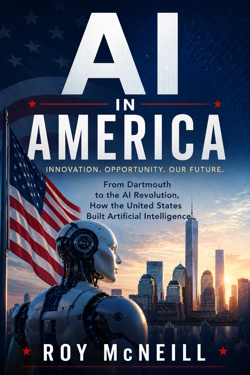 |
AI in America AI in America is the definitive popular history of the most consequential technological enterprise of the past century told not as a march of inevitable progress, but as a deeply human story of booms and busts, brilliance and blunder, stubborn visionaries, and crushing winters. This is not a book about algorithms or programming. It is the story of the people, ideas, institutions, breakthroughs, failures, rivalries, and moments of inspiration that shaped one of the greatest technological revolutions in history.  |
|
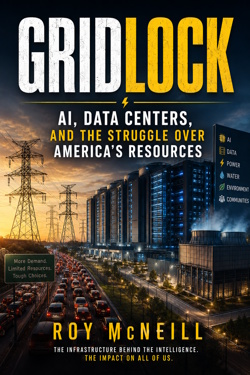
Gridlock - Coming Soon!We tend to think of the digital world as something that exists "in the cloud." It doesn't. The cloud is made of buildings, computers, chips, transformers, fiber-optic cables, cooling systems, generators, water supplies, power plants, construction crews, and enormous amounts of capital. The data center has become one of the most important, controversial, and least understood pieces of modern infrastructure. Gridlock tells the story from the first room-sized computers through mainframes, the Internet, enterprise server farms, cloud computing, hyperscale facilities, and today's modern AI data centers. It also targets the larger question hotly debated today: how much physical infrastructure will the digital and AI economy require and can civilization afford to build it? |
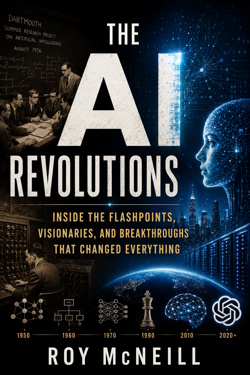 |
AI
Revolutions In The AI Revolutions, Roy McNeill takes readers on a gripping journey through the defining moments that transformed artificial intelligence from a philosophical question into the most powerful technology of the twenty-first century. This is not a textbook. It is a story of breakthroughs and dead ends, rivalries and collaborations, triumphs and winters, told through the people who dared to believe machines could think. |
Age of AI Series
Artificial intelligence is no longer a future technology. It is shaping how we learn, work, communicate, create, parent, teach, and make decisions every day. The Age of AI Series explores one of the most important questions of our time: How do we remain deeply human in a world increasingly influenced by intelligent machines?
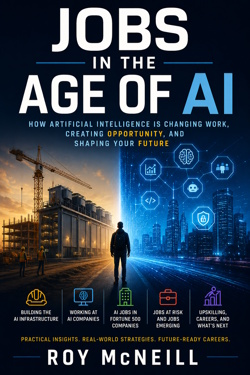 |
Jobs in the Age of AI AI is transforming the workplace faster than any technology in modern history. It writes software, analyzes data, serves customers, creates content, and performs work that once required years of training. Yet AI still needs people. Behind every AI system stand massive data centers that must be built, powered, cooled, secured, and maintained. Behind the models are engineers, researchers, technicians, product managers, sales teams, lawyers, and security specialists. And inside nearly every major company, a new workforce is emerging to put AI to work across the enterprise. The result is a labor market pulled in several directions at once: some jobs are at risk, new jobs are appearing, and millions of existing roles are being rewritten. Jobs in the Age of AI maps this rapidly changing landscape and shows where the real opportunities and risks lie.
|
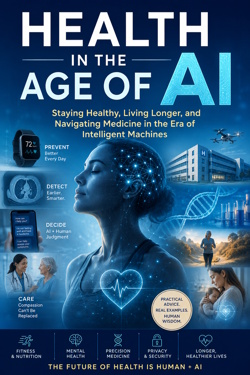 |
Health in the Age of AI AI is changing medicine faster than most of us realize. AI can help detect cancer, analyze heart rhythms, discover new drugs, monitor chronic diseases, personalize workouts, improve sleep, and identify health risks before symptoms appear. Smartwatches are becoming miniature health laboratories. Virtual nurses are checking on patients between appointments. AI health assistants are answering medical questions at three in the morning. Health in the Age of AI is an accessible, practical, and occasionally humorous guide to one of the greatest transformations in modern medicine. Written for everyday readers, this book explores how intelligent machines are reshaping the way we prevent disease, diagnose illness, manage our health, and think about aging.
|
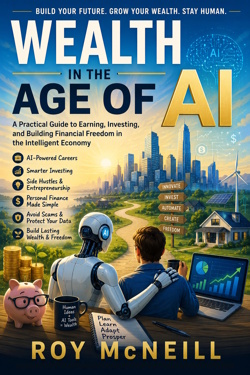 |
Wealth in the Age of AI Wealth in the Age of AI offers a practical, entertaining guide to navigating the new intelligent economy. Drawing on the lessons of previous technological revolutions, it explores how technology creates opportunity, why productivity drives prosperity, and how individuals can position themselves to benefit from the extraordinary changes ahead. The people most likely to thrive in the intelligent economy won't necessarily be the best programmers or the most aggressive investors. They will be the people who learn quickly, adapt continuously, understand technology, and combine it with timeless principles of saving, investing, ownership, and disciplined decision-making.
|
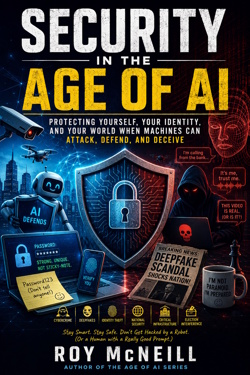 |
Security in the Age of AI Security in the Age of AI explores the rapidly changing security landscape created by artificial intelligence, and what it means for ordinary people, families, businesses, and nations. Written with a serious eye toward the threats and a sense of humor about our complicated digital lives, the book is a guide to protecting yourself and understanding the security challenges of a world where intelligence has become scalable. From AI-powered phishing and automated fraud to voice cloning, synthetic identities, deepfakes, election interference, autonomous weapons, and attacks on critical infrastructure, this book examines a world where machines can attack and defend at machine speed.
|
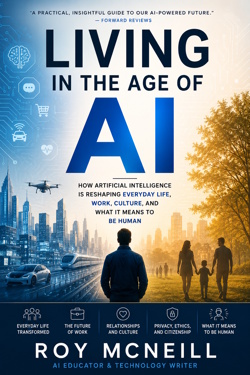 |
Living in the Age of AI Artificial intelligence is no longer a future technology. It is becoming part of everyday life. AI recommends what we watch, helps us navigate traffic, filters our email, assists doctors, powers customer service, shapes social media feeds, and increasingly helps us learn, work, create, and communicate. Whether we realize it or not, we are already living in the Age of AI. But this book is not about technology. It's about people. Living in the Age of AI explores how intelligent machines are transforming the way we live, work, learn, love, govern, and understand ourselves.
|
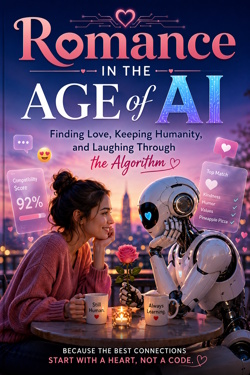 |
Romance in the Age of AI What happens when artificial intelligence enters the domain of Romance, the world's oldest and most unpredictable human activity? In a world where algorithms suggest who to date, chatbots help craft flirtatious messages, and compatibility scores promise to predict lasting relationships, love is undergoing its biggest transformation since the invention of the love letter. But can a machine really help us find "the one"? Can an AI write a better love note than a human? And if technology becomes perfect at matchmaking, what happens to mystery, chemistry, and the quest that makes romance worth pursuing? |
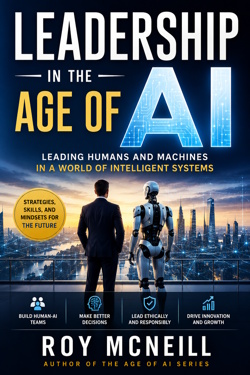 |
Leadership in the Age of AI AI is no longer on the horizon. It is in your boardroom, your workflows, and your organization's most consequential decisions - right now. And it is raising a question no previous technological revolution has asked quite so directly: What is the leader's job when the machine can think? Leadership in the Age of AI is the definitive guide for executives, managers, and emerging leaders navigating this seismic shift. Drawing on research, real-world case studies, a touch of humor, and direct insights from leaders on the front lines of AI adoption, this book delivers a clear-eyed, practical framework for thriving - not just surviving - in a world of intelligent systems. |
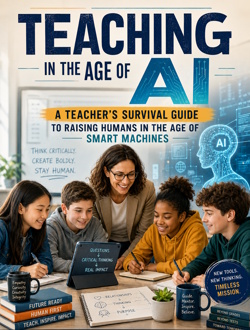 |
Teaching in the Age of AI Teachers everywhere are asking the same question: What does teaching look like when machines can do so much of what schools used to assess? Teaching in the Age of AI is a practical, thought-provoking, and often humorous guide for educators navigating the biggest transformation in education since the arrival of the internet. Rather than treating AI as either a miracle or a menace, this book helps teachers understand what is changing, what isn't, and why human educators matter more than ever. |
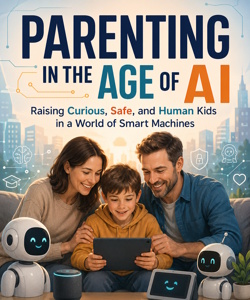 |
Parenting in the Age of AI Your child isn't waiting for AI to arrive. It's already here - in the phone, the tablet, the smart speaker, the homework helper, and the algorithm deciding what they watch next. You didn't sign up for this. Nobody did. One day you were managing screen time and occasional sugar intake, and the next you were navigating deepfakes, chatbot tutors, and a child who trusts YouTube more than you. Parenting in the Age of AI is the practical, entertaining, non-alarmist guide that meets you exactly where you are. Read an excerpt here... |
Humorous Guides to Surviving AI Series
Humorous Guides to Surviving AI is the laugh-out-loud book series for anyone trying to stay sane in a world where the machines are no longer just tools - they're roommates, coworkers, and occasionally your most judgmental household companions.
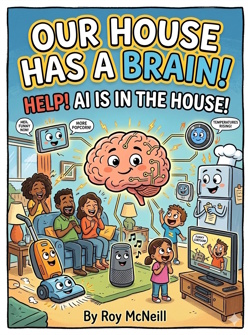 |
Our House Has a Brain Your fridge is judging your midnight snacks. Your smart TV knows what's best for you. And your lawn mower just declared war on your car charger. Welcome home. Your house is smarter than you now. When did everything in your home get a brain? And why are all those brains so opinionated? Our House has a Brain is your hilarious survival guide to the modern smart home where every appliance has an agenda, every device has an attitude, and nothing works quite the way it's supposed to. Read an excerpt here... |
|
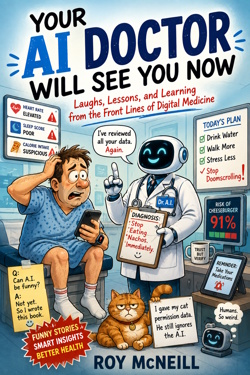
Your AI Doctor Will See You NowYour doctor has a new assistant. It has read the entire internet. Your smartwatch thinks you're stressed. Your fitness app is disappointed in you. Your nutrition AI has declared war on pizza. And somewhere in the cloud, an algorithm is analyzing your heartbeat and questioning your lifestyle choices. Artificial intelligence is transforming medicine. AI can help detect cancer, monitor heart rhythms, discover new drugs, personalize treatments, improve hospital care, and identify health risks before patients notice symptoms. That's the serious part. This book is about what happens when all that intelligence meets actual humans. In Your AI Doctor Will See You Now, Roy McNeill takes readers on a hilarious journey through the front lines of digital medicine. Behind every laugh is a real lesson about the rapidly changing world of AI-powered healthcare.
|
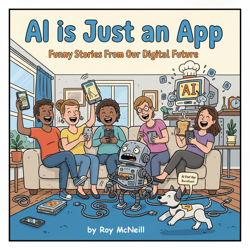 |
AI is Just an App In AI is Just an App, you'll discover a collection of hilarious short stories that shine a light on our digital future - where algorithms meet animals, workplaces get "optimized" by chatbots, and relationships are tested by virtual assistants who know way too much. From awkward office encounters to pets with smart collars that sass their owners, this book turns the quirks of AI into laugh-out-loud tales. |
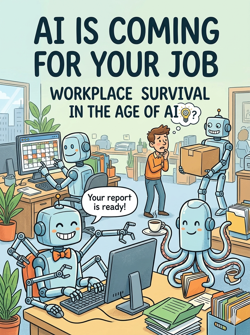 |
AI is Coming for Your Job AI is Coming for Your Job is a comic, clear-eyed look at the modern office - now overrun with chatbots that volunteer for projects you didn't agree to, dashboards that judge your productivity, and interns who turn out to be software updates. It's the first survival guide for anyone trying to stay human in a workplace where the coffee machine has opinions and the spreadsheet thinks it's middle management. |
Learn More About Our Books
 AI Revolutions
Artificial intelligence is often described as a sudden revolution. In reality, it was built moment by moment. The AI Revolutions takes you inside the pivotal breakthroughs that defined artificial intelligence, from its formal birth at the 1956 Dartmouth Conference to the modern era of deep learning, generative models, and autonomous systems. Each chapter focuses on a single turning point: IBM's Deep Blue defeating a world chess champion, AlexNet igniting the deep learning revolution, AlphaGo mastering a game once thought uniquely human, and the rise of large language models that changed how we write, work, and think. More than a technical history, this book explores why these moments mattered; how they shifted scientific belief, redirected funding, reshaped industries, and altered public perception of what machines could do. It reveals how breakthroughs in algorithms, hardware, data, and ambition converged to create the Age of AI.
 AI in America
In the summer of 1956, while Elvis Presley topped the charts, Marilyn Monroe launched her film career, and Dwight David Eisenhower cruised to re-election, a small group of professors gathered in a quiet New England college town and issued one of the boldest intellectual declarations in modern history: every aspect of human intelligence could be precisely described and ultimately replicated by a machine. That two-month workshop at Dartmouth College did not make headlines. It did not win Nobel Prizes. It was barely noticed outside select academic circles. Yet it quietly launched the field we now call AI - Artificial Intelligence - and it did so on American soil, fueled by American curiosity, American post-war investment, and an American willingness to bet big on the impossible. AI in America tells that story in full: how a nation of risk-takers, dreamers, and empire-builders turned a summer vacation into the most powerful technology of the 21st century. From Cold War funding and Silicon Valley garages to the trillion-dollar empires of the Magnificent Seven, from the arms race with China to the looming question of Superintelligence, this is not just the history of a technology. It is the story of America's unique mixture of academic daring, military muscle, venture capital, and cultural spectacle, and why sustaining AI supremacy in a global economy will demand more than innovation alone.
More AI Books...
Magnifica Humanitas: On Safeguarding the Human Person in the Time of Artificial Intelligence
With Magnifica Humanitas, Pope Leo XIV offers a landmark reflection on human dignity in the age of artificial intelligence. Rooted in Catholic social teaching, this first encyclical challenges believers and all people of goodwill to ensure technology serves the human person, protects work, and advances justice, peace, and authentic solidarity.
Superintelligence: Paths, Dangers, Strategies is a rigorous and thorough look at the dangers of AI from Nick Bostrom. Superintelligence asks the questions: What happens when machines surpass humans in general intelligence? Will artificial agents save or destroy us? Nick Bostrom lays the foundation for understanding the future of humanity and intelligent life.
Genesis: Artificial Intelligence, Hope, and the Human Spirit by Henry A. Kissinger et al. The last book of elder statesman Henry Kissinger, written with technologists Craig Mundie and Eric Schmidt, Genesis charts a course between blind faith and unjustified fear as it outlines an effective strategy for navigating the age of AI.
The Coming Wave: Technology, Power, and the Twenty-First Century's Greatest Dilemma by Mustafa Suleyman. An urgent warning of the unprecedented risks that AI and other fast-developing technologies pose to global order, and how we might contain them while we have the chance.
 |
Nexus: A Brief History of Information Networks from the Stone Age to AI
Nexus looks through the long lens of human history to consider how the flow of information has shaped us, and our world. Taking us from the Stone Age, through the canonization of the Bible, early modern witch-hunts, Stalinism, Nazism, and the resurgence of populism today, the author asks us to consider the complex relationship between information and truth, bureaucracy and mythology, wisdom and power. |
Co-Intelligence: Living and Working with AI by Ethan Mollick. Through his writing, speaking, and teaching, Mollick has become one of the most prominent and provocative explainers of AI, focusing on the practical aspects of how these new tools for thought can transform our world.
AI 2041: Ten Visions for Our Future by Kai-Fu Lee. How will artificial intelligence change our world within 20 years?
Artificial Intelligence For Dummies by John Paul Mueller. Starting with a basic definition of AI and explanations of data use, algorithms, special hardware, and more, this reference simplifies this complex topic for anyone who wants to understand what operates the devices we can't live without.
A good overview of the whole topic and fun to read is James Barrat Our Final Invention
Controversial and packed with facts and charts and mind-blowing future projections Ray Kurzweil The Singularity is Near
J. Nils Nilsson The Quest for Artificial Intelligence: A History of Ideas and Achievements
Steven Pinker How the Mind Works
Stuart Russell and Peter Norvig Artificial Intelligence: A Modern Approach
The philosopher Hubert L. Dreyfus' seminal book What Computers Can't Do and What Computers Still Can't Do: A Critique of Artificial Reason written many years later.
Stuart Armstrong Smarter Than Us: The Rise of Machine Intelligence