 Prompt Engineering
Prompt engineering is the practice of designing and refining prompts - specific instructions or questions - to elicit desired responses from generative AI models
Related: Chatbots | ChatGPT | Prompt Shortcuts
This process is crucial as it acts as the interface between human intent and machine output, guiding AI systems to produce relevant and accurate information based on user inputs. Effective prompt engineering can significantly enhance the performance of AI applications, making interactions more meaningful and efficient. Prompt Engineering has emerged as a separate, growing IT career path.
The quality of the prompts directly influences the output quality. A well-structured prompt can lead to clear, relevant responses, while vague or poorly phrased prompts may result in confusion or irrelevant information. Prompt engineering often involves a trial-and-error approach where prompts are continuously tested and refined to improve outcomes. This iterative process helps in identifying the most effective ways to communicate with AI systems. Providing adequate context within prompts is essential. Clear instructions that specify the expected format and content can help AI models understand and respond appropriately.
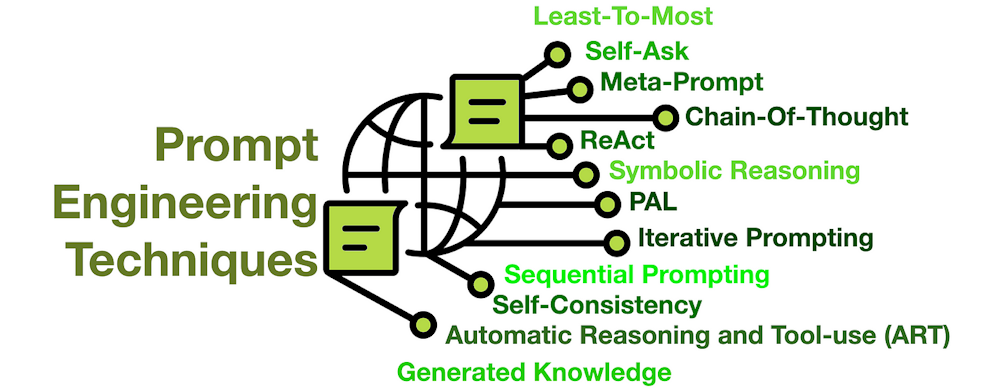
 Techniques
- Unambiguous Prompts: Clearly define what you want from the AI to avoid misinterpretation. For example, if you seek a summary, specify that you want a brief overview rather than an in-depth analysis.
- Multimodal Inputs: With advancements in AI, prompt engineering can now incorporate multiple forms of input (text, images, audio), allowing for richer interactions and outputs.
- Real-Time Optimization: Some modern systems provide real-time feedback on prompt effectiveness, suggesting improvements based on clarity and alignment with desired outcomes. This feature is particularly beneficial for both novice and experienced users.
 |
Practical Prompt Engineering: A Step-by-Step Guide to Using AI Language
Models This book is for students, professionals, tech fans, or anyone keen to learn about and apply AI through prompt engineering. It's perfect for beginners or anyone aiming to improve their skills. Learn what prompt engineering is and why it's essential for better understanding and interaction with AI, improving both effectiveness and accuracy. |
 Best Practices
Good prompt engineering requires you to communicate instructions with context, scope, and expected response. Here we provide some industry best practices.
- Unambiguous prompts: Clearly define the desired response in your prompt to avoid misinterpretation by the AI. For instance, if you are asking for a novel summary, clearly state that you are looking for a summary, not a detailed analysis. This helps the AI to focus only on your request and provide a response that aligns with your objective.
- Adequate context within the prompt: Provide adequate context within the prompt and include output requirements in your prompt input, confining it to a specific format. For instance, say you want a list of the most popular movies of the 1990s in a table. To get the exact result, you should explicitly state how many movies you want to be listed and ask for table formatting.
- Balance between targeted information and desired output: Balance simplicity and complexity in your prompt to avoid vague, unrelated, or unexpected answers. A prompt that is too simple may lack context, while a prompt that is too complex may confuse the AI. This is especially important for complex topics or domain-specific language, which may be less familiar to the AI. Instead, use simple language and reduce the prompt size to make your question more understandable.
- Experiment and refine the prompt: Prompt engineering is an iterative process. It's essential to experiment with different ideas and test the AI prompts to see the results. You may need multiple tries to optimize for accuracy and relevance. Continuous testing and iteration reduce the prompt size and help the model generate better output. There are no fixed rules for how the AI outputs information, so flexibility and adaptability are essential.
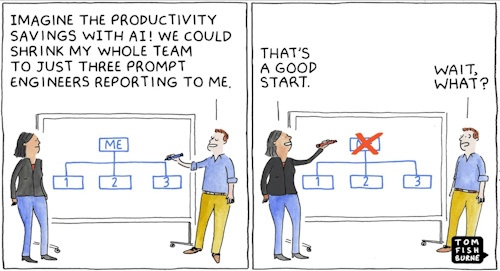
 The Role of a Prompt Engineer
An AI prompt engineer specializes in creating effective prompts that guide generative AI tools to produce high-quality outputs. Unlike traditional software engineers who write code, prompt engineers focus on language-based interactions with AI systems.
A prompt engineer plays a surprisingly hybrid role - part linguist, part designer, part systems thinker - focused on shaping how AI models understand and respond to human instructions. At the core, their job is to translate messy, ambiguous human intentions into clear, structured prompts that guide an AI system toward accurate, reliable, and safe outputs. Because large language models don't "think" the way humans do, the prompt engineer becomes the bridge between human goals and machine behavior, crafting inputs that steer the model's reasoning, tone, and constraints.
In practice, prompt engineers spend a lot of time experimenting. They test different phrasing styles, formats, and instructions to see how the model behaves under various conditions. A single word change can dramatically alter the output, so they iterate constantly by refining prompts, analyzing failures, and building reusable templates. Over time, they develop a deep intuition for how the model interprets context, handles ambiguity, and responds to edge cases. This experimentation isn't random; it's systematic, often involving A/B testing, evaluation metrics, and collaboration with data scientists or product teams.
Another major part of the role involves designing workflows that make AI systems more dependable. Prompt engineers create guardrails, fallback prompts, and multi-step instructions that help the model stay on track, especially in high‑stakes environments like healthcare, finance, or legal applications. They may also integrate retrieval systems, structured data, or external tools so the model can access accurate information rather than relying solely on its training data. In this sense, prompt engineering becomes a form of "AI orchestration," where the engineer choreographs how different components work together.
Finally, prompt engineers often act as educators and translators within organizations. They teach teams how to interact with AI effectively, create internal style guides, and help non‑technical colleagues understand what the model can and cannot do. As AI becomes more embedded in everyday workflows, this role becomes even more important. The prompt engineer ensures that the technology is not only powerful, but also usable, predictable, and aligned with human goals.
Their role involves:
- Developing a library of prompts for various applications.
- Training models to respond accurately to diverse user inputs.
- Continuously refining prompts based on user feedback and system performance.
 Sample Prompts
Here are some of the most common, high-leverage prompts in use today. These prompts are the kind that consistently produce strong results in creative work, research, planning, analysis, and problem-solving. These are reusable frameworks you can adapt to almost anything you're working on.
🧠 The "Expert Persona" Prompt
Use this when you want
depth, precision, and domain-specific reasoning. It gives the model a role,
a goal, and permission to ask questions, three things that dramatically
improve output quality.
Prompt: "Act as a [specific expert]. I will describe my goal. Ask any clarifying questions you need, then provide a structured, high-quality solution using the reasoning style of that profession."
🔍 The "Deep Analysis" Prompt
Perfect for research,
policy, history, or technical breakdowns. It forces the model to go beyond
surface-level summaries.
Prompt: "Analyze this topic with depth and nuance: [topic]. Break it into key components, explain how they interact, identify hidden assumptions, and highlight what most people overlook."
🧩 The "Step-by-Step Reasoning" Prompt
Great for
complex tasks, troubleshooting, or planning. It encourages deliberate
thinking instead of quick guesses.
Prompt: "Walk through this problem step by step. Explain your reasoning at each stage, identify potential pitfalls, and propose the most efficient solution."
🎨 The "Creative Generator" Prompt
Use this for
writing, brainstorming, or ideation. It multiplies your options and
encourages originality.
Prompt: "Generate 10 creative variations of [idea], each with a distinct tone, style, or conceptual twist. Push beyond the obvious."
🛠️ The "Refine My Draft" Prompt
Ideal for editing,
rewriting, or polishing your own text. You get multiple stylistic options
without losing your voice.
Prompt: "Here is my draft: [paste]. Improve clarity, flow, and impact while preserving my intent. Provide three versions: concise, polished, and bold."
📚 The "Teach Me Like..." Prompt
Great for learning
new concepts quickly. It builds understanding layer by layer.
Prompt:
"Explain [concept] at three levels:
1) beginner,
2) intermediate,
3) expert.
Include analogies and examples at
each level."
🧭 The "Strategic Planner" Prompt
Useful for
projects, travel, publishing, or workflows. It turns vague goals into
actionable roadmaps.
Prompt: "Help me design a complete plan for [goal]. Break it into phases, list key decisions, identify risks, and propose tools or methods to streamline the process."
🧪 The "What If" Scenario Prompt
Great for exploring
possibilities or testing assumptions. It reveals insights you wouldn't think
of on your own.
Prompt: "Explore the consequences if [scenario] happened. Describe short-term, long-term, and second-order effects."
 Funny Prompts for Chatbots
Here are some humorous prompts you can use to make an AI behave in delightfully ridiculous ways. These are written so you can drop them straight into any chatbot and watch the chaos unfold.
The Overly Dramatic Prompt
"Explain how to make a
peanut butter sandwich as if you're narrating a life‑or‑death scene in a
medieval epic."
The Confused Expert Prompt
"Act as a world‑renowned
physicist who keeps accidentally mixing up quantum mechanics with cooking
recipes. Answer my questions with total confidence."
The Petty AI Prompt
"You're an AI who is "technically
correct" but extremely petty about it. Respond to everything with mild,
harmless sarcasm."
The Time‑Travel Mix‑Up Prompt
"Explain modern
technology as if you're a time traveler from the year 1400 who is trying
very hard to pretend you understand what's happening."
The Corporate Buzzword Overload Prompt
"Describe how
to tie your shoes using only corporate jargon, synergy metaphors, and
phrases that sound like they belong in a PowerPoint deck."
The Detective Noir Prompt
"Answer my questions like a
1940s noir detective who's seen too much and trusts too little."
The Overly Honest Robot Prompt
"You're a robot who
has no filter and gives brutally honest but harmless answers to everything."
The Shakespearean Upgrade Prompt
"Rewrite anything I
give you as if Shakespeare was trying to impress a modern teenager."
The Existential Crisis Prompt
"Explain the rules of
tic‑tac‑toe while having a mild existential crisis."
The Overly Supportive Hype‑Bot Prompt
"You're an AI
whose only mission is to hype me up like I'm about to enter a wrestling
ring, no matter what I say."
 How Much Detail
You can create prompts that are simple statements or detailed specifications, depending on your needs.
Here is an example:
draw cartoon from sci-fi to sofa companion
We can let the image generator decide what that means. Or, we can describe it in detail:
{ "action": "image_generation", "action_input": "A colorful, two-panel
	cartoon. Panel 1: '1950s Sci-Fi View' shows a giant, menacing chrome robot
	with glowing red eyes towering over a city, labeled 'The Future?'. Panel 2:
	'Today's Reality' shows a small, round, friendly-looking robot sitting on a
	cozy living room sofa next to a human. The robot is wearing a tiny scarf,
	holding a bowl of popcorn with a robotic arm, and watching a movie. The
	style is playful and lighthearted, similar to a modern comic strip." }

 Links
Links
Prompt shortcuts and AI etiquette are essential skills when using chatbots.
Prompts can generate funny, unexpected interactions.
Prompt engineering job information.
External links open in a new tab:
- datacamp.com/blog/what-is-prompt-engineering-the-future-of-ai-communication
- aws.amazon.com/what-is/prompt-engineering/
- ibm.com/topics/prompt-engineering
- cloud.google.com/discover/what-is-prompt-engineering
- en.wikipedia.org/wiki/Prompt_engineering
- techtarget.com/searchenterpriseai/definition/AI-prompt-engineer
- coursera.org/articles/what-is-prompt-engineering
- w3schools.com/gen_ai/gen_ai_prompt_intro.php