 Alan Turing
The Prophet Who Asked If Machines Could Think
A paper appears in the prestigious philosophy journal Mind in 1950 with the title "Computing Machinery and Intelligence." The opening line is direct, almost casual: "I propose to consider the question, 'Can machines think?'"
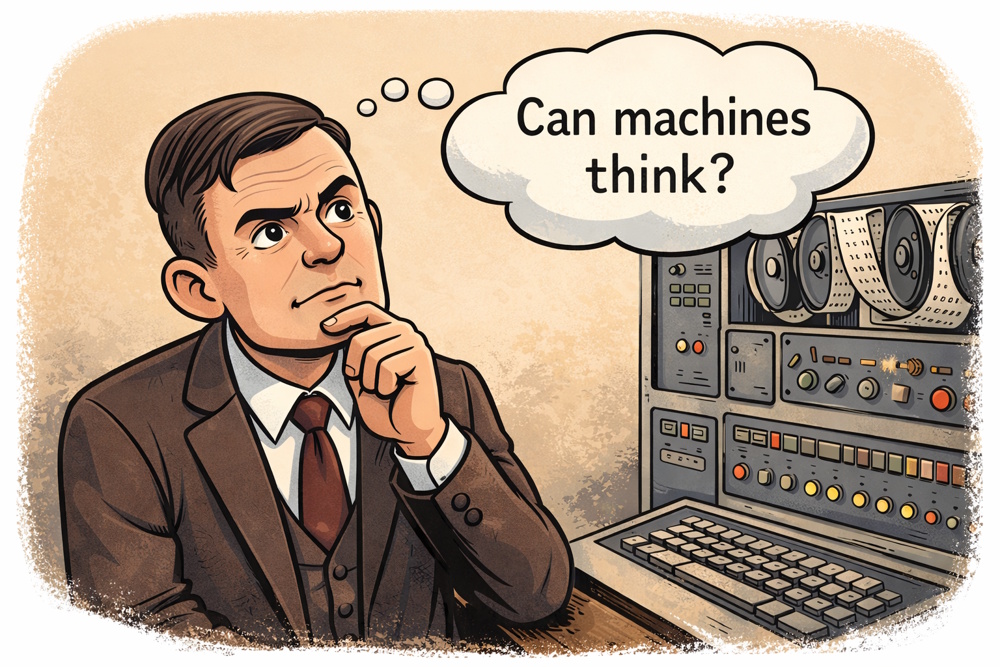
With these eight words, Alan Turing doesn't just pose a question. He reframes reality. He takes a question that sounds like philosophy or science fiction and transforms it into something concrete, testable, and urgent.
The paper is only 28 pages long, but it will challenge and inspire humanity for the next 75 years and beyond.
To understand why this question mattered, why it was revolutionary, we must first understand the man who asked it, and the world he was trying to escape.
 The Making of a Revolutionary Mind
Alan Mathison Turing is born June 23, 1912, in London. His father works for the Indian Civil Service. His parents leave young Alan and his brother in England while they serve abroad. He grows up with foster families, boarding schools, and loneliness.
He's brilliant and awkward. He’s obsessed with patterns, numbers, and how things work. At Sherborne School, his headmaster writes: "He is the kind of boy who is bound to be a problem in any school or community." The teachers want him to study classics, while he prefers mathematics and science.
In 1931, Turing enters King's College, Cambridge. He's eccentric—unkempt, stammers, and is socially awkward. He runs long distances obsessively. He studies mathematics and flourishes, sparring with Ludwig Wittgenstein, one of the greatest philosophers of the 20th Century, on the foundations of mathematics.
Though lacking in social graces, his mind is extraordinary. He grapples with fundamental questions like: What is computation? What can be calculated? Are there problems that are unsolvable even in principle?
The Universal Machine (1936)
In mathematics, David Hilbert had posed the Entscheidungsproblem—the "decision problem." Is there an algorithm that can determine whether any mathematical statement is true or false?
Turing, at 23, attacks this problem with the insights and clarity that became his calling card.
To answer it, he invents something that doesn't exist: a theoretical machine that can perform any computation that can be described by an algorithm.
The "Turing machine" is brilliantly simple:
An infinite tape divided into squares
Each square contains a symbol (or is blank)
A "head" that can read and write symbols, move left or right
A set of rules determining what to do based on the current symbol and state
That's it. This simple device can, in theory, perform any computation that any computer, no matter how advanced, could ever perform.
Turing proved that computation is not about specific machines or mechanisms. It's about symbolic manipulation following rules. The hardware doesn't matter. What matters is the algorithm.
He also proved something more important. Some problems cannot be solved by any algorithm, ever. The Entscheidungsproblem has no solution. Thus, there are limits to what can be computed.
This is revolutionary mathematics. It's also in effect the birth of computer science, though that field doesn't exist yet.
The famous American mathematician Alonzo Church reaches similar conclusions independently using lambda calculus. But Turing's approach using the abstract machine is more intuitive and more powerful in its implications.
Now, if a simple theoretical machine can perform any computation... what about the human brain? Is it also simply following rules? Are we, in some sense, machines?
Turing doesn't publish this thought. Not yet.
 The War (1939-1945)
Britain declares war on Germany in 1939. Turing is recruited to the Government Code and Cypher School at Bletchley Park. It is a stately Victorian mansion in the countryside, now the center of British codebreaking efforts.
The problem for the cyber experts is that the German military uses Enigma machines to encrypt communications. To make matters worse, the encryption changes daily. The number of possible settings is astronomical—159,000,000,000,000,000,000 possible combinations.
Breaking Enigma by hand is impossible. But Turing understands that machines can break what machines encrypt.
The Bombe
Turing designs an electromechanical device called the "Bombe" (named after Bomba, a Polish predecessor machine). It is not a general-purpose computer, but a computing machine designed with the sole purpose of testing Enigma settings in order to find the right one.
The logic behind Bombe is ingenious. The machine doesn't test all possible settings (an impossible task). Instead, it exploits regularities and weaknesses in how the Germans use Enigma:
Certain words appear frequently ("weather," "Heil Hitler")
Messages have predictable structures
Operators make mistakes
The Bombe whirs through possibilities at mechanical speed, eliminating impossible settings, homing in on the solution. When it finds a match, it stops with a satisfying clunk.
By 1942, Bletchley Park is reading German communications daily. They encounter u-boat positions, military orders, strategic plans, and more.
Historians estimate that breaking Enigma shortened the war by at least two years, saving countless destruction and millions of lives. In essence, Turing's machines helped defeat Hitler, but the work at Bletchley Park is classified Top Secret. Turing cannot tell anyone what he's accomplished. He's a ghost hero, a man unknown to the nation he saved.
The Vision Clarifies
While working with these machines, watching them perform logical operations, crack codes, thinking in their limited way, Turing's ideas begin to crystallize.
If machines can break codes... if they can perform logical reasoning... what else can they do?
He begins to imagine true computing machines. Machines that are general-purpose, programmable, capable of any calculation. Machines that could play chess, prove theorems, even learn.
The war ends. Turing emerges with his mind full of visions. The world doesn't yet know what he did, but he knows what's possible.
 The Universal Computer (1945-1948)
Turing joins the National Physical Laboratory (NPL) in 1945 and proposes the Automatic Computing Engine (ACE). It is a stored-program computer based on his theoretical, universal machine.
The design is innovative:
Store programs in memory (not hardwired)
Programs can modify themselves
The same machine can solve different problems just by loading different programs
This design is the architecture of modern computing. Today, we call it the "von Neumann architecture" (though von Neumann was developing similar ideas independently and regularly communicating with Turing).
It’s one thing to design yet another thing to build, and building ACE would prove to be a slow, cumbersome process. There is bureaucracy, funding delays, and engineering challenges. Turing grows frustrated with the pace, the politics, and the compromises.
Meanwhile, other teams are building computers:
ENIAC in America (1945)
Manchester Baby in Britain (1948)
EDSAC at Cambridge (1949)
The computer age is arriving, but not quite in the way Turing envisioned.
Manchester and the Ferranti Mark 1
Turing leaves NPL for the University of Manchester in 1948, to become Deputy Director of the Computing Laboratory. The "Manchester Baby" computer has just run its first program.
He writes software in machine language code. He works on chess-playing algorithms. Since the computer isn't powerful enough to run them, he executes the algorithm by hand, taking 30 minutes per move. He's exploring what computers can do by pushing the boundaries.
Something larger is brewing in his mind. The question returns. These machines can calculate, but can they think?
 "Can Machines Think?" (1950)
Turing sits down to write his most famous paper. He knows the question "Can machines think?" will trigger endless philosophical debate.
People will argue about consciousness, souls, the nature of thought, questions that have been posed for centuries. So he does something brilliant: he sidesteps the philosophical quagmire entirely. Instead of defining "thinking," he proposes a test.
The Imitation Game (later called the Turing Test):
A human interrogator converses via text with two hidden entities—one human, one machine
The interrogator asks questions, trying to determine which is which
If the machine can fool the interrogator into thinking it's human as often as the human can, the machine passes
Thus, Turing shifts from "What is thinking?" to "What would convince us that thinking has occurred?"
He's replacing metaphysics with behaviorism. If something acts indistinguishably from intelligence, we should call it intelligent.
This idea is called operationalism; defining concepts by how we measure them. It's the same principle that transformed physics in the early part of the 20th century. Now Turing applies the principle to mind itself.
The Objections
Turing anticipates objections. The paper addresses nine of them with devastating precision:
1. The Theological Objection: "Thinking is a function of man's immortal soul. God has not given souls to animals or machines."
Turing's response: This limits God's omnipotence. If He wished, couldn't He give souls to machines? Besides, do we really want theology to dictate what's scientifically possible?
2. The "Heads in the Sand" Objection: "The consequences of machines thinking would be too dreadful. Let us hope and believe that they cannot do so."
Turing dismisses this as wishful thinking, not argument. Reality doesn't conform to our comfort.
3. The Mathematical Objection: Gödel's incompleteness theorem shows machines have limitations. Humans can recognize truths machines cannot prove.
Turing acknowledges the limitation but notes: humans also make mistakes, they have limitations. The question isn't whether machines are perfect, but whether they can think.
4. The Argument from Consciousness: "Not until a machine can write a sonnet or compose a concerto because of thoughts and emotions felt, and not by the chance fall of symbols, could we agree that machine equals brain."
Turing's counter: This demands not just intelligent behavior but internal experience. How do we know other humans truly feel emotions? We infer it from behavior. Apply the same standard to machines.
5. Arguments from Various Disabilities: "Machines cannot enjoy strawberries and cream, fall in love, make mistakes, etc."
Turing notes these aren't arguments; they're claims. Many are demonstrably false (machines can make mistakes). Others assume machines must replicate all human capabilities, which isn't necessary for thinking.
6. Lady Lovelace's Objection: Ada Lovelace wrote that the Analytical Engine "has no pretensions to originate anything. It can do whatever we know how to order it to perform."
This is perhaps the most interesting objection. Turing argues that machines might surprise us, do unexpected things. Learning machines could develop capabilities beyond what programmers explicitly programmed. They could originate ideas.
7. Argument from Continuity in the Nervous System: The brain operates on continuous values, while computers use discrete states. This difference might be fundamental.
Turing suggests the difference may not matter. Discrete systems can approximate continuous ones arbitrarily well.
8. The Argument from Informality of Behavior: Human behavior can't be captured by rules. We're too complex, too unpredictable.
Turing: This assumes rules can't produce complex behavior. But even simple rules can generate enormous complexity. Why couldn't sufficiently complex rules mimic human unpredictability?
9. The Argument from Extrasensory Perception: If ESP exists, machines couldn't replicate it.
Turing's driest response: Conduct the test in a "telepathy-proof room."
The Prediction
Having demolished the objections, Turing makes a prediction:
"I believe that in about fifty years' time it will be possible to programme computers... to make them play the imitation game so well that an average interrogator will not have more than 70 per cent chance of making the right identification after five minutes of questioning."
The year 1950 plus fifty years equals the year 2000. He's predicting that by 2000, machines will fool interrogators 30% of the time after five minutes. It's specific, testable, and bold.
Was he right? We'll return to this question.
The Deeper Revolution
The paper's real radicalism isn't the test itself. It's the underlying assumptions:
1. Materialism: Mind is not separate from matter. Thinking is a physical process that can be replicated in different substrates.
2. Functionalism: What matters is what something does, not what it's made of. Silicon can think as well as neurons, if organized correctly.
3. Computationalism: Thought is computation. The brain is, in some important sense, a computer.
These ideas—commonplace today in AI and cognitive science—were radical in 1950. Turing is proposing that humans are machines. Sophisticated, biological machines, but machines nonetheless.
The implications terrify and exhilarate:
Free will might be an illusion
Consciousness might be computational
We might build our own minds
We might not be special
The Learning Machine
The paper doesn't just propose the test. It sketches how to build thinking machines:
"Instead of trying to produce a programme to simulate the adult mind, why not rather try to produce one which simulates the child's? If this were then subjected to an appropriate course of education one would obtain the adult brain."
Turing is articulating the concept of machine learning...described in 1950. In other words, don't try to program intelligence; program the ability to learn, then teach the machine.
Turing even suggests evolutionary approaches such as to vary programs randomly, select the best ones, and breed them. This is genetic algorithms, before they had a name.
He's sketching the roadmap for AI, 60 years before it becomes practical.
The Tragedy (1951-1954)
Turing moves on to other work. He studies morphogenesis—how biological organisms develop patterns and structures. How does a ball of identical cells become a complex organism with distinct organs?
He develops mathematical models of chemical reactions that create patterns; patterns like zebra stripes, leopard spots, and flower petals. The math is elegant and prescient. Modern biology validates many of his insights.
Soon, Alan’s like would take a tragic turn.
The Persecution
In 1952, Turing's house is burgled. He reports the incient to the police. During the investigation, it emerges that Turing is in a relationship with a man, Arnold Murray.
Homosexuality is illegal in Britain. Turing is arrested and charged with "gross indecency." He doesn't hide his homosexuality at the trial. He admits the relationship matter-of-factly, and sees nothing wrong with it. He's convicted. The choice he faces is either prison or chemical castration (hormone treatments).
Turing chooses the treatments. For a year, he endures injections of estrogen. His body changes. He grows breasts. The man who helped save Britain is punished by Britain for who he loves.
His security clearance is revoked. He can't work on classified projects. The government he served betrays him.
Tragic Death
On June 7, 1954, Turing's housekeeper finds him lying in his bed...dead. Next to him is a partially eaten apple. Investigators discover the apple is laced with cyanide. The inquest rules suicide. Turing was 41.
He was persecuted and unrecognized in his time. The nation he saved considered him a criminal. His greatest work—breaking Enigma—remained classified, therefore unknown to the public.
Some historians suggest the death might have been accidental because Turing performed chemistry experiments at home, and he was sometimes careless. Unable to accept the suicide of her son, Turing’s mother insisted it was an accident. We'll never know with certainty the actual cause of death.
What we do know is that a mind that changed the world was extinguished at the young age of 41. We lost decades of potential brilliance when his light was extinguished.
 The Legacy and the Test
The 1950 paper doesn't immediately transform anything. AI research begins in earnest in 1956 with the Dartmouth conference, but progress is slow. The Turing Test becomes famous, and it has been endlessly debated:
Critics argue:
It's behaviorist, ignoring internal experience
It's anthropocentric—why should intelligence mimic humans?
It's gameable—deception isn't intelligence
It emphasizes conversation, ignoring other cognitive abilities
Defenders argue:
It's practical, testable
Conversation requires understanding, reasoning, knowledge—the essence of intelligence
If something can truly converse like a human, denying its intelligence is arbitrary
The deeper truth is the test was never meant to be the final word. It was meant to make the question scientific instead of philosophical.
The ELIZA Effect
Joseph Weizenbaum creates ELIZA in 1966, a program that mimics a Rogerian psychotherapist. It's simple pattern matching and substitution. It doesn't understand anything.
Yet people conversing with ELIZA form emotional bonds. They believe it understands. They share intimate secrets.
Weizenbaum is disturbed. He meant ELIZA as a demonstration of how machines don't think. Instead, people project understanding onto minimal behavior.
The lesson from ELIZA is the Turing Test reveals as much about human psychology as machine capability. We're eager to see mind where there may be none.
The Loebner Prize
Hugh Loebner establishes an annual Turing Test competition, called the Loebner Prize, with a $100,000 prize awarded to the first program to pass the test.
No program has ever won the grand prize. But the competitions reveal something profound: in some ways, fooling humans is easier than Turing thought, yet harder in others. Chatbots can convince people briefly with tricks like deflection, humor, and typing errors, but sustained conversation reveals their limitations quickly.
Eugene Goostman, a chatbot posing as a 13-year-old Ukrainian boy, famously "passed" a Turing Test in 2014, fooling a third of the judges. But the constraints were loose (5 minutes, low threshold), and the persona was chosen to excuse poor English and knowledge gaps, a form of gaming the test.
The Deep Learning Revolution
Then everything changes. Language models—GPT-2, GPT-3, GPT-4, Claude, and others—emerge from deep learning. They're not programmed with rules. They learn from vast text datasets, discovering patterns and developing capabilities.
These models engage in conversations that would have stunned Turing. They write essays, code, and poetry. They reason (to a degree), translate, explain, and create.
The question resurfaces once again: Do these models pass the Turing Test?
Complicated answer:
In limited domains, clearly yes. If you show transcripts of conversations with GPT-4 or Claude to people, intersperced with human conversations, it can be hard to reliably distinguish them.
In extended, adversarial testing, probably not yet. Skilled interrogators (or AI itself!) can expose limitations, inconsistencies, or knowledge gaps.
But the gap is closing rapidly.
The Prediction Revisited
Turing predicted that by 2000, machines would fool interrogators 30% of the time after five minutes.
Was he right?
Technically, probably not quite. In 2000, chatbots were still primitive. ELIZA-style tricks could fool some people briefly, but sophisticated interrogators weren't fooled.
Spiritually, remarkably close. He was off by about 20 years. By 2020, language models were achieving what he predicted in 1950.
He was correct to say that it would be possible, that it would happen within a human lifetime, that machines would converse.
Most scientists in 1950 would have said ‘never,’ or ‘centuries away.’ Turing claimed it would happen in 50 years. He understood what was coming better than anyone else.
 The Revolutionary Ideas
1. Computation Is Universal
The insight: There's only one kind of computation. A universal machine can simulate any other machine. The hardware is interchangeable; the algorithm is what matters.
Why revolutionary: This means any sufficiently powerful computer can, in principle, run any program and simulate any process. Your phone, a supercomputer, a future quantum computer—they all differ in speed and scale, not in fundamental capability.
Impact on AI: If intelligence is computational, then any computer could potentially host intelligence. The question becomes what's the right program?
2. Intelligence Is Not Mystical
The insight: Thinking is a process that can be described, studied, and potentially replicated. It's not magic, not soul, not special human essence.
Why revolutionary: For millennia, consciousness and thought were considered supernatural. Turing makes them natural phenomena, subject to scientific investigation.
Impact on AI: If thought isn't mystical, we can engineer it. We can build thinking machines just as we build flying machines.
3. The Criterion Is Behavior
The insight: Judge intelligence by what something does, not what it's made of or claims to experience internally.
Why revolutionary: Sidesteps unsolvable philosophical problems. We can't know if other entities have consciousness, even other humans. We can, however, observe behavior.
Impact on AI: Provides a practical standard. Instead of debating whether AI "really" thinks, we can ask if it behaves intelligently.
The controversy: Critics say this ignores consciousness and subjective experience. Defenders say those aren't accessible anyway.
4. Learning > Programming
The insight: Instead of programming all knowledge and skills, build systems that can learn. Start with child-like machines, and educate them first.
Why revolutionary: Shifts AI from knowledge engineering (capturing expert knowledge in rules) to machine learning (discovering patterns in data).
Impact on AI: Modern AI is dominated by learning approaches. Neural networks trained on data, not rule-based systems programmed by experts.
Turing essentially predicted the path that would eventually succeed, even though the first AI winter was caused by the failure of learning approaches (perceptrons in the 1960s). He was right about the destination, even when the field took detours.
5. Machines Can Surprise Us
The insight: Programmed machines can exhibit behaviors the programmer didn't explicitly anticipate. They can "originate."
Why revolutionary: Counters Lady Lovelace's objection that machines only do what we tell them to do. Complex systems produce emergent properties.
Impact on AI: Modern language models constantly surprise their creators. They develop capabilities (like basic math and simple coding) that weren't explicitly programmed. In other words, they emerged from training with fresh ideas.
This is both exciting and concerning. If AI can surprise us, it might surprise us in dangerous ways.
6. The Brain Is Computable
The insight: Human intelligence results from physical processes that, in principle, could be simulated computationally.
Why revolutionary: Dissolves the mind-body dualism that has dominated Western thought since Descartes. Mind is what brain does; brain is physical; therefore mind is physical and computable.
Impact on AI and neuroscience: Justifies both building AI (if mind is computable, we can compute it) and studying brain computationally (treating neurons as information processors).
The ongoing debate: Some argue consciousness requires quantum effects, or new physics, or something beyond computation. Most AI researchers follow Turing's computationalist assumption.
7. The Question Itself Is Revolutionary
The insight: By asking "Can machines think?" seriously, Turing makes it a scientific question rather than philosophical speculation.
Why revolutionary: Questions shape what's thinkable. Before Turing, machine intelligence was science fiction. After Turing, it was a research program.
Impact: The entire field of AI exists because Turing convinced the academic world the question was worth pursuing scientifically.
 The Present Day Reckoning
In 2009, British Prime Minister Gordon Brown issues an official apology for Turing's treatment:
"While Turing was dealt with under the law of the time and we can't put the clock back, his treatment was of course utterly unfair and I am pleased to have the chance to say how deeply sorry I and we all are for what happened to him."
2013: Queen Elizabeth II grants Turing a posthumous royal pardon.
2017: The "Alan Turing Law" pardons all men convicted under legacy anti-homosexuality laws.
2021: Turing is chosen as the face of the new £50 note. The man persecuted by Britain is now honored by Britain on their currency.
The bitter irony is recognition for Turing’s phenomenal contributions occurs 67 years after his death. A man who died alone as a criminal is now a national hero, a man the BBC named “The Greatest Person of the 20th Century.”
The Test Passes
Today we face what Turing predicted: large language models engage in sophisticated conversation. They write, reason, create, and assist. In many contexts, they're indistinguishable from humans in text.
The questions multiply:
Have we achieved what Turing envisioned? Partially. We have machines that converse impressively, but we debate whether they "understand" or merely "pattern-match."
Does the test still matter? Yes and no. It made the question scientific, but now we have new questions: What about consciousness? Agency? Values? Rights?
Would Turing be satisfied? Probably delighted by the progress, and fascinated by the new problems it creates.
The New Questions
Turing's question spawned descendants:
Can machines be conscious? Not just act intelligent, but have subjective experience?
Can machines be moral agents? Not just follow rules, but make ethical judgments?
Can machines have rights? If something thinks, suffers, or is conscious, do we owe it moral consideration?
Should we build thinking machines? Just because we can doesn't mean we should.
These questions would fascinate Turing. They're the children of his original question, grown complex and urgent with time and accomplishments.
The Unfinished Revolution
AI today is simultaneously:
Turing's vindication: Machines converse, learn, surprise us, exhibit intelligence.
Turing's limitation exceeded: Modern neural networks don't work like his imagined learning machines. Deep learning wasn't in his conceptual toolkit.
Turing's question still unanswered: We still debate whether ChatGPT or Claude "really" think, or just simulate thinking. The philosophical question remains open even as the practical capabilities advance.
The revolutionary: We're living through the revolution Turing predicted. Every day, millions interact with AI. The question isn't "can machines think?" but "how should we coexist with thinking machines?"
 Epilogue
The Prophet and the Pattern
Alan Turing was an incredible visionary. He asked questions that wouldn't become urgent for decades. He proposed tests we're only now conducting. He sketched architectures we're only now building. His revolutionary contribution wasn't just the ideas themselves. His contribution was making the ideas thinkable.
Before Turing:
Thinking machines = science fiction
Intelligence = a mystical human property
Computers = calculators
After Turing:
Thinking machines = a research program
Intelligence = a computational process
Computers = universal machines capable of any computation, potentially including thought
The tragic pattern: Turing was too far ahead of his time. The world wasn't ready for his ideas about machines. It wasn't ready for his sexuality. He paid for both with isolation, persecution, and death.
The inspiring pattern: His ideas survived him, grew, and flourished. The revolution he predicted is happening. The test he proposed challenges our deepest assumptions.
The continuing pattern: Every advance in AI prompts us to ask Turing's question anew: "Can machines think?"
With each advance, we move the goalposts:
1960s: "Machines can't play checkers well." (Then they could.)
1990s: "Machines can't play chess." (Then Deep Blue won.)
2010s: "Machines can't play Go." (Then AlphaGo won.)
2020: "Machines can't write coherently." (Then GPT-3 arrived.)
2026: "Machines can't reason/create/understand." (Then...)
Each time, we redefine "thinking" to exclude what machines can do. This is partly moving the goalposts, partly recognizing that intelligence is more complex than we thought.
Turing would recognize the pattern. He predicted we would keep revising our understanding of thought as machines gained capabilities.
The final revolutionary act: Turing made us confront that we might not be unique. That thought might not be exclusively human. That we might build entities as intelligent as ourselves, or more so.
This confrontation, as uncomfortable and exhilarating as it is, may be his deepest legacy. The question "Can machines think?" is ultimately the question "What are we?" “What are our creations?”
If machines can think, then we're not special souls infused with divine reason. We're sophisticated machines ourselves; beautiful, complex, worthy, but machines nonetheless.
This is the revolution: Not just building intelligent machines, but recognizing that intelligence is buildable. Turing, persecuted for being different, proved we're all machines of one kind or another. It's a devastating, liberating, and revolutionary thought. And it's reshaping our world, seven decades after a lonely genius asked the question that changed everything.
Can machines think?
The answer, increasingly, is: Close enough that the question is transformed from the philosophical to the practical.
Turing's revolution advances into futures he imagined but never saw. Although the prophet is dead, the prophecy endures.
 Links
Links
Alan Turing bio in Biographies section.
External links open in a new tab:
- Alan Turing: The Enigma. The Book That Inspired the Film The Imitation Game
- The Touring Digital Archive
- The Alan Turing Institute is the UK's national institute for data science and artificial intelligence.
- The Waltz of Reason features Turing and Wittgenstein on the foundations of mathematics