 Azure AI
Microsoft's cloud-based suite of AI services and tools
Azure AI is Microsoft's cloud-based artificial intelligence platform, offering a range of services and software tools designed to help developers build and deploy AI applications, allowing businesses and organizations to integrate advanced AI solutions into their applications. Azure AI is one of the software tools being used by DOGE.
Azure AI is built on the Microsoft Azure cloud platform and provides powerful tools for machine learning, natural language processing, vision analytics, and decision-making.
Azure AI services allow developers to rapidly create intelligent, cutting-edge, market-ready, and responsible applications. These services offer out-of-the-box, prebuilt, and customizable APIs and models. Example applications include natural language processing for conversations, search, monitoring, translation, speech, and vision.
Azure AI enhances customer interactions through services like Azure Bot Service, to build and manage intelligent chatbots to handle customer queries. These services also automate document processing and improve customer service. Azure Cognitive Services, a part of Azure AI, offers pre-built APIs for tasks like vision, speech, language understanding, and decision-making, allowing developers to integrate AI capabilities into their applications without needing deep AI expertise.
Here's a detail breakdown of what Azure AI services offer:
 Key Components of Azure AI
Tools, models, and inferencing that support a wide range of functions
These services can be grouped based on their capabilities, such as targeted language processing, speech recognition and generation, and image and video processing.
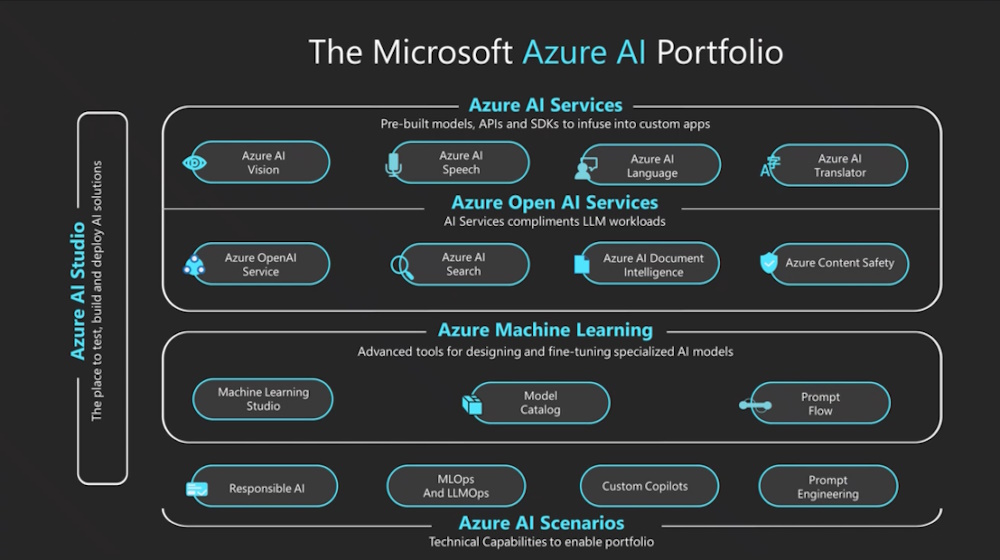
Anomaly Detector: Helps in monitoring and detecting anomalies in time series data, useful for predictive maintenance, fraud detection, and more.
Azure AI Content Safety: This AI service detects harmful user-generated and AI-generated content in applications and processes images and text to flag potentially offensive or unwanted content.
Azure AI Foundry: This is a comprehensive toolkit for building AI applications, providing access to customizable APIs, models, and tools for developing cutting-edge, market-ready AI solutions.
Azure AI Language: Provides natural language processing (NLP) features for understanding and analyzing text, including sentiment analysis, named entity recognition, and language detection.
Azure AI Search: This cloud-based search service provides programmers with the infrastructure, APIs, and tools necessary to create advanced search experiences from private and heterogeneous data collections. It can use optical character recognition (OCR) to extract text from scanned images or documents.
Azure AI Speech: Offers services for speech recognition, text-to-speech, speech translation, and voice-enabled applications, enhancing communication and accessibility.
Azure AI Vision: Focuses on image and video analysis, offering capabilities like optical character recognition (OCR), image analysis, and spatial analysis to extract insights from visual data.
Azure Applied AI Services: Tailored solutions for specific business needs including Form Recognizer for extracting data from documents and Metrics Advisor for anomaly detection in time-series data.
Azure Bot Service: Platform for creating AI-powered chatbots using natural language understanding (NLU). Seamless integration with popular channels like Teams, Slack, and web applications. This service allows developers to create, connect, deploy, and manage intelligent chatbots that can interact with users naturally through various communication channels.
Azure Cognitive Search: AI-powered search functionality for structured and unstructured data. Features natural language search capabilities and relevance tuning.
Azure Cognitive Services: Pre-trained AI models that can be easily integrated into apps. Categories include:
- Vision: Image recognition, object detection, and text extraction (e.g., Computer Vision API).
- Speech: Speech recognition, synthesis, and translation.
- Language: Text analytics, language understanding (LUIS), and translator services.
- Decision: Personalized recommendations and anomaly detection.
Azure Document Intelligence: an automated data processing system that uses artificial intelligence and OCR and applies advanced machine learning to extract texts, key-value pairs, tables and structures from documents automatically and precisely.
Azure Machine Learning (Azure ML): Comprehensive platform for building, training, and deploying machine learning models. Features include AutoML for automated model generation, managed environments for MLOps (machine learning operations), and integration with Python, Jupyter Notebooks, and open-source tools. The Azure Machine Learning service procures and exposes proprietary and open-source models that you can use directly or customize with more training. It also supports creating new models of any type trained using your data.
Azure OpenAI Service: Provides access to powerful OpenAI models such as GPT, Codex, and DALL-E. Enables text generation, code completion, and creative content generation. Provides access to advanced AI models like GPT-3.5, GPT-4, and DALL-E, allowing businesses to leverage these models for various applications while ensuring privacy and control over data. This service allows access to advanced language models, such as GPT, to generate human-like text, enabling new possibilities for content generation and customer support.
 Benefits of Azure AI
Azure AI offers organizations a powerful way to bring advanced artificial intelligence into their operations without needing to build complex infrastructure from scratch. Microsoft reports that businesses are seeing major gains in productivity, efficiency, and innovation by adopting Azure-powered AI solutions. Because Azure AI is cloud-based, companies can access enterprise-grade models, tools, and compute resources on demand, allowing them to experiment, deploy, and scale AI far more quickly than with on-premises systems. This flexibility is especially valuable as AI becomes a general-purpose technology that reshapes how organizations operate and compete.
One of the biggest benefits of Azure AI is that it enables companies to embed intelligence directly into their workflows. Azure AI Services provide ready-to-use capabilities - such as speech recognition, natural language processing, computer vision, and content understanding - that can be integrated with just an API call. This allows teams to automate routine tasks, extract insights from unstructured data, and enhance customer experiences without needing deep AI expertise. Azure AI helps businesses innovate faster and smarter, supporting everything from customer service automation to predictive analytics.
Azure AI also reduces the barrier to entry for organizations that want to adopt machine learning. Instead of requiring specialized hardware or large data-science teams, Azure provides a unified platform where developers, analysts, and data scientists can build, deploy, and manage AI applications at scale. This includes tools for training custom models, orchestrating workflows, and monitoring performance, all backed by Microsoft's security, compliance, and reliability standards. Companies can focus on solving business problems rather than managing infrastructure.
Another key benefit is Azure's ability to turn data into actionable insight. Azure AI integrates tightly with Microsoft's broader cloud ecosystem, enabling organizations to analyze data, forecast trends, and make informed decisions with confidence. Azure AI helps businesses proactively predict outcomes, personalize user experiences, and streamline operations by translating data into intelligence. This makes Azure AI a strategic asset for organizations navigating a digital-first economy.
Azure AI is built for scale. Microsoft reported record Azure growth in early 2026, driven largely by AI-powered solutions that help organizations modernize their operations and stay competitive. Whether a company is deploying a small chatbot or running massive enterprise-wide AI systems, Azure provides the compute, networking, and security foundation needed to support AI at every stage of maturity.
- Ease of Use: Many services provide pre-built models and APIs, reducing the need for deep AI expertise to implement AI solutions.
- Cost-Effectiveness: Offers a range of pricing models, including pay-as-you-go, which can fit various budget constraints.
- Customization: Options to tailor models to specific business needs, enhancing the accuracy and relevance of AI applications.
- Flexibility: Supports a wide range of programming languages and frameworks.
- Integration: Seamlessly connects with other Azure services and Microsoft products, facilitating a holistic approach to cloud and AI application development.
- Scalability: Fully managed cloud services for AI workloads of any size.
- Security: Enterprise-grade security features, high security standards, compliance with regulations, and responsible AI practices.
 Azure AI Applications
- Customer Service: AI-driven chatbots, automated service responses, virtual assistants, and call center operations with natural language understanding and generation.
- Healthcare: Improving patient interaction, diagnostics, personalized treatments, data analytics, and administrative tasks through AI-driven analysis and automation.
- Finance: Fraud detection, document processing, automated reporting, credit risk assessment, and personalized customer experiences.
- Manufacturing: Predictive maintenance, quality control using vision AI, and process optimization.
- Retail: Recommendation engines, customer insights, and supply chain optimization.
 Recent Developments
Microsoft Azure is one of the first major cloud platforms engineered specifically to deploy NVIDIA's Vera Rubin AI infrastructure at scale, and Microsoft publicly confirmed this readiness at the same time NVIDIA unveiled Rubin at CES 2026. Azure's next‑generation data centers were intentionally designed years in advance to support Rubin's extreme power, cooling, and networking requirements, allowing Rubin systems to slot directly into Azure without major retrofits
Posts on X have mentioned the integration of new models like DeepSeek's R1 and o3-mini into Azure AI, showcasing Microsoft's commitment to keeping the platform at the forefront of AI technology. This indicates a focus on providing advanced reasoning and smaller, more efficient models for specific applications.
 Links
Links
Microsoft is one of the Mag 7 companies.
Copilot chatbot.
External links open in a new tab:
- learn.microsoft.com/en-us/azure/ai-services/what-are-ai-services
- learn.microsoft.com/en-au/azure/architecture/data-guide/technology-choices/ai-services
- dev4side.com/en/blog/azure-ai
- azure.microsoft.com/en-us/products/ai-services
- learn.microsoft.com/uk-ua/azure/ai-services