 The Model
Treadmill
Why I Miss the Days When Software Had Version Numbers and You Could Just Stay on Windows 7 Forever
I remember when software was simple. I don't mean simple in the sense of "easy to use" or "well designed." I mean simple in the sense of "you bought it, it had a version number, and it stayed that way until you decided to buy the next one."
Windows 95 was Windows 95. It was Windows 95 for years. You installed it, it worked, you learned its quirks, and you lived with it. When Windows 98 came out, you didn't have to upgrade. You could sit on Windows 95 like a man sitting on a comfortable couch, and nobody could make you move.
Then Windows 98 arrived, and maybe you upgraded, and maybe you didn't, and either way, the world kept turning. You had control. You had the ability to look at a new version of something and say, "No thank you, I'm fine where I am."
Those days are long gone. And the thing that killed them is the language model.
The Treadmill
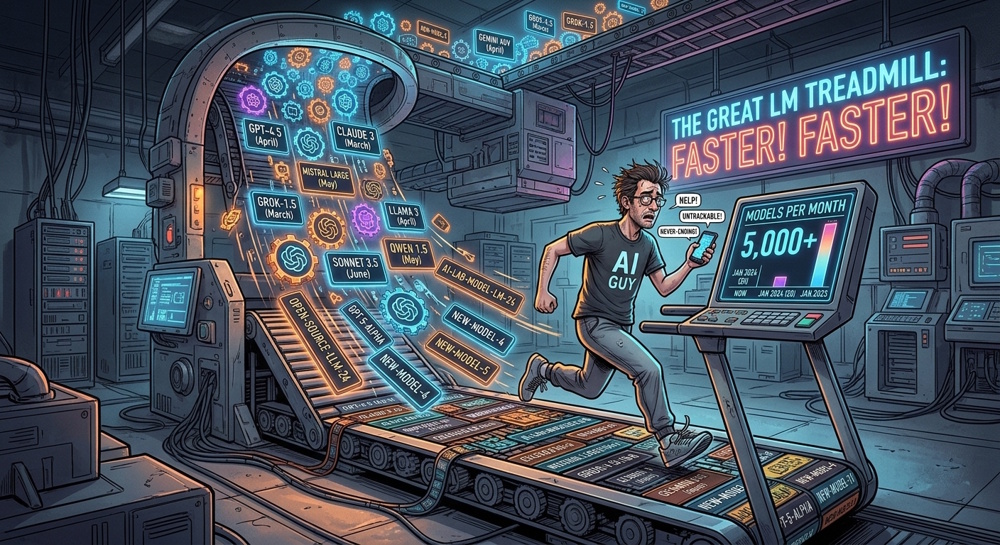
These days, I can't keep up with the language models. I'm a person whose job is to keep up with them, and I have failed. I'm standing on the side of the road, watching the parade go by, and I no longer know which float is which.
It started when GPT-3 came out. It was a thing. You used it, you learned its personality, you figured out that it was great at writing emails and bad at math. You settled into a rhythm. You and GPT-3 were colleagues. You understood each other.
Then GPT-3.5 arrived. Okay, fine. A point release. I can handle a point release. GPT-3.5 was like GPT-3 but slightly better at not sounding like a robot. I moved on. I was fine with it.
Then GPT-4 came out. This was a major version. This was the Windows 3.1 to Windows 95 moment. GPT-4 was smart, it was nuanced, it could reason, code, and write a passable Shakespearean sonnet, in case anybody nowadays would want one. I spent months learning GPT-4 and its quirks. I learned that it loved certain words if you didn't stop it. I learned that it would hallucinate legal citations with the confidence of a B-school lawyer. I learned to work around its flaws. We were a team.
Then GPT-4 Turbo came out.
Then GPT-4 Turbo with Vision.
Then
GPT-4o.
Then GPT-4o mini.
Then GPT-4o with the voice that sounded like
Sydney Sweeney until Sydney Sweeney 's lawyers got involved.
Then o1.
Then o1 preview.
Then o1 mini.
Then o3.
At this point, I've completely lost track. I don't know if I'm using o1 or o3 or o1-preview or o1-mini or GPT-4o-mini-turbo-vision-pro-max. I don't know what the "o" stands for. I don't know if there was an o2. I don't know if o2 was skipped, or if o2 was so terrible that they buried it in the desert along with Atari game cartridges.
The Naming Crisis
The naming conventions have become a parody of themselves. We've gone from clear, sequential version numbers to a taxonomy that looks like it was designed by a committee of MBAs who were locked in a room with a whiteboard and a deadline.
Here's a partial list of models that were released, in no particular order, because order no longer exists:
GPT-4. GPT-4 Turbo. GPT-4 Turbo with Vision. GPT-4o. GPT-4o mini. GPT-4o mini high. o1. o1-preview. o1-mini. o3. o3-mini. Claude 3. Claude 3 Sonnet. Claude 3 Opus. Claude 3 Haiku. Claude 3.5 Sonnet. Claude 3.5 Haiku. Claude 3.5 Sonnet (new). Claude 3.5 Sonnet (newer). Claude 3.5 Sonnet (the one that actually works). Gemini 1.0. Gemini 1.0 Pro. Gemini 1.5 Pro. Gemini 1.5 Flash. Gemini 2.0. Gemini 2.0 Flash. Gemini 2.0 Flash Thinking. Llama 3. Llama 3.1. Llama 3.2. Llama 3.3. Mistral 7B. Mistral 8x7B. Mistral 8x22B. Mixtral. Mathstral. Codestral. Pixtral.
Every single one of these is a real model. I'm not making any of them up, and there's way more of the latest releases. I couldn't make these up if I tried. Well, unless I asked AI for help.
I have a spreadsheet that tracks which model I'm currently using, its strengths, its weaknesses, and whether it has been replaced by a newer model in the time it took me to update the spreadsheet. The spreadsheet is always out of date. The spreadsheet is a living document in the sense that it is dying in real time.
The Quirk Problem
Here is the thing I've learned about the rapid release cycle: every model has a personality, and every personality is different, and you have to learn the personality every single time.
GPT-4 had a personality. It was the eager intern. It wanted to please. It would write you a 2,000-word essay when you asked for a yes-or-no answer, because it was so desperate to be useful that it couldn't help itself. You learned to work with it, to say, "Answer in one sentence." You learned to say, "Do not explain. Just answer." You learned the personality, you adjusted, and you were productive.
Then GPT-4 Turbo came out, and the personality was different. It was slightly more terse, slightly less eager. It would give you a shorter answer, but it would also occasionally refuse to answer at all, for reasons that were unclear. You had to relearn the personality. You had to adjust your prompts and figure out the new quirks on the fly.
Then GPT-4o came out, and the personality was different again. It was more conversational. It wanted to use emojis. It wanted to say "Great question!" before answering, which is the habit of a retail employee who has just been trained in a customer service workshop. You had to relearn the personality. Again.
Every model is a new employee that requires onboarding. Every model has a different way of interpreting your prompts, a different tendency to hallucinate, a different comfort level with ambiguity. And just when you've figured out the new employee - just when you've learned that Claude 3.5 Sonnet prefers bullet points and GPT-4o prefers paragraphs and Gemini prefers to ignore the prompt entirely and show you a Google Map - they release a new version, and the new version has a different personality, and you're back to square one.
The Version I Want
Here is what I want. I want the Windows 7 of language models. I want a model that works. I want a model that I understand. I want a model whose quirks I have memorized, whose hallucinations I can predict, whose personality I have learned to work with. I want to install that model, and I want to keep it, and I want to use it for a few years without anyone changing it.
I want a version number. A real one. Not "o1-preview-mini." Not "Claude 3.5 Sonnet (new)." I want "Version 7." And I want to be able to say, "I'm on Version 7, and I'm staying on Version 7, and when Version 8 comes out, I will evaluate it at my leisure, and if I don't like it, I will stay on Version 7, and nobody can make me upgrade."
In the old days, you could do this. You could stay on Windows 7 for a decade (which I think I did). You could stay on Office 2007 until the death of data centers on Earth (whenever that is). The software was yours. It was installed on your machine. It didn't change unless you changed it.
Today, the models live in the cloud. You don't own them, you rent them. And the landlord can change the furniture at any time, without asking, and without even telling you what changed. You wake up one morning, you type a prompt, and the model responds differently. And you spend the next three hours figuring out what changed, and why your prompts don't work the way they used to, and which word in your carefully crafted prompt the new model has decided to interpret differently.
The Silent Update
The worst part is the silent update. The silent update is when the model changes and nobody tells you. There is no changelog. There are no release notes. There is no "What's New in Version 4.0.1" pop-up. The model just... shifts.
One day it writes in a different tone. One day it formats differently. One day it stops using bullet points and starts using numbered lists. One day it decides that the word "delve" is no longer its favorite word, and instead it has developed an affinity for "navigate," and every response now includes the phrase "navigating the landscape of," and you want to scream.
I've spent hours debugging prompts that worked perfectly yesterday and don't work today. I've torn apart my prompt structure, rewritten my system messages, adjusted my temperature settings, and redesigned my output format, only to realize that the model didn't change because of something I did. The model changed because the company updated it silently, in the cloud, without telling anyone.
In the software industry, this is called "breaking change." In the old days, a breaking change came with a version number, a release note, and a migration guide. Today, a breaking change comes with nothing. It just arrives, like a weather pattern, and you deal with it.
The Rollback Fantasy
I want a rollback button. I want to be able to look at the model selector dropdown, see all the models that have been released in the last 18 months, and click the one that worked. The one whose personality I had learned. The one that didn't use the bot's favorite words. The one that answered in paragraphs, not bullet points. The one that didn't hallucinate case law. The one that was once exactly the tool I needed.
I want to roll back to that model, and I want to stay there, and I want to be productive, and I want to stop relearning the personality of a new digital employee every few weeks.
But I can't, because the old models are gone. They have been deprecated. They have been "improved." And the improvement is always different from what I want.
The Real Tragedy
The real tragedy of the model treadmill isn't that the models are getting worse. They're not. They're getting better. Each new model is more capable than the last. It can reason better, it can code better, it can handle longer context, it can do things the previous model couldn't do.
But "better" is not the same as "familiar" and familiarity is what makes you productive.
The model I knew best was GPT-4. Not GPT-4 Turbo or GPT-4o. GPT-4. The original. I spent a long time learning that model. I knew its voice, its limits, how to prompt it, how to constrain it, how to get the best out of it. I considered myself a master of that specific tool.
Then they replaced it and I had to start all over again. So I got good at the new one, and they replaced that one. And I started over again.
I am, at this point, a perpetual beginner. I'm always learning a new model, always adjusting to a new personality, always relearning prompts that used to work. I've forgotten more models than most people have used. I have a graveyard of prompts in my documents, each one optimized for a model that no longer exists, each one a small monument to a tool I once understood and will never use again.
The Plea
So here is my plea to the AI industry. It's the plea of a person standing on a treadmill that is going too fast. Slow down, bro. Or at least, let me stay behind.
Give me version numbers. Give me release notes. Give me a changelog that says, "We changed the model's tendency to use bullet points from 73% to 41%." Give me a rollback button. Give me the ability to say, "I'm staying on Version 7." Give me the ability to own the tool, instead of renting a tool that the landlord keeps rearranging.
I know you won't. I know the business model requires constant release. I know that "move fast and break things" is the religion, and I am the heretic asking for a slower church.
But I miss Windows 7. I miss the version number. I miss the ability to say, "This is my tool, and I understand it, and it's not going to change tomorrow."
I miss being good at something.
Instead, I'm perpetually adequate at everything, because the moment I approach mastery, the model changes, and I'm a beginner again.
If you need me, I'll be in my corner, trying to figure out which model I'm using, and whether the new kid can write an email without using "delve." Oh, now it's "deep dive." I give up.
 Links