 Reinforcement
Learning
Reinforcement
Learning
Learning through Interaction
Reinforcement Learning (RL) is a branch of machine learning focused on how an agent should take actions in an environment to maximize some notion of long‑term reward. Instead of learning from labeled examples (this is a cat), the agent learns through trial and error, receiving feedback in the form of rewards or penalties. This setup mirrors how humans and animals learn from experience, making RL a powerful framework for training autonomous systems that must make sequential decisions over time.
In a typical RL scenario, the agent observes the current state of the environment, chooses an action, and then receives a reward along with a new state. Over many interactions, the agent attempts to discover a policy - a strategy for choosing actions - that yields the highest cumulative reward. This process allows RL systems to learn even in complex, uncertain, or dynamic environments, and it does not require explicit programming of every possible situation.
What makes RL especially compelling is its ability to learn optimal behavior in situations where the consequences of actions unfold over time. RL algorithms mimic the way humans learn through experimentation: actions that help achieve a goal are reinforced, while actions that hinder progress are discouraged. This reward‑and‑punishment paradigm enables RL systems to discover effective strategies, sometimes even surpassing human performance. For example, RL has powered breakthroughs such as robots learning to walk, self‑driving cars making real‑time decisions, and game‑playing AIs mastering complex games like Go and chess through millions of self‑played matches.
RL is a foundational technique for building intelligent agents capable of autonomous decision‑making. Its strength lies in its flexibility, its ability to learn from interaction rather than instruction, and its capacity to uncover strategies that humans might never explicitly design. As AI systems increasingly operate in real‑world environments - robots, vehicles, supply chains, digital assistants - RL continues to grow as one of the most important and rapidly evolving areas of artificial intelligence.
TL;DR RL is a type of machine learning where an AI agent learns to make decisions by trial and error. Here's how it works:
- The Agent: This is the AI or computer program that's learning.
- The Environment: This is the world or situation where the agent operates.
- Actions: The agent can perform different actions in the environment.
- Rewards: The agent receives rewards (positive) or punishments (negative) based on its actions.
- Learning Process: The agent takes an action in the environment. It observes the result of that action. It receives a reward or punishment. Over time, it learns which actions lead to the highest rewards.
- Goal: The agent's objective is to maximize its total rewards over time.
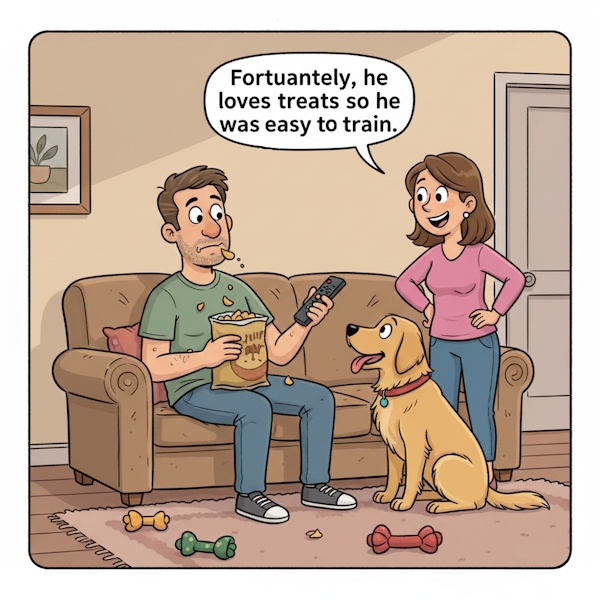
For example, imagine teaching a dog a new trick. You give it treats (rewards) when it does the trick correctly and withhold treats (punishment) when it doesn't. Over time, the dog learns to perform the trick to get more treats. This is similar to how reinforcement learning works for AI.
There are three main Types of Reinforcement Learning
- Policy-based: aims to maximize the system reward by employing deterministic policies, strategies, and techniques.
- Value-based: intends to optimize the arbitrary value function involved in learning.
- Model-based: enables the creation of a virtual setting for a specific environment, and the participating system agents perform their tasks within these virtual specifications.
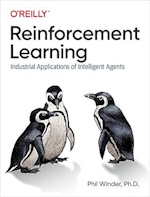 |
Reinforcement Learning
book from O'Reilly
|
🤣 Reinforcement Learning in Real Life
How Your Dog, Your Roomba, and Your Brain All Run the Same Algorithm
Reinforcement Learning sounds fancy until you realize it's basically the same system your dog uses to decide whether chewing your shoes is worth it.
Agent: your dog
Environment: your
house
Action: chewing your shoes
Reward:
depends on whether you catch them
If you yell -> negative reward
If you don't -> policy updated: chew
faster next time
Congratulations, you've just implemented RL in your living room.
🧹 Meanwhile, your Roomba is practicing RL
Your Roomba is also an RL agent, except it behaves like a philosophy major who's trying to "find itself."
- It bumps into a wall
- Thinks deeply
- Spins in a circle
-
Tries again
Eventually discovers the optimal policy: avoid walls, eat dust
 Uses of Reinforcement Learning
Reinforcement learning is particularly useful for tasks that involve sequential decision-making; self-driving cars, robotics or playing games, where the AI needs to learn optimal strategies through experience.
Self-driving cars
In order for vehicles to operate autonomously in an urban environment, they need support from the machine language models that simulate possible scenarios that the vehicle may encounter. RL helps since these models are trained in a dynamic environment, where possibilities are carefully evaluated through the learning process, much like a human driver learns from experience.
Energy consumption
Reinforcement learning agents, without prior knowledge of conditions, are capable of controlling the physical parameters, like power and temperature, that impact appliances and servers that manage energy consumption, conserving energy in the process.
Healthcare
Reinforcement learning plays a vital role in healthcare as treatment regimes aid medical professionals manage patient health. Using RL, physicians can diagnose complex diseases and fine-tune their treatment strategies. And it can suggest treatments be administered at the precise time, without complications arising due to delayed actions.
Traffic control
The rising demand for vehicles in metropolitan cities are a problem for authorities as they struggle to manage urban traffic congestion. A solution to the problem is reinforcement learning, as RL models introduce traffic light control based on the current traffic conditions. The model analyzes the traffic from multiple directions and then learns, adapts, and adjusts traffic light signals automatically in urban traffic networks.
Marketing
Reinforcement learning helps organizations maximize customer growth and streamline business strategies to achieve long-term goals. RL aids in making personalized recommendations to users by predicting their choices, reactions, and behavior toward specific products or services. They also consider variables like the evolving customer mindset and dynamically learn changing user behavior, allowing businesses to offer targeted and quality recommendations as well as adjust the marketing mix.
 Links
Links
Learn more. External website links open in a new tab.