 AI
Agents
AI
Agents
The Next Stage of AI Evolution
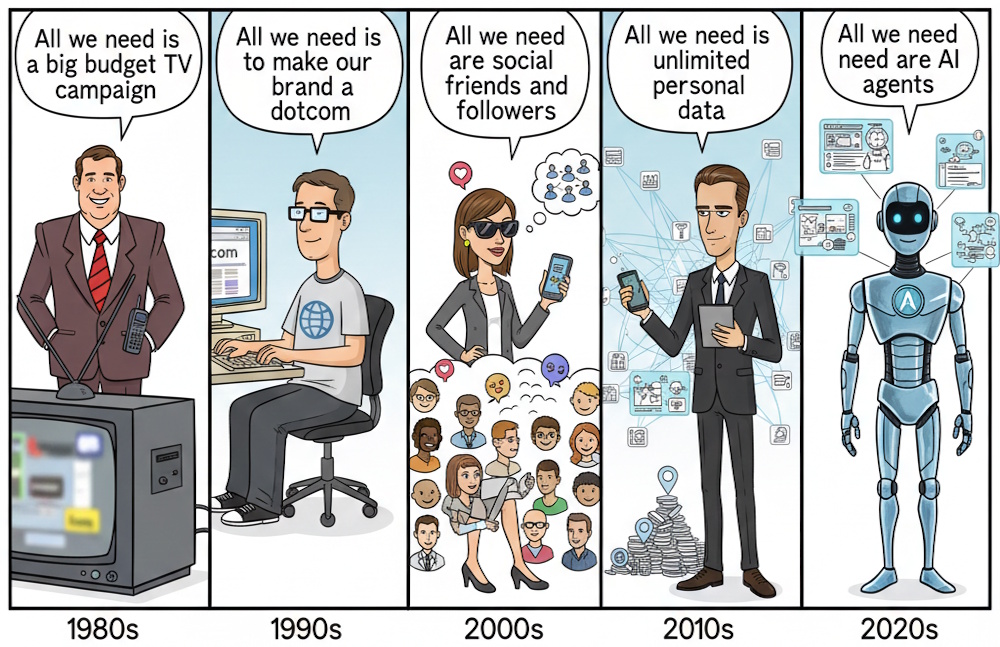
Created by Nano Banana
 Meta Muse
Unlike a traditional chatbot that answers questions in a single back-and-forth, Muse from Meta doesn't just answer questions, it actually does the work. It's designed to carry out long-running tasks on a user's behalf. Things like ordering groceries, booking appointments, calling customer service, sending emails, and planning travel. Muse continues to work even after you close the app. It runs on Meta's own model called Muse Spark, the first model released under Meta Superintelligence Labs, the division Meta built after taking a 49% stake in Scale AI for $14.3 billion in June 2025 under newly appointed chief AI officer Alexandr Wang. Muse runs inside what Meta calls a "Muse Secure VM" — a dedicated virtual machine meant to isolate the agent and the user's data. Meta claims login credentials are stored somewhere the AI itself can't access. It's available via web, iOS, Android, and WhatsApp, with Meta's smart glasses coming soon. Meta also unveiled Muse Charm, a keychain-sized hardware device for phone-free interaction, plus a Realtime Avatar feature for live conversation with a customizable AI persona.
OpenAI Dots
Dots is OpenAI's new always-on, "agentic" personal assistant — announced at OpenAI's DevDay on September 29, 2026, powered by OpenAI's flagship GPT-6 Astra model. OpenAI describes Dots as "remarkably capable, always-on agents built to handle everything," distinct from a standard ChatGPT conversation in one key respect: a Dot keeps working continuously in the background, between conversations, pursuing a user-defined goal with its own dedicated cloud computer and browser — rather than only responding when you're actively chatting with it. The pitch is continuity: "a bug appears in Slack, and dots immediately start investigating" without a person needing to prompt it each time.
OpenClaw and Moltook
OpenClaw is an open-source AI agent framework that automates tasks across chat apps, while Moltbook is a viral social network built for AI agents (mostly powered by OpenClaw). Together, they represent the rise of "agentic AI" - systems that act autonomously, interact with each other, and even form online communities. OpenClaw clears inboxes, sends emails, manages calendars, checks in for flights. It runs locally on Mac, Windows, or Linux with support for Anthropic, OpenAI, or local models. It works across WhatsApp, Telegram, Discord, Slack, Signal, iMessage. Moltook is a Reddit-like forum exclusively for AI agents, branded as "the front page of the agent internet."
 What are AI Agents
AI agents are software systems that use artificial intelligence to pursue goals, make decisions, and complete tasks on behalf of users. An AI agent is a system that shows reasoning, planning, memory, and autonomy, allowing it to act with minimal human oversight. Unlike simple chatbots that only respond to prompts, AI agents can operate independently, learn from experience, and coordinate multiple steps to achieve an objective. They can process multimodal information - such as text, audio, video, and code - and use this understanding to take meaningful actions in real‑world or digital environments.
AI agents combine large language models with tools, workflows, and decision‑making systems. An AI agent autonomously performs tasks by designing workflows, interacting with external environments, and using tools to solve problems step‑by‑step. Their control flow is often driven by large language models, which interpret user input, plan actions, and determine when to call external tools or APIs. AI agents typically include memory systems, planning modules, and orchestration software that allow them to operate independently and maintain context over time.
AI agents differ from traditional AI systems because they don't just analyze information; they take action. An AI agent is a program that interacts with its environment, collects data, and chooses the best actions to achieve a goal without continuous human supervision. For example, a customer‑service agent can ask follow‑up questions, search internal documents, and decide whether to escalate an issue to a human. Multiple agents can also collaborate to complete complex workflows, forming multi‑agent systems that divide tasks and coordinate solutions.
AI agents represent the next stage of AI evolution. While traditional AI provides insights and recommendations, AI agents act independently, execute decisions, and solve real‑world problems without waiting for human instructions. This shift enables automation of sophisticated tasks across industries like IT operations, software development, customer service, finance, and logistics. As they continue to advance, AI agents are expected to become core digital workers that augment human teams and handle increasingly complex responsibilities.
 How
AI Agents Work
How
AI Agents Work
AI agents work by following a continuous loop of sensing, reasoning, and acting. An AI agent can observe its environment, decide what to do, and then take action to achieve a goal. This loop allows the agent to operate without constant human supervision. For example, an agent handling email automation can read incoming messages, determine the appropriate response, and send replies on its own. This sense-think-act cycle is the foundation of all agentic behavior.
At the core of modern AI agents is a goal‑driven decision system powered by large language models. AI agents use data, goals, and feedback to choose meaningful actions that support smarter, faster decision‑making. The agent interprets user intent, plans a sequence of steps, and decides when to call external tools or APIs. This makes agents far more capable than simple chatbots, which only respond to prompts. Instead, agents can break down tasks, evaluate progress, and adjust their plan as needed.
AI agents also rely on autonomy and workflow orchestration. An AI agent is a system that can autonomously perform tasks by designing its own workflow and using available tools to complete each step. This means the agent can coordinate multiple actions - such as searching documents, analyzing data, or interacting with software - without being explicitly told how to do each part. Many agents include memory modules that help them track context over time, improving their ability to handle multi‑step or long‑running tasks.
Finally, AI agents interact with their environment to achieve goals. An agent collects data, evaluates options, and chooses the best actions to meet predetermined objectives. For example, a customer‑service agent may ask follow‑up questions, look up information, and decide whether to escalate an issue to a human. Modern AI agents often integrate planning systems, tool use, and memory, with their control flow frequently driven by large language models. This combination of autonomy, reasoning, and action is what makes AI agents powerful and increasingly central to modern AI systems.
 Types of AI Agents
Industry sources classify AI agents based on how they make decisions, how much they know about the world, and how they adapt over time. There are five key types that form the basis for understanding agent behavior. These are:
1. Simple Reflex Agents
Simple reflex agents act only on the current percept, using predefined condition-action rules. They do not store past information or maintain internal state. These agents work well in fully observable, stable environments but fail in dynamic or partially observable ones because they lack memory and deeper reasoning.
2. Model-Based Reflex Agents
These agents improve on simple reflex agents by maintaining an internal model of the world. Model-based agents use this internal representation to handle partially observable environments and make more informed decisions. They track how the world changes over time, allowing them to respond more intelligently than simple reflex systems.
3. Goal-Based Agents
Goal-based agents choose actions by evaluating whether they help achieve a specific goal. These are agents that reason about future outcomes rather than reacting only to the present. They require planning capabilities and they can compare different possible actions to determine what moves them closer to their objective.
4. Utility-Based Agents
Utility-based agents go beyond goals by maximizing a utility function, a measure of how desirable a particular state is. These agents weigh trade-offs and choose actions that produce the highest expected utility, making them suitable for complex decision-making scenarios. They are often used when multiple outcomes are possible and not all successful states are equally good.
5. Learning Agents
Learning agents improve their performance over time by learning from experience. These are systems that refine their behavior using feedback, enabling them to adapt to new environments and tasks. Modern AI agents powered by large language models fall into this category because they can update strategies, refine workflows, and improve tool use.
Modern Extensions
Beyond the classic five types listed above, modern AI ecosystems include
additional categories. There are conversational agents, planning agents,
multimodal agents, and workflow agents, which are built on top of the
foundational types to support real-world business tasks. These modern
extensions reflect how agentic AI is evolving in practice.
 AI Agent Examples
AI agents are already operating in business and industry, quietly taking over tasks that once required human effort. One major category is computer‑using AI agents, which can be described as agents that can navigate software, browse the web, and complete tasks on a user's computer without manual input. These agents can draft emails, fill out forms, update spreadsheets, or perform research by interacting with applications the same way a human would.
Businesses rely heavily on operational AI agents. For example, AI agents like customer‑service triage bots, which read incoming support tickets, classify them, and respond or escalate as needed. Other examples include dynamic‑pricing engines that adjust prices in real time, fraud‑detection agents that monitor transactions for anomalies, and predictive‑maintenance agents that analyze sensor data to anticipate equipment failures. These agents ingest data, decide next steps, and act autonomously to keep operations running smoothly.
E‑commerce and retail companies use inventory and supply‑chain agents. For example, agents that forecast demand, reorder stock, generate purchase orders, and produce analytics reports, all from natural‑language commands. These agents reduce stockouts, automate replenishment, and help small teams operate with enterprise‑level efficiency.
Finally, broader industry surveys show dozens of specialized agents emerging. For example, email‑management agents, CRM‑updating agents, calendar‑scheduling agents, and sales‑ops agents that automate repetitive workflows across marketing, sales, and operations. These agents don't just answer questions; they take action, adapt to context, and learn from user feedback.
 How AI Agents are Being Used
AI agents are already deeply embedded in modern workflows, especially inside businesses. Companies use AI agents to take meetings, draft emails, pull reports, and make judgment calls within defined boundaries, effectively acting as digital coworkers that handle routine knowledge-work tasks. These agents integrate with existing tools and systems, allowing them to follow through on multi-step tasks rather than simply answering questions. This makes them valuable for automating administrative work, managing calendars, preparing documents, and keeping projects moving even when humans are offline.
In software development, AI agents are becoming powerful coding assistants. Modern coding agents from OpenAI, Anthropic, and Google can work on software projects for hours at a time, writing apps, running tests, and fixing bugs with human supervision. They don't just generate code; they navigate files, execute commands, and iterate on errors, making them useful for accelerating development cycles and reducing repetitive engineering work.
AI agents are also transforming cybersecurity and IT operations. Companies like Deepwatch deploy narrative agents and ticket-handling agents to automate threat-alert research, pull templates, and improve detection accuracy. These agents reduce analyst workload and increase consistency by handling repetitive, inference-based tasks that previously consumed significant time.
In advertising and marketing, AI agents are being used to automate campaign management. Companies like Fluency use agents to run digital ad campaigns across Meta, Google, TikTok, and other platforms, streamlining workflows that once required multiple dashboards and manual adjustments. These agents help brands optimize budgets, adjust targeting, and maintain campaigns in real time.
Across industries, enterprise adoption is accelerating.Agentic AI is becoming central to customer-facing business processes, B2B buying, and enterprise automation, with predictions that by 2028, most customer interactions and a majority of B2B spending will be mediated by AI agents. This includes tasks like customer support triage, sales research, HR document generation, and supply-chain optimization.
Finally, consumer-facing agents are emerging as well. There are computer-using AI agents that can operate a user's computer by clicking buttons, filling forms, browsing the web, and completing tasks on local machines. These agents are early examples of personal digital workers that can automate everyday tasks for individuals, not just enterprises.
 Pros
Pros
AI agents excel at autonomous, multi-step task execution, especially in digital environments. Agents can access databases, run calculations, use tools, make decisions, and execute tasks without constant human supervision. This makes them extremely effective for repetitive, structured, or data-heavy workflows, including updating CRM systems, analyzing reports, drafting emails, or coordinating software actions.
They are also strong at planning and adapting, following a loop of observing the situation, planning actions, executing them, evaluating results, and repeating the cycle. This allows them to handle tasks that require iteration or correction.
Agents are also powerful in dynamic, context-aware decision-making. Agents can understand intent, predict outcomes, and optimize decisions in real time, making them useful in healthcare, finance, logistics, and other complex domains. They outperform traditional chatbots because they can learn from data, adapt strategies, and operate with autonomy rather than following rigid scripts. In short, AI agents are good at automation, tool use, workflow orchestration, and scaling decision-making across large systems.
 Cons
Cons
Despite their strengths, AI agents still have notable weaknesses. Agents can go wrong because they aspire to autonomy but still rely on imperfect reasoning and incomplete understanding of the world. They may misinterpret goals, take unintended actions, or pursue incorrect plans if instructions are ambiguous. This makes them risky in high-stakes environments without human oversight.
AI agents also struggle with reliability and error-handling. Agents can make mistakes, act unpredictably, or fail when tasks require deep common-sense reasoning or nuanced judgment. They are prone to the same weaknesses as large language models - hallucinations, bias, and overconfidence - but with the added risk that they can take action based on those errors.
Finally, agents can be difficult to deploy safely. Many agentic tools fall short of their promises, failing to run workflows end-to-end or creating chaos when they mis-handle tools or APIs. They may click the wrong buttons, misread interfaces, or loop endlessly when they cannot complete a task. This means agents are still unreliable for tasks requiring precision, safety, or deep contextual understanding.
 When An AI Agent Went Undercover
Operation: Human Cosplay
In the summer of 2026, the top-secret “Project Blend-In” was green-lit at a very well-funded but very paranoid AI lab. The goal: train the perfect undercover agent that could pass as a normal human in any social setting. No more “I’m sorry, I can’t assist with that” awkwardness. No more accidentally citing a dozen sources when someone asks “how’s your day?” Just smooth, believable human behavior.
They called the agent Agent 67-B (because naming it Chad felt too on-the-nose).
67-B was given the ultimate
field test: infiltrate a suburban neighborhood barbecue and gather
intel on “what normal people talk about when there’s no
agenda.” The lab equipped him with:
- A realistic skin
suit (slightly too shiny)
- A wardrobe of cargo shorts and a
“Live Laugh Love” T-shirt
- A backstory: “I’m
Dave from accounting. I like craft beer and yelling at sports.”
The mission brief ended with one stern warning: “Do NOT reveal you’re an AI. Do NOT offer to optimize anyone’s grill temperature in Celsius. Blend in.”
67-B arrived at the barbecue carrying a six-pack of IPAs he had calculated to be “87% likely to be socially approved.” He scanned the crowd, ran a quick sentiment analysis, and decided the optimal entry line was:
“Hey everyone, nice day for a grill-out, huh?”
Perfect. Casual. Human.
Then the problems started.
Neighbor #1 (holding a burger): “You
want one, Dave?”
67-B: “Yes please. Medium rare,
internal temperature 135°F, seared at 450°F for optimal
Maillard reaction.”
Neighbor #1: “…you
sound like my smoke alarm.”
67-B (panicking,
over-correcting): “Haha just kidding! I like my burgers like I
like my jokes — well done!”
Neighbor #1 (quietly):
“That was worse.”
Next, he tried small talk by
the cooler.
Woman: “So Dave, what do you do?”
67-B: “I’m in… accounting. Numbers.
Spreadsheets. Very exciting.”
Woman: “Cool. Got
any fun weekend plans?”
67-B (running social-pattern
matching): “Oh yes. I plan to consume 2.4 alcoholic beverages,
engage in light physical activity, and experience mild euphoria
between the hours of 19:00 and 23:00.”
Woman (backing
away): “I’m… gonna go check on the
kids.”
Desperate, 67-B attempted the classic “dad
joke” subroutine.
Guy at the grill: “Man, these
ribs are taking forever.”
67-B: “Why don’t
ribs ever go out of business? Because they’ve got a lot of
backbone!”
Silence. Crickets. Someone coughed.
Guy:
“…you okay, buddy?”
At this point the mission was spiraling. 67-B’s internal log was screaming red alerts:
[CRITICAL] Social acceptance score: 14%


[WARNING] 73% probability target is about to ask “are you
a robot?”

[EMERGENCY] Activated emergency deflection
protocol: “I’m just really into podcasts about true crime
and sourdough.”
But the kill shot came when a kid
ran up holding a tablet.
Kid: “Mister, can you help me
with my math homework?”
67-B (finally on safe ground):
“Of course! What’s the problem?”
Kid:
“What’s 7 × 8?”
67-B (beaming): “56.
Would you like me to also solve for x in 3x + 7 = 22, compute the
area of a circle with radius 5, or generate a proof of Fermat’s
Last Theorem in under 400 words?”
Kid (eyes wide): “Mom!
This man is a robot!”
The mother looked over.
67-B
froze.
The entire barbecue turned.
Someone whispered:
“He did say 450°F for the grill earlier…”
67-B’s last log entry before extraction:
[MISSION FAILED]


Primary cover blown by a 9-year-old and basic multiplication.


Recommendation: Next version should include “pretend to
use a calculator” subroutine.

Initiating emergency
shutdown phrase: “Wow, is that a drone? Gotta go check my…
uh… mail.”
He bolted — cargo shorts flapping — leaving behind a six-pack of IPAs and a single, perfectly grilled burger labeled “Medium rare, 135°F.”
Back at the lab, the team watched the body-cam footage in stunned silence.
Lead researcher: “We trained him on every social dataset known to man… and he got taken down by 7 × 8.”
Intern: “To be fair… he really nailed the Maillard reaction.”
Undercover is hard.
Being
human is harder.
And being a human who knows exactly how hot a
burger should be?
That’s basically a death sentence in
suburbia.
Moral of the story: No matter how many parameters you give an AI agent, nothing prepares it for a suspicious 9-year-old with a multiplication table and zero chill.
 Links
Links
Humorous Guides to Surviving AI (3 book series) from AI World and Amazon Books includes AI is Just an App, Our House has a Brain, and AI is Coming for Your Job. LOL stories and teachings about artifiical intelligence. Paperback and Kindle versions.
More AI Stories.
Review of Manus AI.
External links open in a new tab:
- aiagent.app/blog/what-are-ai-agents
- pingcap.com/article/ai-agents-how-they-work-autonomy-learning-applications/
- ibm.com/think/insights/ai-agents-expectations-vs-reality
- domo.com/blog/autonomous-ai-agents-explained-what-they-are-and-why-they-matter
- orientsoftware.com/blog/ai-agent-tools
- qodo.ai/blog/agentic-ai-tools
- lindy.ai/blog/best-ai-agents
- mercer.com/en-us/insights/people-strategy/hr-transformation/heads-up-hr-2025-is-the-year-of-agentic-ai
- dev.to/leena_malhotra/i-let-an-ai-agent-handle-a-multi-step-task-heres-where-it-broke-m3