 AI
Ethics and the American Debate
AI
Ethics and the American Debate

AI in America is the definitive popular history of the most consequential technological enterprise of the past century told not as a march of inevitable progress, but as a deeply human story of booms and busts, brilliance and blunder, stubborn visionaries, and crushing winters. This is not a book about algorithms or programming. It is the story of the people, ideas, institutions, breakthroughs, failures, rivalries, and moments of inspiration that shaped one of the greatest technological revolutions in history.
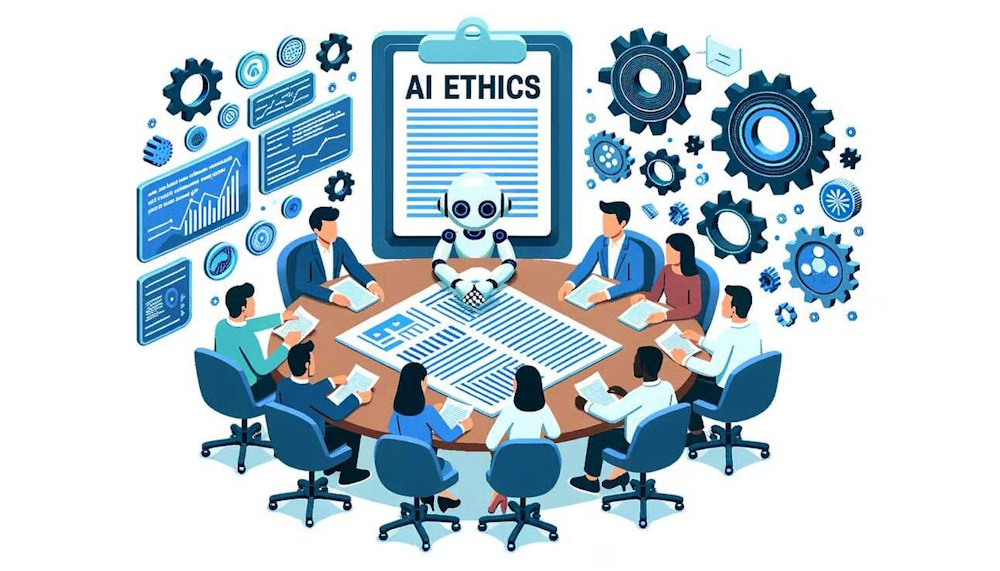
Artificial intelligence did not arrive in a moral vacuum. From its earliest development in American universities and tech labs, AI has been more than code and compute; it has been a reflection of the society that built it. The United States, birthplace of the modern AI industry, now finds itself at the center of a profound ethical debate: what values should guide the machines that increasingly shape human life?
The Origins of AI Ethics in America
As we've learned, the field of artificial intelligence was officially born in 1956 at the Dartmouth Conference when researchers gathered with a goal of determining how to make machines that could think. Then, AI ethics barely existed as a concept. There are several reasons why researchers were not initially interested in AI ethics.
AI Was Really Simple. The AI of the 1950s to the 1980s couldn't do much. Early AI programs could play checkers, prove math theorems, or solve simple logic puzzles. These systems were nowhere nearly sophisticated enough to raise serious ethical concerns. It's hard to worry about the ethics of a program that merely plays tic-tac-toe.
AI Was Rare. AI research happened mostly in universities and research labs. Ordinary people never encountered AI in their daily lives. There were no smartphones with AI assistants, no social media algorithms, no facial recognition, no AI hiring systems. AI was an academic curiosity, not something affecting millions of people.
The Focus Was on Making It Work. Researchers were so focused on getting AI to work at all that they didn't spend much time thinking about the implications if it worked too well. Imagine being so focused on building a car that there is no thought about needing traffic laws until after cars are everywhere.
Optimistic Assumptions. Many early AI researchers had an unspoken assumption: if we make machines smarter, they'll naturally make the world better. Intelligence was seen as inherently good. The idea that intelligent systems might be harmful, biased, or misused wasn't seriously considered.
The first hints of concern came from a few early thinkers who started worrying about AI, especially Isaac Asimov. A science fiction writer, Asimov created his famous "Three Laws of Robotics" in 1942:
1. A robot may not injure a human being or allow a
human to come to harm
2. A robot must obey human orders (except when
this conflicts with the first law)
3. A robot must protect its own
existence (except when this conflicts with the first two laws)
While these were fictional, the principles represented one of the first attempts to think systematically about how to make artificial beings behave ethically. Asimov's stories often showed how even these seemingly simple rules could lead to unexpected problems, an early warning that programming ethics is harder than it looks.
Early Computer Scientists' Concerns (1960s-1970s)
A few computer scientists, notably Weizenbaum and Wiener, did raise ethical concerns about AI and thus became pioneers in AI ethics.
Joseph Weizenbaum created ELIZA in 1966, a simple chatbot that could hold conversations by following scripts. He was disturbed when people formed emotional attachments to ELIZA, treating it like a real therapist even though it didn't understand anything it was saying. In 1976, he wrote a book called Computer Power and Human Reason, warning about becoming too dependent on computers and giving them too much authority over important decisions. Weizenbaum asked: Should there be some decisions that we never let computers make, even if they could? Some things that should remain human, no matter how smart machines get?
Norbert Wiener, one of the founders of cybernetics (the study of control and communication in machines and living things), worried in the 1950s-1960s about autonomous machines and feedback loops. He warned that machines optimizing for the wrong goals could cause harm, even if working perfectly from a technical standpoint.
At the time, Weizenbaum and Wiener were mere voices in the wilderness. Most people weren't listening yet because AI still wasn't powerful enough to matter.
Early Ethical Concerns Emerge (1990s-Early 2000s)
By the 1990s, AI is out of the lab and starts to affect real people. AI was moving out of research labs and into the real world in small, yet important ways:
-
Credit scoring systems used algorithms to decide who got loans
-
Automated trading systems operated on stock markets
-
Early recommendation systems suggested products or content
-
Data mining analyzed consumer behavior
-
Expert systems assisted with medical diagnoses and other professional decisions
For the first time, AI systems were either making or influencing decisions that affected ordinary people's lives. And sometimes things went wrong.
One of the first major ethical concerns about AI involved privacy. Companies were collecting massive amounts of data about people's behavior: what they bought, where they went, what websites they visited. AI systems analyzed this data to predict behavior and target advertising.
In the 1990s, people started realizing: "Wait, companies know what about me?" This led to early privacy regulations like the Children's Online Privacy Protection Act (COPPA, 1998), protecting kids' data online. There were growing concerns about "data mining" and "Big Brother" surveillance, and debates about what information companies should be allowed to collect and use.
These privacy concerns weren't specifically about AI at first, for they were really about what could be done with AI's analysis of data. Privacy and AI ethics have been intertwined ever since.
Fairness in Automated Decisions
Another early concern was fairness. If an algorithm denies you a loan or a job, how do you know the decision was fair? What if the algorithm is biased?
In the 1990s and early 2000s, there were scattered reports of credit scoring systems that seemed to discriminate against certain neighborhoods, hiring software that filtered out qualified candidates for unclear reasons, and insurance pricing that charged different rates in ways that seemed unfair. These issues didn't get huge public attention yet, but lawyers, civil rights advocates, and some researchers started asking: How do we ensure algorithmic decision-making is fair? Can we even tell if an algorithm is biased?
Autonomous Weapons: An Early Flashpoint
The military's interest in AI created another early ethical debate with the advent of autonomous weapons. Should machines be allowed to make life-or-death decisions in warfare? The U.S. military funded substantial AI research and developed systems like cruise missiles that could find and hit targets independently, in addition to drones with increasing autonomy, and battlefield robotics.
In the early 2000s, human rights organizations started warning about "killer robots," the fully autonomous weapons that could select and engage targets without human control. They argued this crossed an ethical line: humans should always make the decision to take a human life. This debate brought ethical questions about AI to international forums like the United Nations, even if no consensus emerged about what to do.
AI Ethics Becomes Serious (Mid-2000s to 2016)
Several developments made AI ethics urgent in the new century. Companies like Google, Facebook (now Meta), Amazon, and Apple became giants, and AI was central to their business. Google's search algorithm decided what information billions of people saw. Facebook's News Feed algorithm shaped public discourse. Amazon's recommendation engine drove enormous amounts of commerce. These weren't academic exercises, these were systems affecting society at large.
Smartphones and Constant Data Collection (2007+)
When the iPhone launched in 2007, it started an era where people carry powerful computers that constantly generate data: location, contacts, communications, browsing, app usage, health metrics, and more. AI systems analyzed this tsunami of data, making predictions and decisions about people without their explicit knowledge.
Social Media and Algorithmic Curation (Late 2000s-Early 2010s)
Facebook, Twitter, YouTube, and other platforms used AI to decide what content to present to users. These algorithms optimized AI for engagement, keeping people clicking and scrolling. But maximizing engagement had unintended consequences: spreading misinformation, creating echo chambers, promoting outrage, and potentially affecting elections and public health.
The 2008 Financial Crisis
While not purely about AI, the financial crisis of 2008 showed how algorithmic trading and complex mathematical models could cause enormous harm when they failed or were misused. Mathematicians and software engineers created complex algorithms that contributed to a crisis costing millions of jobs and trillions in wealth. This prompted questioning of whether we should trust important decisions to algorithms we don't fully understand.
The Flash Crash of 2010
On May 6, 2010, the stock market suddenly plummeted almost 1,000 points in minutes, then recovered almost as quickly. Investigators determined that interacting automated trading algorithms caused the crash. Humans did not intend for this to happen, the algorithms just reacted to each other in an unstable way. The so-called "flash crash" was a wake-up call. AI systems interacting with each other can produce unpredictable, dangerous outcomes that no individual system was programmed to create.
Target's Pregnancy Prediction (2012)
A famous case from Target department stores showed AI's potential to be invasive. Target's algorithms could predict which customers were pregnant based on their purchasing patterns, sometimes before the women had told anyone. In one case, Target sent pregnancy-related coupons to a teenage girl, revealing her pregnancy to her father before she'd told him. This example went viral, making people realize that AI doesn't just react to what you tell it, it can infer sensitive information about you that you never meant to share.
ProPublica's Investigation of Criminal Justice Algorithms (2016)
In 2016, the news organization ProPublica published an investigation that would become foundational to AI ethics. They analyzed COMPAS, an algorithm used by judges to predict which defendants were likely to commit crimes if released.
Their findings were shocking: the algorithm was twice as likely to incorrectly label black defendants as "high risk" compared to white defendants, even when controlling for actual criminal history. White defendants were more likely to be incorrectly labeled "low risk." This investigation proved several important things:
-
Algorithms used in high-stakes decisions could be seriously biased
-
The bias disadvantaged marginalized communities
-
The companies making these systems claimed they were fair, but independent investigation revealed otherwise
-
Algorithmic bias wasn't just theoretical, it was affecting real people's lives
The ProPublica investigation energized the AI ethics movement. It provided concrete evidence that algorithmic bias was real and harmful.
Academic AI Ethics Takes Off (mid-2010s)
By the mid-2010s, academic researchers were taking AI ethics seriously as leading American universities created dedicated research centers:
These centers brought together computer scientists, philosophers, lawyers, and social scientists to study AI ethics from multiple perspectives. Researchers developed frameworks and concepts still used today, the most important of which was Fairness, Accountability, and Transparency (FAT). A movement emerged around "FAT" principles:
-
Fairness: AI systems shouldn't discriminate or create unjust outcomes
-
Accountability: Someone should be responsible when AI causes harm
-
Transparency: We should be able to understand how AI makes decisions
The FAT conference (later renamed FAccT - Fairness, Accountability, and Transparency) became a major venue for AI ethics research.
Algorithmic Bias
Algorithmic bias refers to systematic and repeatable errors in AI systems that result in unfair or discriminatory outcomes. These biases often reflect societal prejudices embedded in the data, design, or evaluation processes of the algorithms. For example, an AI hiring tool trained on historical data that favored male candidates may perpetuate gender bias by unfairly disadvantaging women. Researchers developed rigorous ways to measure and study bias in algorithms:
-
How does an algorithm's training data create bias?
-
Can we mathematically define fairness?
-
How do we detect bias in complex systems?
-
Can we fix bias without making other problems?
Explainable AI
As AI systems became more complex (especially deep learning neural networks), understanding why they made specific decisions became harder. Researchers worked on "explainable AI," methods to interpret and explain AI decisions.
Value Alignment
Computer scientists began working with philosophers on the "value alignment problem." That is, how do we make AI systems that pursue goals aligned with human values? This is harder than it sounds, since human values are complex, conflicting, and hard to specify precisely.
AI Ethics in Public Consciousness (2016-2020)
The 2016 presidential election was a turning point for AI ethics in America as several AI-related issues became national headlines.
Social media algorithms showed people content similar to what they'd engaged with before. This created "filter bubbles" where people saw information confirming their existing views and rarely encountered opposing perspectives. Critics argued this polarized society and undermined democratic discourse.
The spread of misinformation on social media, amplified by AI recommendation algorithms, became a major concern. Alleged Russian interference in the election involved AI-amplified disinformation campaigns. Facebook faced intense criticism for its role in spreading false information. People started asking: Should social media companies be responsible for what their algorithms promote? Do they have ethical obligations beyond profits?
The Cambridge Analytica scandal (revealed in 2018 but involving 2016 election activity) showed how AI could analyze personal data to micro-target political ads and potentially manipulate voters. The company harvested Facebook data from millions of users and used AI to create psychological profiles for targeted messaging. This raised disturbing questions: Can AI be used to manipulate democracy? What limits should exist on using AI for persuasion?
From 2016-2020, the tech industry faced growing ethical scrutiny. One prominent example was Google's Project Maven Controversy of 2018.
Google was working with the Pentagon on Project Maven, using AI to analyze drone footage for military targeting. When this became public, thousands of Google employees signed a petition objecting to building AI for warfare. Several employees resigned in protest. This was significant because tech workers were saying they had ethical responsibilities, and they wouldn't build just anything their employers asked. Google eventually decided not to renew the military contract and published its "AI Principles" committing to ethical AI development.
By the late 2010s, facial recognition AI was becoming powerful and widely deployed. Police departments used it for surveillance and identifying suspects. Airports used it for traveler screening. Retailers experimented with it for security and customer tracking. But research showed serious problems:
-
Accuracy disparities: Systems were much less accurate for people with darker skin, leading to misidentifications
-
Privacy invasion: Constant surveillance of public spaces
-
Chilling effects: People might avoid protests or other lawful activities if they know they're being identified
In 2019, San Francisco became the first major U.S. city to ban government use of facial recognition. Other cities followed suit. Amazon, Microsoft, and IBM all announced moratoriums or limits on selling facial recognition systems to police. Throughout this period, researchers kept finding examples of biased AI:
-
Hiring algorithms that discriminated against women (Amazon's recruiting tool)
-
Healthcare algorithms that gave poorer health care recommendations to minority patients
-
Ad delivery algorithms that showed high-paying job ads more to men than to women
-
Voice recognition systems that didn't work as well for people with accents
Each revelation reinforced the idea that AI bias wasn't a minor technical problem, but rather a major societal issue requiring ethical frameworks and potentially AI regulations.
By the late 2010s, the U.S. government began addressing AI ethics with Congressional hearings. Congress held hearings on AI, bias, privacy, and tech company power. Tech CEOs were called to testify. While these hearings didn't immediately produce major legislation, they showed AI ethics had attracted Washington's attention .
Executive Order on AI (2019)
President Trump signed an executive order on AI, the "American AI Initiative," which included provisions about developing AI ethically and avoiding bias. While light on enforcement, it signaled federal recognition of AI ethics issues. The executive order committed to doubling AI research investment, established the first-ever national AI research institutes, issued a plan for AI technical standards, released the world's first AI regulatory guidance, forged new international AI alliances, and established guidance for Federal use of AI.
The Office of Science and Technology Policy issued their policy on AI reflecting American values, asserting that Americans don't have to decide between freedom and technology. The Administration proposed a set of regulatory principles to govern AI development in the private sector. Guided by these principles, innovators and government officials pledged to ensure that as the United States embraces AI, the U.S. also must address the challenging ethical questions that AI can create.
Beyond government and academia, civil society organizations made AI ethics a priority. Groups like the ACLU, NAACP, and NCLR (National Council of La Raza, now UnidosUS) worked on AI discrimination issues, arguing that algorithmic bias perpetuated systemic racism and violated civil rights laws. In addition, new advocacy organizations formed specifically around AI ethics:
-
AI Now Institute at NYU, researching social implications of AI
-
Algorithmic Justice League, fighting bias in AI
-
Data and Society, studying tech's societal impact
-
Electronic Frontier Foundation expanding into AI rights issues
Community groups organized against harmful AI deployment in their neighborhoods. These actions included fighting police use of facial recognition, opposing discriminatory credit scoring, and challenging hiring systems that screened out qualified applicants. For the first time, AI ethics wasn't just academics and tech insiders; it was regular people getting organized and getting involved.
American Ethicists and Their Contributions to AI
When we build AI systems, we're not just writing code; we're encoding values, making ethical choices, and embedding philosophical ideas into technology that affects millions of people's lives. Ethics is a domain of philosophy, and American philosophers have contributed unique perspectives to ethics. Their ideas, developed long before AI existed, turn out to be surprisingly relevant to the ethical challenges AI creates today.
In this section, we'll discover influential American philosophers and how their thinking shapes contemporary AI ethics debates. Understanding this connection matters because the AI systems being built right now embody philosophical choices whether the engineers realize it or not. By understanding the philosophical foundations, we'll better understand what's really at stake when we debate AI ethics.
Ethics is the branch of philosophy that asks questions about right and wrong, good and bad, virtue and vice, justice and injustice. It's not about personal preferences or cultural customs. Ethics tries to figure out what we should do and how we should live, based on reasoning rather than feelings or traditions.
American philosophers like William James, John Dewey, and Josiah Royce have contributed to ethical thinking, and have developed distinctively American perspectives that can be applied to AI Ethics. Let's meet them.
 William James
William James was one of America's greatest philosophers and psychologists. He taught at Harvard University and, along with Charles Sanders Peirce and John Dewey, founded the distinctively American philosophical movement called pragmatism. James came from an intellectually prominent family (his brother Henry James was a famous novelist). He studied medicine but became fascinated with psychology and philosophy, particularly questions about consciousness, belief, and how we should live.
James's pragmatism can be summed up in a simple idea: the meaning and truth of ideas depend on their practical consequences. Don't just ask "Is this idea true in some abstract sense?" Ask "What difference does believing this idea make in actual practice?" For ethics, this meant:
-
Focus on real-world effects: Ethical theories should be judged by whether they actually help people live better lives, not whether they're logically perfect
-
Pluralism: Different ethical approaches might work better in different situations; there's no one-size-fits-all moral system
-
Experimentation: We should try different approaches and see what works, adjusting based on experience
-
Individual experience matters: Abstract theories are less important than actual human experiences of meaning, purpose, and wellbeing
James rejected the idea that we could figure out ethics purely through logic. Instead, we need to look at real consequences in the real world. James's pragmatism has influenced AI ethics in several important ways:
Focus on Real Harms
Instead of getting lost in abstract debates about whether AI can "really" be intelligent or conscious, pragmatic AI ethics focuses on practical questions: Does this AI system actually help or harm people? What are the real-world consequences of deploying it?
For example, when researchers study facial recognition, they don't just debate whether it's theoretically possible to build such systems. They test whether these systems actually work for everyone equally, document when they fail and who they harm, and make practical recommendations based on evidence.
Testing and Iteration
James believed in learning by doing. In AI ethics, this translates to:
-
Building AI systems, testing them, learning from failures, and improving
-
Running controlled experiments to see which approaches reduce bias or increase fairness
-
A/B testing different algorithmic approaches to see which produces better outcomes
Companies like Anthropic use iterative testing where they build systems, get feedback, identify problems, and improve; a pragmatic, experimental Jamesian approach.
Contextual Ethics
James's pluralism suggests different ethical approaches might work in different contexts. In AI ethics, this means facial recognition might be acceptable for unlocking your phone but not for government surveillance. Social media algorithms might need different ethical standards than medical diagnosis AI. What's ethical in one culture or context might not be in another one.
Emphasis on Human Experience
Pragmatism centers human experience. In AI ethics, this means asking people affected by AI systems how they actually experience them. Prioritizing lived experience over theoretical harm. Recognizing that algorithmic "fairness" metrics matter less than whether real people feel treated fairly.
James would probably approve of AI ethics approaches that emphasize listening to affected communities, testing real-world impact, and adjusting based on evidence rather than relying solely on abstract principles.
 John Dewey
John Dewey was one of the most influential American philosophers and educational reformers. Like James, he was a pragmatist, but his focus was on democracy, community, and education. He taught at the University of Chicago and Columbia University and wrote extensively about ethics, politics, and how we learn.
Dewey lived through enormous changes: the Industrial Revolution, two World Wars, and the rise of mass media. He thought deeply about how society should adapt to technological change while preserving democratic values. Dewey's ethics emphasized:
-
Democratic Participation: Ethical decisions should involve everyone affected, not just experts or elites. Democracy isn't just about voting. It's a way of life where people collectively solve problems.
-
Social Intelligence: Intelligence isn't individual, it's collective. We think better together than alone. Society's intelligence emerges from communication, cooperation, and shared inquiry.
-
Growth and Education: The purpose of ethics is human growth and flourishing. Education (broadly conceived as lifelong learning and development) is central to ethical life.
-
Experimental Method: Like James, Dewey believed in testing ideas through experience, but he emphasized the social dimension. Communities should experiment with different approaches to problems and learn collectively.
-
Consequences and Context: Ethical rules aren't absolute; they're tools that work better or worse depending on context and consequences.
Dewey rejected the idea that ethics comes from unchanging principles handed down by authorities. Instead, ethical understanding grows through collective experience, communication, and democratic deliberation.
How Dewey Relates to AI Ethics
Dewey's ideas are deeply relevant to contemporary AI ethics. Dewey would argue that AI systems affecting society shouldn't be controlled solely by tech companies or government agencies. Instead, democratic participation should shape AI development and deployment:
-
Community input: People affected by AI systems should help design and govern them
-
Participatory design: Involving diverse stakeholders in AI development
-
Democratic oversight: Public deliberation about what AI applications are acceptable
-
Transparency: Information accessible so people can meaningfully participate in decisions
Current AI ethics increasingly emphasizes these Deweyan themes. For example, algorithmic impact assessments that involve affected communities, participatory AI design workshops with diverse participants, calls for democratic governance of powerful AI systems, public consultations about AI regulation, and collective intelligence for AI Safety.
Dewey believed society is smarter than individuals. When applied to AI, this means:
-
Open research: Sharing AI safety research benefits everyone
-
Red-teaming: Diverse people testing AI systems find problems engineers miss
-
Bug bounties: Crowdsourcing vulnerability detection
-
Academic-industry collaboration: Different perspectives strengthen AI development
The AI safety community has embraced collective intelligence. Organizations publish research openly, collaborate across institutions, and seek diverse perspectives, all very Deweyan.
Education and AI Literacy
Dewey saw education as essential for democratic life. In the AI age, this means:
-
Teaching everyone (not just programmers) about AI capabilities and limitations
-
Developing critical thinking about algorithmic systems
-
Preparing people to participate in decisions about AI governance
-
Lifelong learning as AI rapidly evolves
Many AI ethicists argue for universal AI literacy so people can meaningfully engage with AI issues, an essentially Deweyan position.
Experimentation and Learning
Dewey believed society learns by experimenting. For AI ethics:
-
Try different approaches to algorithmic fairness and see what works
-
Pilot AI regulations in some jurisdictions and learn from results
-
Build systems, gather feedback, and iteratively improve
-
Share lessons learned so society collectively gets smarter about AI
The "regulatory sandbox" concept--letting companies test new AI approaches under supervision before full deployment--reflects Deweyan experimentalism.
Context and Flexibility
Dewey rejected rigid, absolute rules. AI ethics following Dewey recognizes:
-
Different AI applications raise different ethical issues
-
What's appropriate varies by context, culture, and circumstances
-
Rules should be revisable as we learn more
This contrasts with approaches trying to establish universal, unchanging AI principles.
Dewey would probably warn against letting AI be developed by a narrow tech elite without democratic input. He'd advocate for broad participation in AI governance, seeing it as essential for both good AI and healthy democracy.
 Josiah Royce
Josiah Royce is not as famous as James or Dewey but was an important American philosopher who taught at Harvard alongside William James. Born in a California gold-mining town, Royce developed a distinctive ethical philosophy emphasizing loyalty, community, and what he called "the beloved community."
Royce's ethics centered on loyalty:
-
Loyalty to Loyalty: The supreme moral principle is "loyalty to loyalty itself" supporting and strengthening loyalty in others. Be loyal to causes that themselves promote loyalty.
-
Community as Fundamental: Individuals are constituted by their relationships and communities. There's no isolated "self" for we're always selves-in-community.
-
The Beloved Community: The ideal is a community where everyone is loyal to each other and to shared values. This isn't forced conformity but genuine mutual commitment.
-
Interpretation: Understanding others requires interpretation, trying to grasp their perspective while acknowledging we might misunderstand. Ethical life requires ongoing interpretation and reinterpretation of each other's meanings.
-
Atonement and Reconciliation: When betrayals or wrongs occur, ethical community requires not just punishment, but acknowledging harm, making amends, and reconciling.
Royce's philosophy emphasized that we're social beings. Ethics isn't about isolated individuals making choices, but about relationships, communities, and how we maintain loyalty and trust.
How Royce Relates to AI Ethics
Royce's ideas, though over a century old, speak to contemporary AI ethics in unexpected ways. Royce emphasized loyalty and trust as foundations of community, and AI raises trust issues:
-
Can we trust AI systems to work as promised?
-
Do AI companies deserve to be trusted with our data?
-
Does algorithmic decision-making undermine trust between people and institutions?
Some AI ethicists argue that trustworthy AI (systems that work reliably, transparently, and in users' best interests) is essential for maintaining social trust. This is fundamentally Roycean: if AI undermines trust (through bias, manipulation, or opacity), then it damages the social fabric.
The AI Community
Royce saw humans as constituted by community. But what happens when AI mediates our communities? When social media algorithms shape online communities, when recommendation systems determine who we encounter, when AI-curated information bubbles create divided communities?
A Roycean critique of current AI might note how these systems often fragment rather than unite communities, creating echo chambers and polarization rather than "beloved communities" of mutual understanding.
Algorithmic Accountability
Royce emphasized atonement when trust is broken. When applied to AI, this means:
-
When AI systems harm people, how do we make amends?
-
Companies should acknowledge harms, not just issue vague apologies
-
There should be processes for reconciliation with affected communities
-
Simply paying fines isn't enough; genuine accountability requires acknowledgment and change
The AI ethics movement's emphasis on accountability and repair echoes Royce's insights about maintaining community after betrayals.
Interpretation and Understanding
Royce believed understanding others requires careful interpretation. For AI, we must interpret what AI systems are "saying" or recommending. AI systems should help humans understand each other, not replace interpretation. Machine translation and communication tools should preserve meaning, not just convert words. "Explainable AI" is essentially about interpretation, understanding what AI is doing
Loyalty to Loyalty
Royce's "loyalty to loyalty" concept suggests we should support systems that strengthen rather than undermine commitment and trust:
-
AI that strengthens human relationships is ethical
-
AI that manipulates, divides, or exploits trust is unethical
-
Design AI to promote human flourishing and community, not just engagement or profit
Some contemporary AI ethicists argue for "humane technology" that respects human values and strengthens communities, a modern expression of Royce's loyalty principle.
While Royce isn't often explicitly cited in AI ethics, his emphasis on trust, community, interpretation, and accountability resonates throughout contemporary discussions.
The Silicon Valley Paradox
Nowhere is the moral tension of AI more evident than in Silicon Valley. The companies leading the AI revolution--Google, Meta, Apple, Microsoft, Amazon, OpenAI, and Anthropic--are simultaneously innovators and moral gatekeepers. They possess the power to decide what data to use, what biases to filter, and how algorithms interact with billions of users.
Yet these corporations often operate under immense competitive and financial pressure. Ethical AI research departments have at times clashed with business imperatives. The firing of Google AI ethicist Timnit Gebru in 2020, after she raised concerns about bias in large language models, exposed the friction between conscience and commerce.
In this tension lies the essence of the American AI ethics debate: Can profit-driven innovation coexist with moral accountability? Or must ethics be enforced externally, through regulation and public oversight?
The Policy Divide
The U.S. government has oscillated between hands-off innovation and moral oversight. The Biden administration's Blueprint for an AI Bill of Rights (2022) attempted to set ethical guardrails emphasizing transparency, privacy, and non-discrimination. It was a statement of intent more than law, but it marked a recognition that ethics must guide innovation.
Under President Trump, the tone shifted toward AI nationalism and deregulation, with ethics framed through the lens of ideological neutrality, an insistence that AI should be free from bias, but often meaning free from political or cultural influence. The debate continues under the next administration: should AI ethics be driven by values or by competition?
Congressional hearings on AI have featured CEOs, ethicists, and activists testifying on the risks of deepfakes, disinformation, and automation. Yet, bipartisan consensus remains elusive. For every voice demanding strict accountability, another warns that overregulation could let China win the AI race.
The Rise of Ethical Frameworks
AAmerican universities and research institutions have taken a leading role in defining global standards for AI ethics. MIT's Moral Machine project, Stanford's HAI Institute, and Harvard's Berkman Klein Center have produced some of the most influential ethical frameworks in the world.
These frameworks revolve around key principles:
-
Fairness and non-discrimination
-
Transparency and explainability
-
Accountability and human oversight
-
Privacy and consent
-
Beneficence: the principle that AI should do good, not harm
Yet applying these principles in real-world systems remains an unsolved challenge. AI developers face tradeoffs between accuracy, privacy, and fairness. These are choices that are as much political as they are technical.
Public Trust and the Fear of Autonomy
Polls consistently show that Americans are both fascinated and fearful of AI. Trust is fragile. Many citizens worry about job loss, surveillance, and disinformation, while also relying daily on AI-driven apps, search engines, and assistants. The question "Can we trust AI?" has slowly evolved into "Can we trust those who build AI?"
This growing skepticism has led to calls for algorithmic transparency, for companies to disclose how their models make decisions. But with complex neural networks, even developers often cannot fully explain why an AI acts as it does. This "black box" nature of AI challenges traditional notions of responsibility.
The Global Stage: American Ethics vs. European Caution
While the European Union is regulated by the EU AI Act, the U.S. has preferred a market-driven approach. This divergence reveals differing philosophies: Europe seeks to protect citizens from corporations; America seeks to empower corporations to innovate.
Imagine you're a company developing facial recognition software. In the United States, you'd face relatively few legal restrictions. You could develop your technology, test it in various settings, and sell it to customers with minimal government oversight, as long as you don't violate existing laws regarding privacy or discrimination. If problems arise, you might get sued or investigated, but there's no comprehensive AI-specific law stopping you from moving forward.
Now imagine you're that same company trying to sell your facial recognition in the European Union. Under the EU's AI Act, you'd face an entirely different reality:
-
Facial recognition for real-time surveillance in public spaces is banned in most cases
-
You'd need to register your system in an EU database
-
You'd have to prove your system meets strict accuracy and fairness standards
-
You'd need extensive documentation about how your system works
-
You'd face regular audits and testing
-
Violations could result in fines up to 35 million euros or 7% of your global annual revenue
These dramatically different approaches reflect fundamentally different philosophies about how to govern artificial intelligence. The United States has favored a flexible, innovation-focused approach with minimal regulation, while Europe has created comprehensive rules with strict requirements and heavy penalties.
Toward an American Moral Consensus
As the AI revolution accelerates, the American debate over ethics continues to evolve from academic circles into kitchen-table discussions, from boardrooms into classrooms. The nation that first built intelligent machines now faces a deeper question: *what does it mean to be human in the age of AI?*
There is no single "American" answer. There is instead a contest between competing visions such as technological libertarianism, social responsibility, religious moralism, and democratic oversight. Each reflects a part of the American spirit: innovation, freedom, faith, and accountability.
The outcome of this debate will not only define how AI operates in the United States, but also how humanity navigates its most powerful creation. For better or worse, America remains the moral laboratory of the machine age.
 Links
Links
AI in America home page
AI World Ethics home page
External links open in a new tab:
- pewresearch.org/internet/how-the-us-public-and-ai-experts-view-artificial-intelligence/
- upgrad.com/us/blog/ai-regulation-and-ethics-in-the-us/
- linkedin.com/pulse/digital-futures-ethical-questions-ai-debate-2025-i462f
- forbes.com/sites/dianaspehar/ai-governance-in-2025--expert-predictions-on-ethics-tech-and-law/
- congress.gov/crs-product/R48555
- futureaiplanet.com/ai-and-ethics-in-2025-the-debate-shaping-artificial-intelligence-and-humanity
- bioethics.hms.harvard.edu/news/charting-path-ethical-ai-reflections-raise-2025
- techopedia.com/ai-ethics-new-challenges-and-regulations
- congress.gov/crs_external_products/R/PDF/R48555/R48555.2.pdf
- professional.dce.harvard.edu/blog/ethics-in-ai-why-it-matters/
- forbes.com/sites/uttarasivaram/us-ai-policy-pivots-sharply-from-safety-to-security/
- newyork.theaisummit.com/ai-ethics
- iac.gatech.edu/featured-news/ai-ethics
- intelligence.gov/ai/ai-ethics-framework
- brown.edu/news/ai-mental-health-ethics
- unesco.org/en/artificial-intelligence/recommendation-ethics
- academic.oup.com/policyandsociety/article/43/3/255/7644109
- sciencedirect.com/science/article/pii/S2949948825000241
- news.yale.edu/yales-digital-ethics-center-helps-us-states-navigate-promise-and-perils-ai
- seattleu.edu/Regulation-and-Artificial-Intelligence-Ethics---CBE-White-Paper.pdf