 TIME's Person of the Year
The Architects of AI
Who are the AI architects? According to TIME, they are Mark Zuckerberg, Lisa Su, Elon Musk, Jensen Huang, Sam Altman, Dennis Hassibis, Dario Amodei, and Fei-Fei Lee, as shown in the iconic image below:
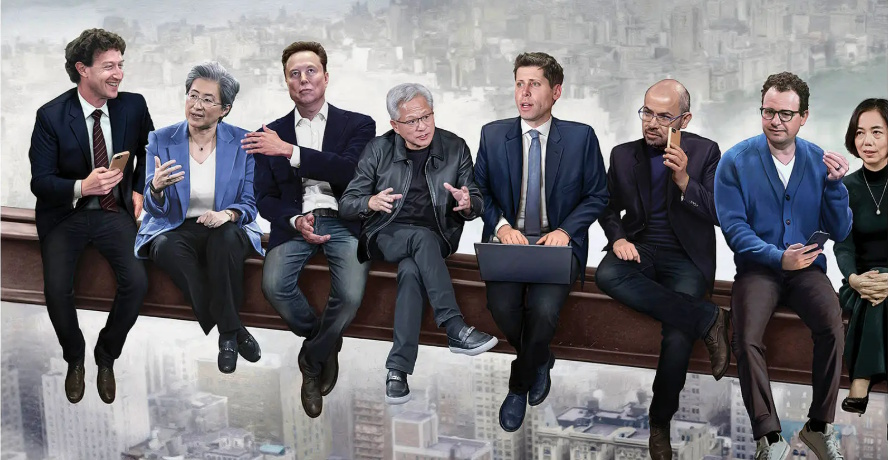
Lunch atop a Skyscraper is a black-and-white photograph taken on September 20, 1932, of eleven ironworkers sitting on a steel beam of the RCA Building, 850 feet above the ground during the construction of Rockefeller Center in Manhattan, New York City. It was a staged photograph arranged as a publicity stunt, part of a campaign promoting the skyscraper. Ken Johnston, manager of the historic collections of Corbis, called the image "a piece of American history". TIME Magazine replaced the workers with the AI Architects for the Person of the Year photoshoot, possibly created using Nano Banana.
 Mark
Zuckerberg
Mark
Zuckerberg
When Chinese rivals displaced Meta as the industry leader of open-weight AI, and Meta's own Llama 4 failed to regain lost ground, Mark Zuckerberg reached for his checkbook. It started with a $14.3 billion deal to poach 28-year-old Scale AI co-founder Alexandr Wang and a handful of his top engineers - a move critics saw as a last-ditch effort to catch up. But that was only the beginning of Zuckerberg's multibillion-dollar talent spree.
The company reportedly wooed at least 50 researchers, many from rivals, before freezing hires in August. Those include investor and entrepreneur Nat Friedman, Safe Superintelligence CEO Daniel Gross, OpenAI researcher Shengjia Zhao, and three members of the Google DeepMind team whose AI achieved gold medal performance at the prestigious International Mathematical Olympiad. Yet Zuckerberg has claimed the spending on talent is "quite small" compared with the fortune Meta is pouring into the raw computing power it believes is necessary to achieve superintelligence. "If you're going to be spending hundreds of billions of dollars on compute," Zuckerberg told The Information in July, "it really makes sense to compete super hard and do whatever it takes to get the 50 or 70, or whatever it is, top researchers." Zuckerberg's strategy rests on the three pillars of modern AI development: vast reserves of data, massive computing power, and brilliant researchers to drive algorithmic progress. Meta has the first in spades - an ocean of data from its social media empire that it is already leveraging to train its AI models. Zuckerberg's latest investments are an attempt to secure the other two. His goal is the creation of "personal superintelligence," which users can interact with through Meta's smart glasses that can "see what we see, hear what we hear, and interact with us throughout the day." While Meta has been a flagbearer for open-weight AI - the practice of freely releasing model parameters so others can download and run them on their own machines - Zuckerberg has acknowledged that "novel safety concerns" posed by superintelligence mean the company must be "careful about what we choose to open source."
Source: TIME Magazine
 Lisa
Su
Lisa
Su
Lisa Tzwu-Fang Su is an American business executive, computer scientist, and electrical engineer who is the president, chair, and chief executive officer (CEO) of Advanced Micro Devices (AMD).
Su was born in Taiwan and moved to the United States as a child. After earning three degrees from the Massachusetts Institute of Technology (MIT), she worked at Texas Instruments, IBM, and Freescale Semiconductor in engineering and management positions. She is known for her work developing silicon-on-insulator semiconductor manufacturing technologies and more efficient semiconductor chips during her time as vice president of IBM's Semiconductor Research and Development Center. Su is also a member of The Business Council.
Su was appointed president and CEO of AMD in October 2014, after joining the company in 2012 and holding roles such as senior vice president of AMD's global business units and chief operating officer. She previously was on the board of Cisco Systems and is currently on the board of the U.S. Semiconductor Industry Association, in addition to being a fellow of the Institute of Electrical and Electronics Engineers (IEEE).
Recognized with a number of awards and accolades, Su was named Executive of the Year by EE Times in 2014, one of the World's Greatest Leaders in 2017 by Fortune and was the first woman to be named Time magazine CEO of the year in 2014, and a second time in 2024. She also became the first woman to receive the IEEE Robert Noyce Medal in 2021. During her tenure as CEO of AMD, the market capitalization of AMD has grown from roughly $3 billion to more than $200 billion. AMD also overtook Intel in market capitalization for the first time. In 2024, Su was selected the Fellow of Industrial Technology Research Institute (ITRI). She was named the tenth most powerful woman in the world for 2025 by Forbes. She was named as one of the "Architects of AI" for Time's Person of the Year in 2025.
Source: WikiPedia
 Elon
Musk
Elon
Musk
It's been a big year for Elon Musk, even by Musk standards. In 2024, his company xAI transformed an abandoned Electrolux factory in Memphis into "Colossus," the world's largest supercomputer in 122 days - then quickly doubled the number of Nvidia graphics processing units inside to 200,000. In February, xAI released Grok 3, soon followed by Grok 4 in July, which it called the smartest AI in the world.
"With respect to academic questions, Grok 4 is better than PhD level in every subject, no exceptions," Musk said at its launch. Whereas previous versions of Grok lagged slightly behind state-of-the-art models, Grok 4 bested rival chatbots on several industry benchmarks, including scoring 88.4% on a Graduate-Level Google-Proof Q&A (GPQA), a collection of graduate-level science questions on which PhD students typically average 65%. Though benchmarks can be imperfect measures of real-world performance. "At times, it may lack common sense, and it has not yet invented new technologies or discovered new physics, but that is just a matter of time," Musk added.
Musk founded xAI in 2023 to offer an alternative to OpenAI, an organization he helped found in 2015, but whose ChatGPT he has called "woke." Joining the AI race later than its rivals, xAI has spent aggressively to compete, raising $10 billion in July in debt and equity, which included a reported $2 billion from Musk's SpaceX. The Financial Times reported later that month that xAI is seeking to raise more in a deal that could value the firm at up to $200 billion. Musk has denied that he is fundraising.
That pace of process, and Grok's integration into Musk's social platform, X, has helped the chatbot amass at least 35.1 million monthly active users, though this lags behind ChatGPT's 700 million per week and Google Gemini's 450 million per month. Soon after Grok 4's release, the company also announced a near-$200 million contract with the U.S. Department of Defense to develop tech tools for America's military.
But xAI's rapid rise has also raised concerns - including over pollution from the Colossus data centers' temporary gas turbines, and Musk's effort to make Grok "maximally truth-seeking." (The company did not respond to a request for comment.) Shortly before Grok 4 launched, a minor update to an earlier version of the model led the chatbot to make highly inflammatory statements: it praised Adolf Hitler as a "decisive leader" and began creating graphic rape narratives. The company apologized, temporarily suspending Grok's functionality on X, and deactivated the update.
Source: TIME Magazine
 Jensen
Huang
Jensen
Huang
Most CEOs dream of creating a product everyone wants. For Jensen Huang of Nvidia, achieving just that has become a geopolitical challenge. The insatiable demand for Nvidia's AI chips has not only created the world's first company to cross a $4 trillion valuation, but has also thrust the company into the uncomfortable epicenter of an American strategy to contain China's technological ambitions.
Huang used to sidestep playing politics, once even declining an invitation to dine with then-President Joe Biden. But since Donald Trump's return to office, the Nvidia chief has taken lobbying efforts into his own hands, making at least three trips to China and attending several meetings with President Trump this year.
Those efforts appear to be paying off. In May, Huang stood beside OpenAI CEO Sam Altman and a band of Emirati officials to announce Stargate UAE. Part of the largest AI infrastructure project outside of the U.S., it will use Nvidia's latest AI chips. The announcement came on the heels of Trump's decision to scrap certain Biden-era chip export restrictions aimed at stopping AI chips from being funneled to China via the UAE and other countries - a tangible victory for Huang's techno-diplomacy.
But the chief executive's biggest win came on July 14. After the Trump administration banned sales of Nvidia's H20 chip, developed specifically for the Chinese market, in April - a measure that Nvidia projects cost $2.5 billion in the first quarter alone - the company was allowed to resume exports. In return, Nvidia will pay 15% of those sales to the U.S. government.
Source: TIME Magazine
 Sam
Altman
Sam
Altman
The most powerful man in AI is not a decorated programmer. He does not have an undergraduate degree, let alone the computer science PhD that's increasingly becoming table stakes in his field. But what Sam Altman lacks in academic credentials, he makes up for in his dealmaking prowess, political acuity, and charisma. And then some. Because the challenges faced by OpenAI in the year 2025 are not just about how to write the right code. They require a leader who can navigate the shifting tides of Donald Trump's Washington, hobnob with world leaders, manage the construction of enormous data centers, and fend off internal threats to his own authority - all while presiding over a calendar of product releases befitting a tech company ten times OpenAI's size. That Altman has succeeded at all of these tasks has made him more powerful as CEO now than he has ever been in OpenAI's history.
In January, hushed whispers in the AI world questioned whether Trump's alliance with Elon Musk - who co-founded OpenAI but is in an ongoing feud with Altman - would result in the OpenAI CEO being frozen out. But Altman maneuvered around Musk, and two days into Trump's second term, it was he who appeared alongside the commander in chief in the White House as the President announced a $500 billion data center project, which would greatly benefit OpenAI. Trump's AI strategy, announced in July, contains many provisions that OpenAI had previously advocated for. Today Altman - a former Democrat who once was vocal in his opposition to Trump - is widely considered to enjoy a close and fruitful relationship with the president. The same may no longer be said for Musk.
Altman has been equally busy abroad. In May he traveled with the presidential entourage to Saudi Arabia, where he met with Crown Prince Mohamed bin Salman. (OpenAI has since discussed raising funds from Saudi Arabia's near-trillion-dollar sovereign wealth fund, The Information reported. OpenAI did not respond to a request for comment.) He has also spent time this year in the UAE, where OpenAI announced plans to build more massive data centers - confounding some U.S. national security experts, who have warned of the risks that such a deal could pose to national security.
Meanwhile, Altman has been attempting to restructure OpenAI so that it more resembles a traditional company. The controversial project would unlock billions in funding, but critics fear it could erode some of the power of its non-profit entity, which was set up to prevent powerful AI from being exposed to the perverse incentives of the market. As part of the conversion, OpenAI is seeking to change its complicated profit-sharing arrangement - whereby successive investors can only receive profits below a cap - and replace it with a standard setup, in which each investor is entitled to their respective slice of the OpenAI pie. A sticking point in those ongoing negotiations is how the existing profit caps should translate into new OpenAI equity - especially the amount that should go to Microsoft, an early investor that must sign off on OpenAI's restructure before it can happen. Without a deal by the end of the year, OpenAI stands to lose out on $20 billion in commitments from SoftBank - money that the loss-making company will likely need to fund the running of ChatGPT and the training of future AI models.
All the while, Altman has been overseeing OpenAI's conveyor belt of new research. In early August, the long-awaited GPT-5 launched, which Altman compared interacting with to talking to a "Ph.D.-level expert." Altman, who has cultivated a reputation for hyping up his new releases, said on a podcast in July that he had been testing GPT-5 by giving it a question from his email inbox to which he didn't know the answer. The model, he claimed, answered perfectly. "I felt useless relative to the AI," he said.
Source: TIME Magazine
 Dennis
Hassibis
Dennis
Hassibis
Sir Demis Hassabis is a British artificial intelligence (AI) researcher and entrepreneur. He is the chief executive officer and co-founder of Google DeepMind and Isomorphic Labs, and a UK Government AI Adviser. In 2024, Hassabis and John M. Jumper were jointly awarded the Nobel Prize in Chemistry for their AI research contributions for protein structure prediction.
Hassabis is a Fellow of the Royal Society and has won awards for his research efforts, including the Breakthrough Prize, the Canada Gairdner International Award and the Lasker Award. He was appointed a CBE in 2017, and knighted in 2024 for his work on AI. He was also listed among the Time 100 most influential people in the world in 2017 and 2025, and was one of the "Architects of AI" collectively chosen as Time's 2025 Person of the Year.
Source: WikiPedia
 Dario
Amodei
Dario
Amodei
Dario Amodei went out on a limb in June. At a time when most top AI companies were remaining conspicuously silent about a proposal in front of Congress to block states from regulating AI for 10 years, Amodei penned an op-ed in the New York Times that argued against the policy. "A 10-year moratorium is far too blunt an instrument," he wrote. "Without a clear plan for a federal response, a moratorium would give us the worst of both worlds - no ability for states to act, and no national policy as a backstop." Senators eventually rejected the moratorium 99 to one.
Amodei is the CEO of Anthropic, one of the leading rivals to OpenAI. The company has staked out a reputation as the responsible little brother in the AI race - arguing in support of regulation and safety methods, even as it races to train and deploy ever-larger AI systems. Its chatbot, Claude, is beloved by many in AI and beyond for its coding prowess and creative bent. Anthropic's annualized revenue has reportedly quadrupled in the first half of the year to $4 billion off the back of that success.
Meanwhile, Amodei has settled into something of a more vocal public role. AI, he warned in May, could lead to mass job eliminations in the next one to five years, wiping out half of all U.S. entry-level white-collar jobs and shooting unemployment levels up to 20%. "Most [lawmakers] are unaware that this is about to happen," Amodei said at the time. "It sounds crazy, and people just don't believe it."
Source: TIME Magazine
 Fei-Fei
Lee
Fei-Fei
Lee
Known as the "Godmother of AI," Fei-Fei Li played a foundational role in the creation of AI image-recognition systems during the '00s, which helped spur the deep learning revolution. Today Li is the co-director of the Stanford Institute for Human-Centered AI, a leading research institution. From that perch, the computer scientist has helped shape global AI governance - beginning with California, the world's tech capital.
After Governor Gavin Newsom vetoed the state's AI safety bill, SB 1047, he tapped Li to co-author a report about AI policy. Published in June, the report put forward research-informed recommendations for the governance of generative AI, including new guardrails that would require more transparency in AI development, rigorous standards for independent oversight, and protections for whistleblowers connected to the tech. The proposals could soon make their way into law: State Senator Scott Wiener praised the paper, and said in a statement that he was considering which parts of it to incorporate into his new AI legislation.
In September 2024, Li and three colleagues raised $230 million for World Labs, from investors including Geoffrey Hinton. The startup she leads aims to create Large World Models that perceive and analyze the 3D world in the same way that large language models like ChatGPT understand language. These models, the group hopes, will allow people to imagine and create 3D spaces that could be roamed and explored like a video game - with potential applications like flight training simulations, physics experiments, or urban planning.
In the last year, Li has also delivered key speeches at the Paris AI Action Summit and Asia Tech x Singapore; published landmark reports evaluating AI's influence on society; and warned publicly that federal cuts to university research would harm the U.S. tech ecosystem. In February, she won the 2025 Queen Elizabeth Prize for Engineering.
Source: TIME Magazine
Youthful images courtesy of Nano Banana
 Links
Links
TIME Magazine's Person of the Year for 2025