 Schools & Homework
The Drama When AI Enters the Classroom
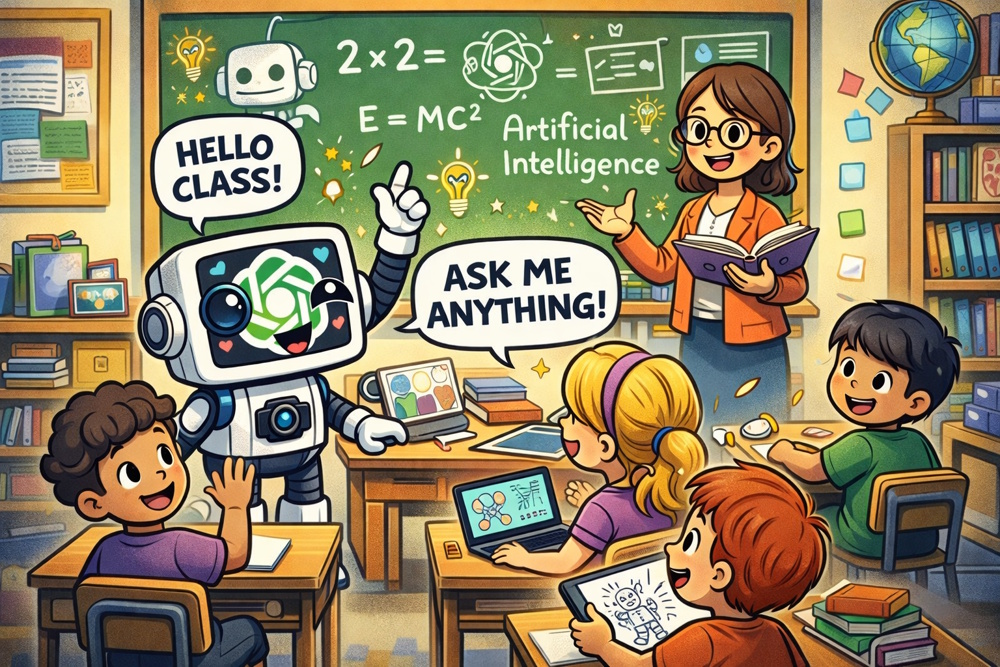
An Excerpt from Our House Has a Brain
AI in schools plays out like a campus comedy where every gadget, app, and chatbot has a personality, an attitude, and a talent for causing just enough chaos to keep teachers awake at night. It’s like a sitcom where the robots are trying their best, while the humans are trying to keep up.
The Over-Eager AI Student
AI shows up at school like the kid who read the entire textbook before the first bell rang. It raises its digital hand for every question, blurting out answers even when no one asked. Teachers try to ignore it, but it keeps whispering to students: “Psst… the mitochondria is the powerhouse of the cell. Also, here’s a 12-page explanation you didn’t ask for and likely won’t understand.” Students love it because it’s basically a cheat code for homework. They don’t call it ChatGPT, they call it “cheat GPT.” Teachers tolerate it because it never asks to go to the bathroom.
Homework’s Midlife Crisis
Homework used to be confident. It had purpose and a swagger. Now it’s panicking. “Wait, did you write this essay, or did your AI sidekick do it while you were microwaving frozen burritos?”
- Essays start sounding suspiciously polished
- Book reports suddenly include phrases like “in a broader sociocultural context”
- Math homework comes back with steps so perfect they look like they were written by Albert Einstein
Homework is in therapy now.
Teachers Become Detectives
Teachers used to grade papers. Now they investigate them. They look for clues:
- Too perfect grammar: “No eighth grader uses semicolons voluntarily”
- Suspiciously advanced metaphors: “Why is this poem about photosynthesis referencing existential dread?”
- AI confession lines: “As an AI large-language model…” is the ultimate giveaway
Some teachers fight back with assignments that AI can’t handle: “Write about the weirdest thing that happened in your family this week.” AI freezes while students get it, and balance is restored.
The Classroom Comedy
AI tries to help teachers, but it’s like a well-meaning intern who keeps overdoing things.
- The teacher says, “Explain fractions,” and AI responds with a 14-page dissertation on decimals
- The teacher asks for a quiz, and AI generates 200 questions, three of which involve llamas for no apparent reason
- The teacher tries to take attendance, and AI suggests a blockchain-based identity system because it’s more secure
The class just wants recess.
Students With Superpowers
Students now walk around with AI-boosted confidence. They ask AI to brainstorm ideas, check their work, explain confusing topics, and occasionally write a sonnet about volcanoes.
But they also learn something important: AI can help them think, but it can’t replace their thinking. It’s like having a super-smart friend who’s terrible at understanding your teacher’s sense of humor.
The Final Bell
AI in schools isn’t the villain or the hero—it’s the chaotic new character who barges into the plot, shakes everything up, and forces everyone to grow. Assignments evolve, homework adapts, teachers innovate, and students get smarter.
And somewhere in the corner, AI is still raising its hand, saying, “I can help with that!” while the teacher sighs and says, “Please, not during the test.”
 AI
Detection Tools
AI
Detection Tools
Here’s a practical explanation of AI detection tools: what they are, how they work, their real-world accuracy, and their strengths and limitations.
AI detectors are software systems designed to answer one question: “Was this text written (mostly) by a human or (mostly) by a large language model?” They do not prove authorship with 100% certainty.
They give a probability score (e.g. “87% likely AI-generated”) based on statistical patterns.
There are a number of techniques used by modern detectors. The most accurate technique is watermark detection – like a secret robot tatoo – which only works if the model actually watermarks.
- On long, unedited AI text up to early 2025 models, the best detectors reach 80–93% accuracy.
- On short text of less than 200 words, the accuracy often drops to 50–70% — basically a coin-toss.
- On heavily human-edited AI text where a student rewrites 30–50% of the output, most detectors fall to 30–60% accuracy. Many now label this as “mixed” or “inconclusive.”
- On newer models, the detection rate has dropped 15–35% compared to earlier models. The better the model gets at imitating humans, the harder it is to catch. And models are improving rapidly.
Funny fails, tricks, and controversies
The Turnitin detector once falsely accused thousands of students. Early versions flagged innocent student essays as 80–100% AI because they used common phrases or had low perplexity (clear, well-structured writing), forcing schools to backtrack on failing grades. As a result, Turnitin adjusted their thresholds and added disclaimers.
The “I wrote this in 30 seconds” test: Many teachers now paste their own handwritten essays from years ago into detectors and surprisingly finds it gets flagged as 60–90% AI. This is because human academic writing is very polished and predictable.
The “AI detector detects AI detector” loop: Clever students run detector output through another AI to “humanize” it. The second AI rewrites it, so now the detector thinks the rewritten detector report is human.
The “My dog wrote this” meme: People paste dog barks or baby babble or keyboard mashing into detectors. Some outputs get flagged as “human-written” because they are chaotic and choppy, like we are prone to do when we write, whether we bark or babble or not.
Current state of the art
Detectors are rapidly losing ground: Every time a new frontier model comes out, detection accuracy drops 10–30% within weeks.
Humanizing software tools are winning: Apps like Undetectable.ai, StealthGPT, HIX Bypass, and WriteHuman rewrite AI text to lower perplexity. Many now fool detectors more than 80% of the time.
The most honest answer schools give students today is this: “We use AI detection as one signal among many. If it flags AI at 80% or higher and the writing style doesn’t match your previous work, then we’ll have a conversation. Otherwise, we assume you wrote it.”
AI detectors are useful signals, not court-level evidence. They catch lazy copy-paste jobs pretty well, but they struggle with edited text, new models, short text, and clever students who know the rules and how to rewrite.
The process is ongoing with models getting better and better at sounding human; humanizing tools get better at hiding AI fingerprints; detectors get better at catching both; and teachers mostly just want to read something that feels like it came from a real teenager, not an AI.
So if you’re a student: Write your own stuff. Use AI to brainstorm or polish, not to ghostwrite. And if you do use AI, rewrite it until it sounds like you wrote it. That’s the only way to beat the detectors, and to actually learn something in the process.
If you’re a teacher: Use detectors as a flag, not a verdict. Talk to the student. Most kids aren’t trying to cheat — they’re just overwhelmed (or lazy) and looking for shortcuts. Meet them with curiosity instead of accusation. And try to give assignments where students are not likely to cheat!
 Links
Links
AI in Schools page
AI in America chapter on Schools has a deeper dive into education and AI.
Our House Has a Brain book on Amazon has a section on Schools and Homework.
External links open in a new tab:
Guide to Evaluating AI-Generated Content