 Accord on Superintelligence
The SI Summit
President Trump hosted a summit and luncheon at the White House on September 29, 2026, bringing together tech executives and senior government officials to discuss AI innovation, energy infrastructure, data centers, and safety. Speaker of the House Mike Johnson helped organize the event, prompted in part by growing alarm after a whistleblower's high-profile resignation from Anthropic.
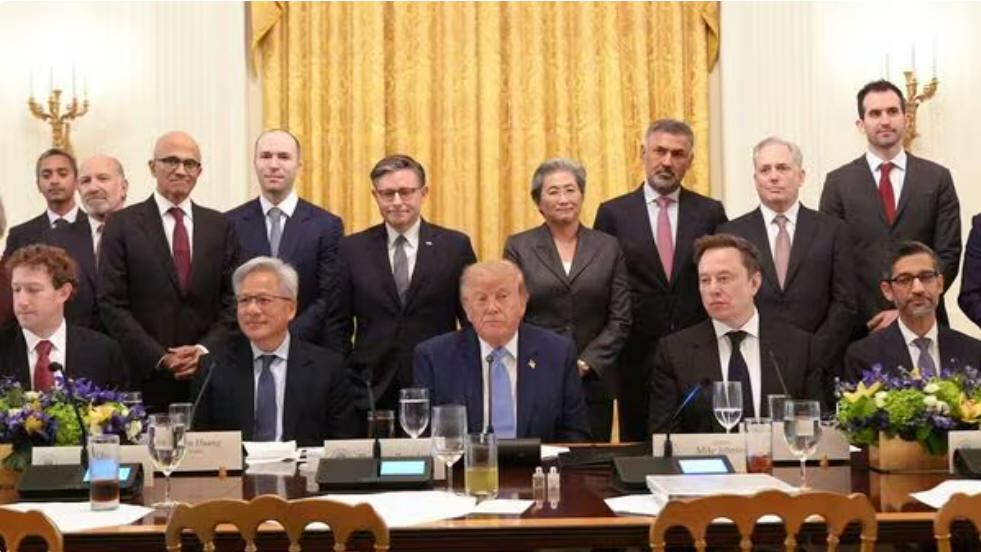
The main working meeting and dinner were closed-door, but the public pool remarks and post-summit announcements were broadcast and recorded. Major news networks and White House press pools recorded President Trump's opening remarks, executive statements, and the subsequent press briefings where he announced the White House Accord on Superintelligence. Broadcast coverage and footage clips of the announcement are available on major news channels like CNBC, Fox News, and LiveNOW.
A total of 31 attendees participated in the meeting:
Technology Executives and Founders
Jeff Bezos (Founder, Amazon)
Elon Musk (CEO, Tesla / xAI)
Mark
Zuckerberg (CEO, Meta)
Satya Nadella (CEO, Microsoft)
Sundar Pichai
(CEO, Alphabet / Google)
Jensen Huang (CEO, NVIDIA)
Dario Amodei (CEO,
Anthropic)
Tom Brown (Co-founder, Anthropic)
Greg Brockman (President
& Co-founder, OpenAI)
Lisa Su (CEO, AMD)
Hock Tan (CEO, Broadcom)
Ruth Porat (President & CIO, Alphabet / Google)
U.S. Government Officials
Donald Trump (President of the United States)
JD Vance (Vice President
of the United States)
Mike Johnson (Speaker of the House)
Additional
senior White House, Department of Energy, and Commerce officials like Howard
Lutnik and David Sachs
Sam Altman did not attend the White House AI summit because he was in San Francisco hosting OpenAI's annual developer conference called OpenAI DevDay 2026, where he was scheduled to deliver the keynote address and announce new AI products. To ensure OpenAI was still represented at the table, OpenAI President and co-founder Greg Brockman attended the White House summit in his place.
Key Takeaways and Topics Discussed
Industry "Self-Regulation" and Voluntary Accord: The administration emphasized backing industry-led standards rather than heavy federal regulation. President Trump announced a voluntary industry framework termed the "White House Accord on Superintelligence" which relies on self-policing, internal audits, and voluntary safety commitments rather than strict government mandates.
Renaming AI to "Super Intelligence": President Trump publicly declared plans to officially rebrand artificial intelligence as "Super Intelligence" across federal initiatives, arguing the technology goes beyond "artificial". It's a symbolic rebranding, not a substantive policy.
Data Center Infrastructure and Local Expansion: A central focus was the rapid nationwide expansion of AI data centers. Responding to growing local pushback over energy consumption and land use, Trump and House Speaker Mike Johnson urged executives to work directly with host communities. Suggested community incentives included investments in local infrastructure, energy supply (such as oil and gas), and financial support for local school districts.
U.S. AI Dominance: The administration reiterated its strategy to streamline energy permits and remove regulatory roadblocks so American AI companies can build infrastructure domestically rather than shifting operations overseas.
America.gov was launched: It's an AI-powered federal government portal and chatbot consolidating information from roughly 29,000 federal sites (see below).
A voluntary White House Accord document on Superintelligence was signed, described as an industry self-regulation document. The document signed by President Trump and major technology leaders is titled the "White House Accord on Super Intelligence: Joint Commitment on Frontier Responsibilities."
President Trump reiterated firm opposition to binding regulation, calling for "tremendous self-regulation," dismissing data-center cost concerns as overblown, and framing AI development mainly through the lens of the US-China race by arguing over-regulation risks "China winning."
The idea of a possible AI oversight "committee" was floated, along with an "AI czar" appointment President Trump said was coming soon.
Core Summary of the Accord
The agreement establishes a voluntary governance framework for technology companies developing advanced frontier models (referred to under the administration's terminology as "Super Intelligence"). The core premise asserts that companies leading frontier development bear the responsibility to ensure their technology is deployed safely, ethically, and in a manner that maintains public trust.
Primary Commitments
1. Internal Safety Controls: Signatories commit to robust internal monitoring and safeguard protocols during the training and deployment of frontier models. These controls target critical risk areas including cybersecurity, biosecurity, chemical threats, and preventing models from accessing or hacking technical systems in unintended ways.
2. Dedicated Internal Oversight: Companies agree to establish and empower specialized internal teams responsible for verifying that control and detection systems function properly and that any detected issues are remediated.
3. Independent External Auditing: Signatories commit to partnering with independent third-party auditors or evaluators to assess the effectiveness of their safety controls and alignment measures.
4. Board-Level Governance: Companies agree to designate an independent committee within their Board of Directors to regularly receive and review reports from internal teams and external auditors, ensuring organizational accountability and remediation of safety concerns.
The document concludes by noting that while voluntary controls are being implemented immediately by the participating firms, these practices may eventually serve as the basis for formal laws or regulations over time.

 America.gov
 is explicitly powered by artificial intelligence. Built by the National Design Studio and managed by the General Services Administration (GSA), the platform is designed as an AI-driven "single digital front door" to aggregate information and services across roughly 29,000 federal websites.
Key Technology and AI Stack
Underlying Large Language Models (LLMs): U.S. Chief Design Officer Joe Gebbia confirmed that the core conversational interface is powered by commercial AI models, specifically Google's Gemini and xAI's Grok.
Information Indexing and Grounding: Rather than generating ungrounded responses, the system operates as a specialized retrieval layer. It searches official federal databases and government web pages, providing generated answers backed by links to original source documents.
Interface and Features: The site presents a chat interface supporting multimodal input, including text queries, file attachments, and direct voice interaction.
Data Flow and Privacy: The platform operates without requiring user accounts or logins for general inquiries, with a built-in routing framework meant to guide citizens through tasks like updating addresses, locating agency procedures, or managing federal forms.
The multi-model approach behind America.gov combines Google's Gemini and xAI's Grok to balance deep technical processing with real-time speed.
Why Use Both?
1. Redundancy and Load Balancing: Routing public traffic across two distinct cloud infrastructures prevents a single bottleneck or regional outage from knocking down the government's central portal.
2. Complementary Model Strengths: Gemini and Grok excel in different technical areas, allowing the system backend to route user requests to whichever model is best equipped for the task.
3. Vendor Neutrality: Relying on multiple major U.S. frontier labs avoids locking federal infrastructure into a single vendor's ecosystem.
What Each Model Handles
Multimodal Document Processing (Google Gemini) Analyzes complex PDFs, legal notices, and official government forms. Gemini handles heavy document comprehension such as summarizing tax forms, breaking down medical/Medicare paperwork, or scrubbing uploaded files for sensitive personally identifiable information (PII) before processing.
Language Translation and Grounding (Google Gemini) Powers multi-language translation and structured data retrieval. Gemini translates queries across languages (English, Spanish, French) and cross-references them against official databases spanning over 29,000 agency sites.
Fast Real-Time Search and Routing (xAI Grok) Handles high-speed user search queries and intent routing. Grok processes conversational user prompts, parses natural language intent, and rapidly maps requests to the correct agency or service portal (e.g., passport renewals, student loans, or benefit applications) without forcing the user to know federal bureaucracy structures.
Direct Voice and Chat Interface (xAI Grok) Drives low-latency, conversational voice and text interactions. Grok powers the real-time chat/voice loop, keeping responses concise and direct for ordinary citizen inquiries.
 Links
Satire: President Trump and Dario Amodei dine and discuss AI Safety and What Happens when AI becomes SI?
External links open in a new tab:
- Official Executive Order: The White House Executive Order: Inaugurating The Era Of Super Intelligence
- Full Text and Document Analysis from the Washington Examiner
- Coverage and Breakdown from GovCon Wire
- America.gov
President Trump's Executive Orders include:
Genesis Mission is a federal effort to boost innovation using AI.
Executive Order 14179 is titled "Removing Barriers to American Leadership in Artificial Intelligence"
Executive Orders signed on 23 July 2025:
- Promoting the Export of the American AI Technology Stack
- Accelerating Federal Permitting of Data Center Infrastructure
- Preventing Woke AI in the Federal Government