 Coding
The Language of the Machine Age
If AI is the engine of the 21st century, coding is the literacy that makes the engine run. Long before America embarked on its quest for artificial intelligence supremacy, it built another revolution, one line of logic at a time. From the first punch-card programs of the 1940s to the deep-learning frameworks of today, coding has remained the craft that bridges human intention and machine execution. It is both art and engineering, intuition and structure, creativity wrapped in syntax.
Coding is not just a technical skill. It is the foundation of digital civilization. Every chatbot response, every autonomous car maneuver, every quantum simulation, every smart device request; all of it is the product of coding. In a century defined by AI, coding is no longer merely a career; it is a cultural force shaping how people learn, work, communicate, and compete.
This chapter explores the evolution of coding, its shifting role in the age of AI, and why it remains the bedrock of American technological power, even as AI systems begin to write code themselves.
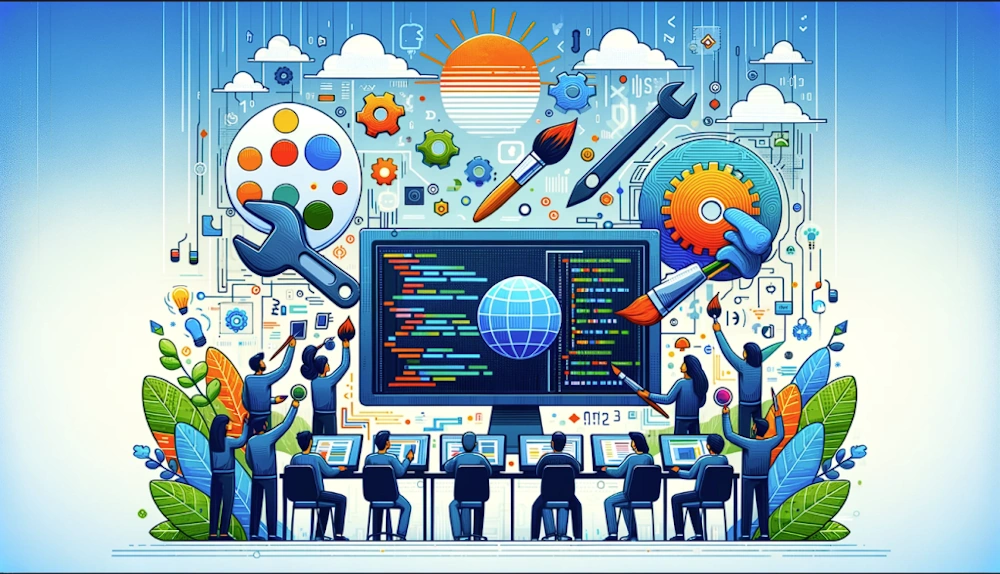
The Origins of Coding: A Human Conversation With Machines
In the beginning, coding was physical. Early programmers fed information into machines using switches, wires, and punched cards. The work required meticulous planning: one mistake meant hours of debugging by hand. The first coders were often mathematicians, engineers, or, in the case of the ENIAC computer, brilliant women like Jean Bartik and Betty Holberton, who programmed the world's first electronic general-purpose computer without the luxury of modern languages. Another famous early programmer was Grace Hopper, a pioneering computer scientist, mathematician, educator, and US Navy Rear Admiral renowned for her contributions to computer programming.
Then, in the 1950s and 1960s, America saw the emergence of something new: high-level programming languages that allowed humans to speak to machines more naturally. FORTRAN, COBOL, Lisp, and BASIC transformed the field. Suddenly, coding became abstract, expressive, and scalable. Early programming languages were often acronyms, the shorthand of computing, like FORmula TRANslation became FORTRAN, and COBOL stood for COmmon Business Oriented Language.
These languages laid the groundwork for everything we now call AI. Lisp, the brainchild of John McCarthy, would become the lingua franca of early artificial intelligence research, while FORTRAN powered scientific computing that gave rise to neural network simulations decades later. Coding was no longer wiring; it was writing.
Before artificial intelligence, before personal computers, before the internet, there was a deeper and more fundamental breakthrough: humans learned how to speak to machines. Coding, today seen as a technical skill, began as something far stranger and more profound. It was the birth of a dialogue between human thought and mechanical logic. It was, quite literally, the first conversation between people and the machines that would eventually reshape humanity.
The origins of coding are not just a story of mathematics or engineering. They are a story of translation, of imagination, of trial and error. Coding emerged because humans needed a way to turn ideas into actions, and machines needed a way to interpret those ideas. What followed was the invention of a new kind of language, one that bridged biology and hardware, intuition and precision.
This chapter explores the dawn of programming: the people, technologies, concepts, and moments that transformed early computers from inert hardware into responsive partners in a new form of communication.
Before Machines Existed: Ada Lovelace's Vision
The story of coding begins long before digital computers were even possible. In the 1840s, working alongside Charles Babbage, Ada Lovelace did something extraordinary. Dubbed the world's first programmer, she imagined a machine whose operations could be described step-by-step, and she designed instructions for how that machine might compute Bernoulli numbers. Her work on the Analytical Engine is now recognized as the world's first computer program.
Lovelace understood something radical for her time: that programming was not just mathematics but "symbolic reasoning". Machines could manipulate symbols just like numbers. This insight would become the philosophical foundation for modern coding and, eventually, for artificial intelligence. She wrote that the Analytical Engine "weaves algebraic patterns" the way a loom weaves textiles. This metaphor, computation as creation, still resonates in the code we write today.
From War Rooms to Workrooms: The First Programmers
Coding as we know it began during World War II. Computing machines like the British Colossus and the American ENIAC were built to calculate ballistic trajectories and decrypt enemy messages. These early computers had no keyboards, no screens, and certainly no operating systems.
Programming them meant manually manipulating machinery. The tasks included plugging cables into giant switchboards, setting dials on control panels, and configuring electrical pathways through vacuum tubes.
The work was meticulous and often performed by teams of women whose contributions remained uncredited for decades. Among them were Jean Bartik, Kay McNulty, Ruth Teitelbaum, and others, pioneers whose legacy is only now receiving full recognition.
These programmers invented debugging, subroutines, and structured logic, not because theory demanded it, but because the machines did. They were the first to experience the reality of coding as a negotiation between human thought and machine constraints.
The Birth of Stored Programs: Teaching Machines to Remember
The major conceptual leap happened in the late 1940s and early 1950s with the stored-program architecture, proposed by John von Neumann and others. Instead of controlling a computer by rewiring it, instructions could now be stored in memory as data. This allowed computers to modify their own instructions and opened the door to loops, recursion, and dynamic logic.
In essence, machines learned to read and interpret their own instructions. For the first time, coding became reproducible, modifiable, scalable, and portable. This shift is what truly made programming a language rather than a configuration task.
The First Programming Languages: Abstraction Arrives
Early programming was done in machine code which were long, cryptic sequences of ones and zeros or assembly language, which introduced mnemonics like 'MOV', 'ADD', and 'JMP'. But as computers spread beyond military laboratories, programmers needed a way to write more quickly and more expressively.
The 1950s and early 1960s saw the birth of high-level languages:
-
FORTRAN (1957): for scientific computation
-
COBOL (1959): for business and government
-
Lisp (1958): for artificial intelligence research
-
ALGOL (1958): the ancestor of modern programming syntax
-
BASIC (1964): the gateway language for millions of students
A high-level programming language allows people to communicate with computers. It consists of rules that convert string values into machine code or, for visual languages, graphical elements. Although unseen by most, programming languages power modern technology by giving instructions to computers and devices.
These languages brought human-like structure to code. Programmers could now use loops, functions, and variables, concepts that separated logic from machinery. Coding became accessible to more than just electrical engineers and mathematicians. Each new language expanded the range of ideas that machines could express.
Despite revolutionary development, many old programming languages remain relevant today. Fortran is used by approximately 60% of high-performance computing applications, especially where accurate simulations are required by the scientific and engineering field at a faster computational time. The developers continue to incorporate these older languages into their projects today, due to the stability and problem-solving abilities of these languages.
Coding as Communication: The Human-Machine Dialogue
As coding evolved, it became clear that programming wasn't a technical chore. It was a form of communication, a way for humans to express intent clearly enough that a machine could execute it without ambiguity. This sparked new disciplines:
-
compiler design, to translate human code into machine logic.
-
software engineering, to manage complexity.
-
human-computer interaction, to design interfaces that made coding easier.
-
formal methods, to mathematically verify programs.
Every advance deepened the relationship between human ideas and machine execution. Coding forced humans to think differently. It trained people to break problems into parts, to anticipate failure modes, to reason sequentially and abstractly. These skills shaped the intellectual culture of the emerging digital age.

Coding Becomes a Creative Act
By the 1970s and 1980s, coding had escaped the confines of academia, industry, and government. Personal computers like the IBM PC turned programming into a playground for experimentation. Young coders wrote games, graphics demos, early internet tools, text adventures, and entire operating systems.
The idea that code could be art began to emerge. Coders created digital poetry in the form of elegant algorithms, compact routines, and visual effects that pushed hardware beyond its limits. Coding had become expressive. It was no longer just instructing machines, it was crafting experiences.
This chapter examines how coding professionalized, how software engineering emerged as a discipline, and how programming became a lever of economic, military, and cultural influence, ultimately forming the backbone of American leadership in the global AI race.
The Foundations of AI Were Coded by Hand
Long before neural networks could train themselves, early AI researchers hand-coded intelligence. They built rule-based systems, symbolic logic engines, planning algorithms, and expert systems using languages like Lisp and Prolog.
These early systems were brittle, but they carried an essential insight: intelligence could be formalized, represented, and computed. Programming languages became the medium for testing theories of the mind. In many ways, AI was born out of coding before machine learning made it statistical.
The Legacy: Coding as Modern Literacy
By the time AI began to flourish in the 21st century, coding had become foundational. Every modern AI model rests on millions of lines of code. Every digital service, from airplanes to hospitals to stock markets, relies on programming.
Coding is no longer just a technical skill; it is a cultural force. It shapes how people solve problems and how societies operate. It defines the boundary between the analog past and the intelligent future. And yet, at its core, coding still resembles Ada Lovelace's original insight: the machine does not think for itself because it follows patterns of logic that humans design.
The First Language of the Machine Age
The origins of coding tell us something profound about AI and about ourselves. Programming began as an attempt to harness mathematical machines for practical tasks. But it became something far greater, for it has become a bridge between human intention and computational possibility.
Every algorithm, every interface, every AI system is part of the same story, a story of humans learning how to speak to their creations, and machines learning, in their own way, how to listen. Coding is the original interface between humanity and intelligence. And in the age of AI, our conversation with machines is only beginning.
Coding Becomes a Profession and a Power
By the 1970s and 1980s, coding matured from research curiosity to corporate necessity. The rise of personal computers created an industry hungry for software, and America responded with a generation of programmers who built operating systems, databases, and applications.
Microsoft was born from a few lines of BASIC. Apple's earliest graphical interfaces were crafted by a small team of visionary coders. Video games, enterprise tools, and early internet services sprang from the hands of programmers who saw computers as blank canvases. Coding was now a job, one of the most influential jobs in America, and one of the highest-paying.
By the 1990s, coding became the backbone of Silicon Valley culture. Programmers were celebrated, aggressively recruited, and given stock options that turned many into millionaires, some into billionaires. The open-source revolution democratized coding further, allowing anyone with a keyboard and curiosity to build world-changing software.
It was during this period that machine learning, still in its infancy, found new life. Better software meant better algorithms. Better algorithms meant better models. And better models would eventually spark the AI renaissance.
Coding began as an experiment; an improvised skill learned by mathematicians, engineers, and hobbyists who needed a way to coax early computers into usefulness. But by the late 20th and early 21st centuries, coding had transformed into something far more significant; a profession, an industry, and a source of geopolitical power. What started as a niche technical practice became one of the foundational capabilities of modern civilization. And nowhere did this transformation occur more dramatically than in the United States.
From Hobbyist Hackers to Professional Engineers
In the 1960s and 1970s, coding was messy, improvised, and largely undocumented. Programmers relied on spiral-bound manuals, punch-card stacks, handwritten flowcharts, and tribal knowledge passed from senior to junior in dimly lit machine rooms.
But as computers spread from laboratories to corporations, and eventually to homes, coding had to mature. The stakes were no longer academic experiments; they were payroll systems, airline reservations, banking networks, and national defense.
This maturation gave rise to software engineering, formalized project management, version control, quality assurance, structured programming, and documentation standards.
Programmers became software engineers; professionals with methodologies, expectations, responsibilities, and a seat at the table of industrial progress.
Silicon Valley and the Professionalization of Code
Nowhere embodied the shift from hobby to profession more vividly than Silicon Valley. What began as a collection of hardware companies evolved into a software-driven ecosystem, with coding at its core.
By the 1980s Apple's Macintosh popularized GUI-driven development. Microsoft's MS-DOS and later Windows transformed software distribution into an industry. Sun Microsystems, Oracle, and IBM formalized enterprise software. Startups emerged with software-first business models.
The Valley became a magnet for talent; not just engineers, but investors who realized that code was leverage. A few lines of elegant programming could create products that scaled to millions of users. Software, for the first time, demonstrated exponential returns.
This professional boom created new career paths, including front-end, back-end, and full-stack developers, database administrators, systems architects, DevOps engineers, cybersecurity experts, and machine learning engineers. Coding was no longer one job. It was an ecosystem.
The Credential Era: Degrees, Bootcamps, and Certifications
As coding gained prestige, a credentialing infrastructure emerged to define and regulate the profession. Universities established computer science departments. Companies hired entry-level developers through competitive internships. Certifications from Cisco to Microsoft to AWS became a parallel education industry.
By the 2010s, coding bootcamps democratized entry into the field, compressing years of training into months of project-based instruction. This opened pathways for new talent pools, including career switchers, first-generation students, veterans, and underrepresented groups. The message was clear: coding was not just for the "naturally technical." It was a professional, career path.
Software Eats the World: Coding Becomes Global Power
In 2011, Marc Andreessen famously wrote that "software is eating the world." He underestimated the extent of the feast. By the 2020s, every major industry had become a software industry:
-
Transportation (Tesla, Uber)
-
Retail (Amazon)
-
Media (Netflix, YouTube)
-
Finance (PayPal, Stripe)
-
Communication (Meta, Apple, Google)
-
Defense (Palantir, Anduril)
Education, healthcare, manufacturing; the list was endless. Coding became synonymous with productivity. Nations recognized that software was the new infrastructure, just as vital as highways, power plants, or satellites.
The United States, home to the world's largest concentration of programmers and software companies, gained enormous influence. U.S. software powered global communication, commerce, and knowledge-sharing. American Application Programming Interfaces (APIs) became the standard tools for the world's developers. The modern geopolitical landscape could be summarized in a single insight: those who control software, control the future.
The Rise of Big Tech: Coders as Kingmakers
As the MAG7 companies--Microsoft, Apple, Google, Amazon, Meta, NVIDIA, and Tesla--rose to dominance, coding became the engine of trillion-dollar enterprises. Engineers held remarkable internal power. Great programmers were recruited like athletes, rewarded like financiers, and courted like diplomats.
Inside big tech, coders influenced product strategy, revenue flows, privacy standards, advertising systems, global data governance, and even national policy through lobbying and technology exports.
An elite software engineer could influence the behavior of billions of people through a feature rollout or algorithmic change. Few professions in history had ever wielded such scale of impact. Coding had become power in the literal sense: the power to shape societies.
The AI Explosion: Software Engineers Become AI Engineers
The arrival of deep learning in the 2010s and 2020s elevated coding again. Engineers now needed to understand neural architectures, large-scale training, distributed GPUs, data pipelines, AI safety, prompt engineering, and model alignment.
Machine learning engineers became the new elite within the profession. They designed models that wrote code, passed exams, diagnosed diseases, composed music, and predicted markets.
Coding stopped being just the act of programming; it became the act of teaching machines how to think. This shifted the profession's identity entirely. Coders were no longer just tool-makers. They were intelligence-makers.
The Cultural Shift: From Backrooms to Boardrooms
By the mid-2020s, CEOs of major companies often came from engineering backgrounds. Policymakers consulted technologists on issues ranging from privacy to national defense. Schools introduced coding as a core subject. Entire political debates formed around algorithms, automation, and AI governance.
This cultural shift elevated the status of programmers. A once-obscure craft became a central pillar of modern power structures. Coders moved from the back rooms of companies to the front lines of corporate strategy, national security, startup innovation, political regulation, and global competition. The "profession" had become an institution.
Coding in the Age of AI: The Next Transformation
Ironically, as coding reached its apex of influence, AI began automating parts of it. Tools like GitHub Copilot, ChatGPT-based IDE assistants, and automated code synthesis systems now generate routine code faster than most junior engineers.
Yet this didn't diminish coding as a profession; instead, it elevated its role. Coders became developers, curators, editors, architects, verifiers, AI supervisors, and system designers. The human role shifted from writing instructions to shaping behavior. Coding became more conceptual, more strategic, more like leadership than labor. The profession continued to hold power, even as the act of coding evolved.
The Profession That Built the Modern World
Coding's rise from the handwritten routines of ENIAC to the billion-parameter models of the AI era is one of the most dramatic professional transformations in history. What began as an esoteric craft matured into a pillar of national strength, corporate dominance, and global influence.
Today, coding is not merely a skill; it is a force that shapes the economy, communication, culture, governance, warfare, and the future of intelligence itself. As long as machines remain central to human progress, those who understand how to instruct them, whether through traditional programming or AI-driven paradigms, will continue to wield extraordinary power.
And in America, perhaps more than anywhere else, that power has defined the modern age.
AI Changes Coding and Coders Change AI
How Automation, Human Creativity, and Machine Intelligence Are Transforming Each Other
Machine learning transformed programming from a deterministic craft into a probabilistic one. Classical programming told a computer what to do. Machine learning allowed a computer to discover what to do. This shift altered the very nature of coding. Instead of writing rules, coders built systems that learned rules. Instead of perfect logic, they managed massive datasets. Instead of sleek code, they engineered pipelines, distributed systems, and training loops.
New languages like Python rose to prominence because of their compatibility with AI frameworks such as TensorFlow, PyTorch, and Scikit-learn. Meanwhile, domain-specific languages for GPUs and specialized hardware emerged to support high-performance AI systems. Coders were no longer just writing code. They were shaping intelligence.
When artificial intelligence entered mainstream software development, it did not arrive quietly. It rewrote the rules. For decades, coding had been the exclusive domain of humans, painstakingly crafting instructions, debugging logic, and shaping digital systems one line at a time. Then, in the early 2020s, AI crossed a threshold. Instead of merely assisting developers, it began writing code itself. And in doing so, it forever changed what it means to be a coder.
At the same time, coders changed AI by designing the architectures, building the datasets, curating the behavior, and ultimately shaping the intelligence that now empowers the next generation of programmers. This feedback loop of AI transforming coding, and coders transforming AI is one of the defining relationships of the modern technological era.
The Day AI Started Writing Code
The arrival of AI-assisted coding tools like GitHub Copilot in 2021 and ChatGPT in 2022, marked a turning point in computing history. For the first time, machines participated in programming as creative partners rather than passive tools. Developers could describe functionality in natural language, and AI systems could convert those descriptions into working code. Sometimes the code was surprisingly elegant, sometimes astonishingly flawed, but almost always useful.
This shift transformed coding from a manual craft into a hybrid workflow where AI handled boilerplate, mundane logic, and repetitive patterns, while humans handled architecture, design tradeoffs, ethics, security, and high-level reasoning. The partnership boosted productivity, often by orders of magnitude.
Suddenly, coding looked less like keystrokes and more like strategic thinking. The skillset changed. The mindset changed. The entire profession changed.
The New Skills of the AI Era
AI did not eliminate the need for coders, but it did redefine what good coders must know. In the pre-AI era, mastery was measured largely by syntax and technical memorization. The best coders had encyclopedic knowledge of language constructs, libraries, design patterns, and idioms.
In the AI era, the premium shifted toward system-level thinking. Developers needed to understand the big picture of how components interact, how data flows, and how architecture scales. AI-generated code must be checked, tested, and challenged. Coders became part auditor, part editor, and part tester. The quality of AI-generated code depends heavily on the clarity of a human prompt. Coders became translators, turning ideas into precise instructions for machines.
AI can write insecure, biased, or harmful code unless guided carefully. Human oversight became indispensable. The craft of coding became less about typing and more about thinking; conceptual, critical, and ethical thinking.
Coding Becomes Accessible and Ubiquitous
AI made coding accessible to millions who previously lacked the training to enter the field. Students, entrepreneurs, researchers, artists, and small business owners could describe what they wanted software to do, and the AI would generate an implementation.
This democratization reshaped the workforce where non-programmers became low-code creators. Professionals in every field began using code as a tool, and entire industries gained new software capabilities without hiring large engineering teams.
Just as spreadsheets empowered office workers in the 1980s, AI-powered coding empowered knowledge workers in the 2020s. America's economic productivity responded accordingly.
The Other Side of the Shift: Coders Shape AI
Even as AI transformed coding, coders transformed AI. Every major advancement in machine intelligence, from neural networks to transformers to reinforcement learning, was the result of innovators who pushed the boundaries of what computers could understand.
Coders invented the structures that made AI possible. These technologies include backpropagation, convolutional networks, LSTMs, attention mechanisms, transformers, and diffusion models. These were not accidental discoveries, they were crafted, tuned, debated, and refined by generations of engineers and researchers.
Coders also built the datasets and guardrails that shaped AI's worldview. These include labeling millions of images, designing training pipelines, filtering toxic content, building red-teaming tools, and curating safe model behaviors. In this sense, coders became "cultural engineers", embedding human norms into machine intelligence.
AI safety and alignment researchers, many of them seasoned coders, worked to ensure that systems were reliable, controllable, and ethical. They defined the principles that now guide how AI interacts with the world.
Coders are the authors of AI's thinking, and therefore the architects of its potential and its limits.
A Feedback Loop That Accelerates Itself
The relationship between AI and coders is recursive:
1. Coders invent AI.
2. AI accelerates coding.
3. Accelerated coding leads to faster AI
innovation.
4. Faster AI innovation empowers coders even more.
5. And
the cycle repeats, moving faster each time.
This self-reinforcing loop created the rapid acceleration of AI progress seen between 2020 and 2025, arguably the fastest technological advancement in human history outside of wartime. The United States, with its vast engineering workforce and leading AI companies, sits at the heart of this loop.
The Ethical and Economic Consequences
As AI began writing code, policymakers, economists, and technologists faced new questions:
-
If AI can write software, what happens to entry-level coding jobs?
-
How do we ensure AI-generated software is secure and trustworthy?
-
Who is liable when AI-generated code fails?
-
Will coding become more elitist (fewer experts doing high-level work) or more accessible (more people creating software)?
In practice, the answer has been mixed. Routine programming is increasingly automated. High-level engineering is more valuable than ever. Demand for AI-literate coders continues to rise. American companies dominate the AI tooling ecosystem.
AI didn't replace coders. AI changed what our coders do.
The Next Era: Humans and Machines Co-Programming the World
The next frontier is not AI coding alone or humans coding alone, but co-programming, where humans and machines collaborate in tight feedback loops. In this era developers describe goals, machines generate prototypes; machines test code, humans design constraints; machines propose optimizations, humans decide trade-offs; and humans define ethics, and machines enforce policy.
Coding becomes less about telling a computer what to do and more about shaping what an intelligent system can become. This hybrid form of creation combines human judgment, intuition, and values with machine speed, precision, and pattern recognition. Together, they build software at a scale and complexity once unimaginable.
The Symbiosis That Defines the Future
AI now writes code, improves code, tests code, explains code, and even debugs itself. But behind every advance in AI lies a human coder who designed the model, curated the data, engineered the pipeline, or shaped the behavior.
The story of AI and coding is not one of replacement, but of symbiosis. AI expands what coders can do while coders expand what AI can become. This mutually amplifying relationship will shape America's technological leadership for decades, influencing industries, national security, economic growth, and the evolution of intelligence itself.
The machines may be learning fast, but they are still learning from us. And as long as humans steer the loop, coding will remain one of the most powerful and transformative professions in the world.
When AI Learns to Code
From Autocomplete to Autonomous Software Engineers
The 2020s introduced a profound twist: AI began writing code. Autocompletion tools became copilots. Large language models produced entire software modules from natural-language prompts. AI could debug, optimize, and even design architectures. At first, this caused anxiety. Would AI replace coders? The reality was more nuanced. AI did not eliminate coding, it changed what coding meant.
Programmers shifted from writing every line to orchestrating systems. The role of the programmer included guiding AI-generated code, validating logic, designing workflows, building guardrails, integrating complex components, and thinking at higher levels of abstraction. The coder became a conductor rather than a carpenter.
Far from making coding obsolete, AI elevated it. It expanded what one person could build, turning individuals into small, efficient teams and teams into innovation engines.
Artificial intelligence has changed countless professions, but few shifts have been as dramatic or as philosophically perplexing as AI's rise inside software development itself. Coding, once regarded as the most future-proof career in the digital age, is now being reshaped by the very tools it helped bring into existence. What began as simple autocomplete has evolved into AI systems that write functions, design architectures, optimize performance, correct bugs, learn from repositories, and increasingly act like junior engineers.
This chapter traces that transformation: how AI learned to code, what it means for developers, and how America is preparing for a future where the line between human and machine programmer grows increasingly blurred.
The First Sparks: Machines That Could "Guess" the Next Line
Long before ChatGPT or GitHub Copilot, programming assistants began with predictive models trained on code samples. Early machine learning systems such as n-gram models predicted likely next tokens in a line of code. They weren't creative; they were statistical parrots. They didn't understand programming logic, just patterns in data.
But these primitive predictions proved something important: software development was patterned enough and repetitive enough that machines could meaningfully assist. The industry didn't know it then, but the seed was planted.
The Transformer Revolution
The leap came with the introduction of the Transformer architecture in 2017. Unlike previous models, Transformers could handle long-range dependencies, understand context across entire files, learn complex structures, and scale into massive, multi-billion-parameter models. This architecture unlocked something unprecedented: models that could learn the underlying grammar, logic, and reasoning of code across dozens of languages.
OpenAI's Codex, DeepMind's AlphaCode, Google's Gemini Code Assist, and Meta's LLaMA Code variants transformed coding from a purely human activity into a shared cognitive space between engineer and machine.
What AI Actually Learned: Beyond Syntax
From 2023 to 2025, AI coding systems weren't just memorizing GitHub repositories, they were exhibiting capabilities associated with true software engineering:
-
Logical inference: AI could deduce missing steps, infer intent from incomplete instructions, and generate functions that had never appeared in training data.
-
Architectural reasoning: Some systems could design multi-file projects, propose design patterns, and recommend libraries based on trade-offs.
-
Debugging and optimization: Models learned to fix errors recursively, test their own code, and refactor for efficiency.
-
Natural language logic translation: AI became the ultimate interpreter between human ideas and computational structures.
Coding stopped being about writing instructions. It became about clarifying intentions.
The Changing Job: From Typist to Orchestrator
Once, a programmer's value was defined by fluency in languages like C, C++, Python, or JavaScript. But when AI systems could write idiomatic, optimized code in all of them, the skill landscape shifted.
What humans still do better:
-
Understanding ambiguous requirements
-
Designing systems for human users
-
Ethical reasoning and alignment
-
High-level architecture with fuzzy constraints
-
Creative problem framing
-
Debugging extremely novel or domain-specific problems
What AI increasingly does better:
-
Boilerplate generation
-
Testing and validation
-
Refactoring
-
Configuring environments
-
Converting specs to code
-
Migrating legacy systems
-
Learning new libraries instantly
Developers didn't become obsolete, they became directors. The keyboard mattered less, and the thinking mattered more.
AI Agents and Autonomous Developers
By 2025, the frontier moved from "AI that helps you code" to "AI that independently builds software." AI agent frameworks like OpenAI's DevAgent systems, Google's Gemini Agents, Anthropic's Claude Tools, AutoGPT and swarm-based agents, and Meta's open autonomous coding models allowed models to plan tasks, write and run code, evaluate output, revise based on failures, interface with tools and terminals, and produce entire applications end-to-end. These agents weren't conscious, but they behaved like ultra-fast, tireless junior engineers with the ability to self-correct.
America's tech firms realized the bottleneck in software development was no longer human labor; thanks to AI, it was imagination, safety, and computation.
The Economic Earthquake
When AI learned to code, three industry shifts followed:
-
The cost of software plummeted: What once required 20 engineers and months of work could often be prototyped in days.
-
Small teams built enormous companies: Startups with 2-5 people could compete with companies 100 times their size.
-
The demand for "AI-fluent" roles exploded: Product managers, architects, quality engineers, AI supervisors, and "prompt engineers" surged in relevance.
In this new world, software became more like film production with small human teams directing large AI teams.
The Philosophical Shock: What Is a Programmer?
For decades, coding was seen as the modern equivalent of literacy, a fundamental skill separating the empowered from the powerless. Parents told children to learn programming to secure their economic future. But what happens when machines learn it better? Does coding become obsolete, like mathematics after calculators?
The answer lies in what coding really is; a way of expressing logic, structure, and creativity. AI can emulate the mechanics, but the purpose still comes from human goals, ethics, and imagination. Coding doesn't disappear, it evolves into a higher form.
The New Frontier: Human-AI Co-Creation
In the emerging era, humans specialize in problem definition while AI specializes in problem execution. Together, they achieve superhuman productivity. This partnership mirrors earlier technological revolutions:
-
Cameras didn't eliminate painting, they changed it.
-
Calculators didn't end math, they expanded it.
-
AI doesn't end programming, it transforms what it means.
The process becomes conversational, visual, and iterative. Coding becomes collaborative thinking between minds; one biological, one artificial.
The Big Question: When AI Outgrows Us
If AI eventually reaches AGI-level reasoning, able to architect complex systems without human intervention, then society must confront new questions:
-
Who is responsible for AI-written code?
-
What happens when AI creates algorithms beyond human comprehension?
-
Do we still "program," or do we merely supervise?
-
Does America maintain dominance by investing in AI engineers or by letting AI become the engineers?
The future depends on decisions being made now about safety, regulation, access, and alignment.
The Machine That Became a Programmer
AI learning to code is not the end of human software development. It is the beginning of a new, more powerful form of creation. America's advantage lies not in preventing AI from coding, but in leading the world in training, aligning, and collaborating with these systems.
The future coder is not a person or a machine but a team, united across silicon and synapse. And the question is no longer "can AI learn to code?," now it's "what will humanity choose to build with it?"

Coding as the New Civic Literacy
Why Programming Has Become a Fundamental Skill for Modern Citizenship
Just as reading and writing became universally essential in the industrial age, coding emerged as a baseline literacy in the AI age. Schools across the U.S. began integrating computer science into K-12 education. Universities expanded AI and machine learning programs. Bootcamps, online platforms, and self-learning tools democratized access like never before.
Learning to code was no longer just about preparing for a job, it was about understanding the systems that shape modern life. Coding teaches logic, problem solving, structured thinking, creativity, and the ability to break complex tasks into understandable steps.
Even in a world where AI generates code, humans still need to understand what code *does*. The same way calculators didn't eliminate math, coding tools didn't eliminate the need for computational reasoning. Coding became the grammar of digital citizenship.
For most of American history, literacy meant the ability to read, write, and participate in civic life. Later came digital literacy; the basic competence with computers, the internet, and online communication. But as artificial intelligence, automation, and algorithmic governance reshape nearly every aspect of society, a new form of literacy has emerged as essential. That is coding literacy, the ability to understand, interpret, and shape the digital systems that increasingly rule our lives.
This chapter argues that coding is no longer merely a technical skill or a career path. It is becoming a form of civic power, a language of participation in a world governed by software. Just as democratic societies depend on educated citizens, the future of American democracy may depend on citizens who understand the code that structures their world.
When Software Became Law
In 2000, software shaped daily life, but by 2025, software shapes society. Algorithms decide what information citizens see, how they apply for jobs, how loans, insurance, and benefits are distributed, what medical options appear in their healthcare apps, how they're policed, surveilled, or investigated, whether they can board a plane, and how elections are secured and counted.
Coders increasingly play roles that once belonged to policymakers, regulators, and bureaucrats. When programmers write recommendation engines, ranking algorithms, risk assessments, or AI moderation systems, they create rules that govern millions of people. This gives coding a civic dimension. Understanding algorithms becomes necessary for understanding power.
Code as a Civic Language
Coding was once a niche dialect spoken only by specialists. Today it resembles English or mathematics. It has become the connective tissue of modern society.
In school districts across America, students are discovering that coding explains how their devices behave, coding reveals how AI chatbots think, coding uncovers how biases enter systems, and coding empowers them to advocate, build, and critique.
Just as citizens must understand how laws are written, they increasingly must understand how digital systems are built. You don't have to be a professional programmer to benefit. You only need enough fluency to ask the right questions, challenge unfair systems, demand transparency, and participate in public conversations about AI and automation.
This is what makes coding a civic literacy. Coding empowers citizens to participate, not just consume.
Algorithms as Opinions Embedded in Code
There is a dangerous myth that algorithms are neutral. In reality, every line of code embodies decisions like what to measure, what to ignore, who to prioritize, what to predict, and how to rank or classify. Coders encode values; sometimes consciously, often unconsciously.
When citizens lack coding literacy, they cannot see the values shaping their lives. They may misinterpret automated decisions as objective or infallible. When citizens understand code, even at a conceptual level, they gain the tools to question systems that once seemed opaque or untouchable. This is why coding literacy strengthens democracy. It fosters skepticism, transparency, and informed consent.
Coding as Economic Citizenship
In the 20th century, literacy enabled economic mobility. In the 21st century, technical literacy plays a similar role. Coding skills, even basic ones, give individuals access to higher-paying jobs, the ability to navigate an AI-driven workplace, the power to automate tasks or start businesses, the means to collaborate with AI agents, and protection against technological unemployment.
Coding is no longer a "STEM specialty." It is economic infrastructure. Without it, individuals risk becoming digital tenants in a world designed by others. With it, they can become digital citizens; creators, participants, and innovators.
Coding and AI Literacy: A Dual Competency
In the age of AI, coding literacy and AI literacy are intertwined. AI systems generate code, interpret human instructions, decide on program structure, automate debugging, and build apps end-to-end.
So why learn to code when AI can do it? Because understanding code is how humans understand AI. Just as reading helps citizens understand media, coding helps citizens verify AI outputs, evaluate whether a model is aligned, detect hallucinations or errors, and guide AI agents toward safe behavior.
Coding is how citizens converse with AI; not in English, but in logic and structure. Even if AI becomes the primary coder, humans need to understand the architectural blueprint.
Coding as Expression, Empowerment, and Resistance
Beyond governance and economics, coding is a form of expression and agency. Citizens use code for many endeavors. These include building tools ignored by big tech, creating transparency dashboards, analyzing open datasets, producing independent media, monitoring police activity, exposing algorithmic discrimination, auditing public systems, and building open-source civic infrastructure.
Coding becomes a peaceful form of resistance, a way to push back against centralized power, corporate surveillance, or digital monopolies. When people understand code, they can rewrite their environments rather than simply living in them.
The Civic Divide: Who Codes and Who Does Not?
America is experiencing a new form of inequality: the coding divide. Citizens with coding literacy have access to opportunities, an understanding of digital systems, the ability to navigate AI tools, and the power to question or build. Citizens without it face greater susceptibility to misinformation, fewer high-paying job prospects, limited influence over algorithmic decisions, and reduced participation in technological democracy.
This divide will shape politics, economics, and culture for decades. Coding is no longer a luxury skill. It is becoming a civic necessity.
The Future: Coding as a Universal Right
A growing movement argues that coding should be taught from elementary school. That it should be integrated into the classroom, not just taught in STEM courses. It should be treated like reading or math, and it should be accessible, free, and equitable.
The logic is simple. If software rules the world, citizens must understand the software. If AI shapes society, citizens must shape the AI.
In America's democratic experiment, literacy has always been tied to empowerment. And coding is simply the newest form of literacy citizens need to remain free, informed, and engaged.
The New Citizenship
Coding is more than a professional skill. It is a civic language, a democratic safeguard, a tool of economic empowerment, a lens for understanding the systems that govern us, and a means to collaborate with the most powerful technologies ever invented.
As AI and automation accelerate, America must treat coding not as an elective, but as a foundation for modern citizenship. The coders of today are not just building apps, they are shaping the rules of society. And the citizens who understand code will shape the future of American democracy.

The Geopolitics of Code
How Software Became the New Territory, Currency, and Weapon of Nations
America's global AI leadership is inseparable from its dominance in software. Silicon Valley succeeded not just because of hardware innovations, but because of the nation's exceptional coding culture. That culture consisted of open-source communities, world-class universities, companies that attract global talent, and a deep entrepreneurial ecosystem.
Countries compete for coders the way they once competed for oil. Nations invest heavily in STEM education. Immigration policies now explicitly target software and AI professionals. Code is now a strategic asset. Whoever writes the world's software shapes the world's systems. Whoever writes the world's AI shapes the world's future.
In the 20th century, geopolitics revolved around land, oil, and nuclear weapons. In the 21st century, it revolves increasingly around something intangible yet infinitely more pervasive: Code.
Lines of software written in quiet offices, open-source repositories, or corporate labs, now influence global power as profoundly as armies, treaties, and energy supplies. Nations are realizing that code is not merely a tool, but also a geopolitical force; a strategic resource, a battleground, and a means of projecting influence across borders without moving a single soldier.
This chapter explores how software shapes global power politics, why America has dominated the landscape, how China has challenged U.S. supremacy, and why the future of geopolitics may be decided not by territory or trade, but by who controls the algorithms that run the world.
Code as Territory: The New Map of Global Influence
Traditional geopolitics draws borders on land. Modern geopolitics draws borders on networks. Control over platforms like Android, Windows, iOS, AWS, and Google Search gives nations (and corporations) influence over billions of people. Operating systems, cloud infrastructures, app stores, and social media platforms form digital territories, spaces where rules, economies, and behaviors are governed by code.
A smartphone's OS update, an algorithmic ranking shift, or a cloud provider outage can disrupt regions more effectively than a conventional blockade. When nations rely on foreign software, they rely on foreign sovereignty.
This is why countries worldwide are pursuing national cloud infrastructure, domestic app ecosystems, local AI models, sovereign operating systems, and data localization laws. In geopolitical terms, code has become digital land.
Code as Currency: The Wealth of Nations in the Digital Age
Nations once measured wealth in gold, oil, or industrial output. Today, they measure it in patents, algorithms, digital platforms, semiconductor designs, AI models, and software developer talent.
The world's most valuable companies, the Mag7 companies, are built not on physical goods but on code. Their infrastructure may be hardware, but their power lies in software.
Countries with advanced software industries enjoy global economic influence, control over standards, bargaining power in diplomacy, high-value jobs, and technological resilience. In economic terms, code is capital.
Code as a Weapon: Cyber Power and AI Conflicts
In the old paradigm, military power was measured in tanks, missiles, and aircraft. In the new paradigm, military power is measured in cyber capabilities, AI-enabled intelligence, autonomous systems, digital surveillance, malware arsenals, drones, and algorithmic warfare.
Cyberattacks can disable hospitals, pipelines, power grids, banks, and satellites. AI models can supercharge espionage, misinformation, or battlefield awareness.
No nation can be a superpower today without supercomputers, encryption, data collection systems, and cyber defense. The battlefield is no longer physical, it is digital. And the frontline is written in code.
The U.S. Advantage: Open Ecosystems and Innovation Culture
America's lead in the global code race comes from unique structural advantages:
-
Open-source leadership: Linux, TensorFlow, PyTorch, Apache, Kubernetes, and countless foundational frameworks are American-led.
-
World-class universities: MIT, Stanford, Carnegie Mellon, and others trained several generations of software innovators.
-
Venture capital and startup culture: No other nation has funded innovation at the scale of Silicon Valley.
-
Corporate dominance: The Mag7 companies control global cloud infrastructure, AI models and chips, digital advertising, developer platforms, and app ecosystems.
-
Talent magnetism: For decades, engineers from around the world came to the U.S. to build the future.
America's dominance in software has given it unparalleled geopolitical leverage, effectively shaping global standards, digital economies, and AI research. But this dominance is no longer unquestioned.
China's Challenge: The Great Technological Rival
China sees code not just as technology, but as national destiny. Its strategy is comprehensive. It includes building domestic replacements for everything American. China has already developed its own equivalents to AWS, Google, Microsoft, Apple, and Facebook.
Another part of China's strategy is to internationalize its platforms. Belt and Road digital initiatives and Chinese apps, networks, and cloud platforms are exported across Asia, Africa, and Latin America. China is racing to reduce reliance on U.S. chip technologies to achieve semiconductor independence. Investing in AI supremacy, China produces more researchers and more papers than any other country, with state-backed mega-projects in surveillance, robotics, and large models. Finally, algorithmic decision-making and digital control systems are deeply embedded across Chinese society.
To China, code is a tool for national revival. To America, code is a continuation of the innovation frontier. The clash is geopolitical as much as technological.
Europe, India, and the Rest: The Fragmentation of Digital Power
The world is splitting into digital blocs:
-
Europe has become the regulator of tech. The EU lacks tech giants but wields regulatory power (GDPR, DMA, AI Act) to shape global norms.
-
India is the platform state. India's identity systems, payment rails, and digital infrastructure form a national "tech stack" now admired worldwide.
-
Middle East is the epicenter of energy. Saudi Arabia and the UAE are becoming dominant investors in AI infrastructure and R&D.
-
Africa and Latin America are digital frontiers. These regions are battlegrounds for U.S. and Chinese platform dominance.
In geopolitics today, there is no digital neutral territory.
The New Cold War: Competing Standards and Protocols
The U.S. and China are building incompatible technological universes, with two AI ecosystems, two cloud systems, two chip supply chains, two cybersecurity doctrines, two social media worlds, and two data governance philosophies
This is the "splinternet" in action, a world where nations choose digital alliances the way they once chose military ones. In the 20th century, nations chose between NATO and the Soviet bloc. In the 21st century, they choose between Android + AWS + OpenAI (USA) or HarmonyOS + Alibaba Cloud + Baidu AI (China). Code determines geopolitical alignment.
The Sovereignty Question: Who Controls the Algorithms?
Nations increasingly ask who controls the data of our citizens, the cloud where our government runs, the AI that shapes public speech, the chips that power our economy, and the security of our digital borders. These questions are as fundamental as borders and treaties.
As AI becomes central to governance, health, defense, and commerce, nations fear losing sovereignty, not to another nation, but to tech platforms. Digital dependence becomes a geopolitical liability.
The Future: Code as the Foundation of National Power
The next century will be shaped by countries that can produce advanced algorithms, train frontier AI models, design cutting-edge chips, secure digital infrastructure, nurture world-class developer communities, and govern AI wisely and strategically.
The geopolitics of code is not about software alone, it is now about the future direction of civilization. The nations that master code will shape economics, warfare, diplomacy, culture, education, identity, and governance. In this sense, code is the new global lingua franca, the new oil, the new battlefield, and the new diplomacy.
The Source Code of Power
Geopolitical power no longer hinges solely on geography or military might. It hinges on servers, protocols, data, and algorithms. America and China know this. Europe knows this. India knows this. And the rest of the world is rapidly learning it.
The geopolitics of the 21st century is built on code. And the nations that write the best code--secure it, govern it, and innovate with it--will write the future of the world.

The Future of Coding: More Human Than Ever
Why the Next Era of Programming Isn't About Machines Replacing Us, But Understanding Us
Although AI will continue to automate parts of software development, coding is poised to become more human, not less. Future coders will design intelligent agents, define ethical parameters, architect AI ecosystems, write laws into machine-readable formats, and build systems that interact seamlessly with human values.
The low-level syntax may fade into the background, but the high-level thinking of creative reasoning, systemic insight, and ethical decision-making, will only grow in importance. Coding is evolving from technical labor to conceptual craft.
For decades, the evolution of coding followed a familiar trajectory: languages became more abstract, tools more powerful, and software more complex. But the underlying assumption remained constant; humans write instructions, machines follow them. Now, that assumption is collapsing.
AI systems write code, debug code, translate code, refactor code, and even design entire software architectures. Tools like GitHub Copilot, ChatGPT, Replit AI, Google Gemini Code Assist, and Amazon CodeWhisperer have turned programming into a collaborative act between human intent and machine interpretation.
This has sparked a paradoxical question: If machines can code, what becomes of the coder? The easy conclusion is that coding is becoming automated and therefore less human. The truth is almost the opposite: Coding is becoming more human, more about ideas, judgment, ethics, creativity, and communication than ever before.
This chapter explores how AI is transforming coding into a deeply human craft, why the future of programming depends more on human insight than technical syntax, and how America is positioned to shape this new era of software creation.
Coding Was Never Just About the Code
The myth of programming has always been that coders speak to machines. But what coders actually do is speak through machines to other people. Behind every function or API is a human intention. Behind every repository is a debate. Behind every architecture is a worldview.
Code documents how humans classify problems, how they structure information, what they consider important, and how they conceptualize relationships.
When seen this way, the arrival of AI coding tools doesn't diminish the role of humans, it elevates it. For the first time, machines can handle the mechanical aspects of programming, making it obvious that coding was always about human thinking, not typing.
The Shift From Syntax to Semantics
For most of programming history, the barrier to entry was syntax; the precise symbols, brackets, and formats needed to make software run. AI removes this barrier. Instead of:
for i in
range(len(arr)):
if arr[i] % 2 == 0:
result.append(arr[i])
The coder of tomorrow will simply say:
"Filter the list to include only even numbers."
This is not the death of programming. It is the liberation of programming. The future of coding emphasizes meaning over mechanics, logic over language, design over debugging, architecture over implementation, and intention over instruction. In essence, coding evolves from writing commands to expressing ideas clearly.
The Rise of the Human API
AI coding partners require clear, structured, and thoughtful instructions. The more precisely humans articulate intent, the better the results. This gives birth to what might be called the Human API:
The skill of translating human thoughts, goals, and values into specifications machines can understand.
The Human API relies on communication, empathy, domain expertise, reasoning, creativity, and ethical awareness. These are humanistic, not technical skills. Paradoxically, AI makes these human qualities more essential to programming, not less.
Architects Over Artisans
Even as AI writes code, humans remain responsible for many, diverse technical tasks. These include defining system behavior, identifying edge cases, ensuring safety and fairness, integrating user needs, challenging assumptions, designing interfaces, and preventing misuse.
Programmers become software architects, problem framers, and quality guardians. In construction terms, AI becomes the contractor, while humans remain the architects who determine what gets built and why. This shift elevates coding from labor to leadership.
The Return of Creativity
When syntax fades into the background, creativity comes to the forefront. Future coders will prototype ideas instantly, experiment freely without fear of syntax errors, build tools that reflect personal philosophies, explore new forms of software-based art, invent languages and environments unique to their projects, and collaborate with AI agents as creative partners.
The bottleneck of coding was never computers, it was the cognitive overhead of managing syntax, structure, and libraries. Remove that burden and programming becomes fluid, expressive, and intuitive like storytelling or music composition. The future coder will be less like an engineer and more like a designer, author, or director.
Coding as Conversation
As AI becomes central to software development, programming becomes dialogic. Coders will ask questions, negotiate with models, test hypotheses, refine instructions, explore alternative approaches, and iterate through conversation.
Coding no longer means writing a script. It means holding a conversation with a machine that understands your goals. This conversational coding style makes programming more inclusive, collaborative, and human-centered.
Debugging Becomes Ethical, Not Technical
In the future, AI will solve technical bugs before humans notice them. But ethical bugs? Value bugs? Social bugs? Those will require human judgment.
Coders must confront questions like whether an algorithm should exist, who could be harmed, what biases might emerge, what trade-offs are acceptable, and what does responsible behavior look like.
As AI handles technical details, the moral dimension of software means coding gains a conscience.
AI Doesn't Replace Coders: It Reveals What Coders Truly Are
AI handles syntax, low-level logic, translation, boilerplate, integration, and refactoring. Humans handle meaning, values, goals, context, empathy, narrative, system design, and ethical oversight.
In essence, AI does the mechanical tasks so humans can do the meaningful tasks. This makes coding more human than ever before.
America's Advantage in Human-Centered Coding
America leads the world in computer science as a creative discipline, integrating liberal arts into technology, designing human-focused interfaces, producing world-class AI models, fostering open-source collaboration, and blending engineering, design, and storytelling.
The future of coding is not just technical, it is cultural. And America's culture of innovation, experimentation, and cross-disciplinary thinking gives it a strategic advantage in this new era.
The Human Renaissance of Coding
The fear that AI will make programmers obsolete misunderstands both coding and humanity. Coding is not the act of typing commands into a machine. Instead, it is the act of shaping ideas into structures that machines can execute.
With AI, coding becomes more accessible, more creative, more conversational, more expressive, more ethical, and more human.
The future of coding is not a world where machines replace coders. It is a world where machines amplify human imagination and where the most important skill is not knowing how to write code, but knowing how to think.
Coding in the Age of American AI
Coding built the digital world, and now defines America's role in the AI era. It is the foundation upon which neural networks run, robots navigate, and quantum computers simulate. Even as AI writes more of the code, humans remain the authors of the ideas, the architects of systems, and the stewards of intelligence.
Coding is how we tell machines what matters. In a century shaped by artificial intelligence, coding remains the American superpower; the quiet, precise, creative force that makes everything else possible.
 Links
Links
AI in America home page
External links open in a new tab:
- en.wikipedia.org/wiki/Vibe_coding
- blog.replit.com/what-is-vibe-coding
- dev.to/erikch/what-i-learned-vibe-coding-30em
- cloud.google.com/discover/what-is-vibe-coding
- tanium.com/blog/what-is-vibe-coding
- jpmorgan.com/insights/technology/artificial-intelligence/vibe-coding-a-guide-for-startups-and-founders
- news.microsoft.com/source/features/ai/vibe-coding-and-other-ways-ai-is-changing-who-can-build-apps-and-how
- ibm.com/think/topics/vibe-coding