 AI Acronyms
It's nearly impossible to ignore the buzz around AI. But with terms such as GPT, ML, and NLP now in use, let's ask what exactly do all these acronyms mean?
These acronyms represent fundamental concepts in the field of artificial intelligence and are important for understanding how AI technologies operate.
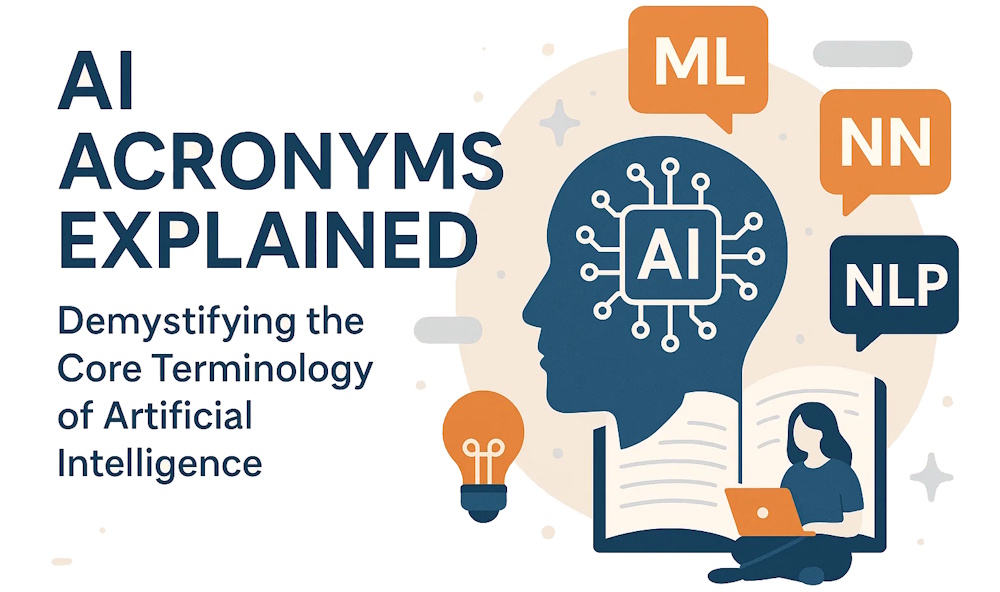
Refers to the simulation of human intelligence processes by machines, particularly computer systems. This includes learning, reasoning, problem-solving, perception, and language understanding. In 1956 John McCarthy, a professor at Dartmouth College, organized a workshop - the Dartmouth Conference - to clarify and develop ideas about thinking machines, choosing the name "artificial intelligence" for the project. The term stuck and has been used ever since.
AGI -Artificial General Intelligence
Artificial General Intelligence (AGI) refers to a theoretical form of AI that has the ability to understand, learn, and apply knowledge across a wide range of tasks, much like a human being.
API - Application Programming Interface
A set of rules that allows different software applications to communicate with each other. In AI, APIs are often used to integrate AI capabilities into applications.
CNN - Convolutional Neural Network
A class of deep learning algorithms primarily used for processing structured grid data such as images. CNNs are particularly effective in image recognition tasks.
CV - Computer Vision
A field of AI that enables computers to interpret and make decisions based on visual data from the world, such as images or videos.
DL - Deep Learning
Deep learning is a branch of machine learning where networks have many layers and can draw conclusions from unlabeled data with minimal human intervention.
LLM - Large Language Model
A type of NLP model that is trained on vast amounts of text data to understand and generate human-like text. LLMs are used in applications like chatbots and text generation.
ML - Machine Learning
A subset of AI that enables machines to learn from data and improve their performance over time without being explicitly programmed. It involves algorithms that can identify patterns and make predictions based on input data.
NLP - Natural Language Processing
A field of AI that focuses on the interaction between computers and humans through natural language. It involves enabling machines to understand, interpret, and respond to human language in a valuable way.
NN - Neural Network
A neural network is a type of machine-learning model designed to recognize patterns, make predictions, and learn from data by loosely imitating how the human brain works. A neural network is made up of many small processing units - called neurons or nodes - that are connected together in layers. Each neuron receives input, performs a simple mathematical operation, and passes the result to other neurons, allowing the network to build up complex understanding from simple parts.
GPT - Generative Pre-Trained Transformer
A specific type of large language model developed by OpenAI. GPT models are designed to generate human-like text based on the input they receive, making them useful for various applications in natural language processing, like ChatGPT.
Reinforcement learning is a type of machine learning focused on how an agent should take actions in an environment to maximize some notion of long‑term reward. Instead of learning from labeled examples (this is a cat), the agent learns through trial and error, receiving feedback in the form of rewards or penalties.
RNN - Recurrent Neural Network
A type of neural network designed for processing sequential data by maintaining a memory of previous inputs. RNNs are commonly used in tasks such as speech recognition and language modeling.
 Links
Links
Glossary of AI terms and FAQs.
Books about AI.
AI Primer for the book AI in America.
Learn more about AI History.
External links open in a new tab:
- kindo.ai/blog/45-ai-terms-phrases-and-acronyms-to-know
- ahrefs.com/writing-tools/acronym-generator
- luminance.com/news/blogs/20230710_luminance.html
- coursera.org/articles/what-does-ai-stand-for
- dictionary.cambridge.org/dictionary/english/ai
- geeksforgeeks.org/ai-algorithms/
- collinsdictionary.com/dictionary/english/ai
- servisbot.com/ai-definitions/
- merriam-webster.com/dictionary/ai