 Silicon Valley and the AI Boom
AI moves to the West Coast

AI in America is the definitive popular history of the most consequential technological enterprise of the past century told not as a march of inevitable progress, but as a deeply human story of booms and busts, brilliance and blunder, stubborn visionaries, and crushing winters. This is not a book about algorithms or programming. It is the story of the people, ideas, institutions, breakthroughs, failures, rivalries, and moments of inspiration that shaped one of the greatest technological revolutions in history.
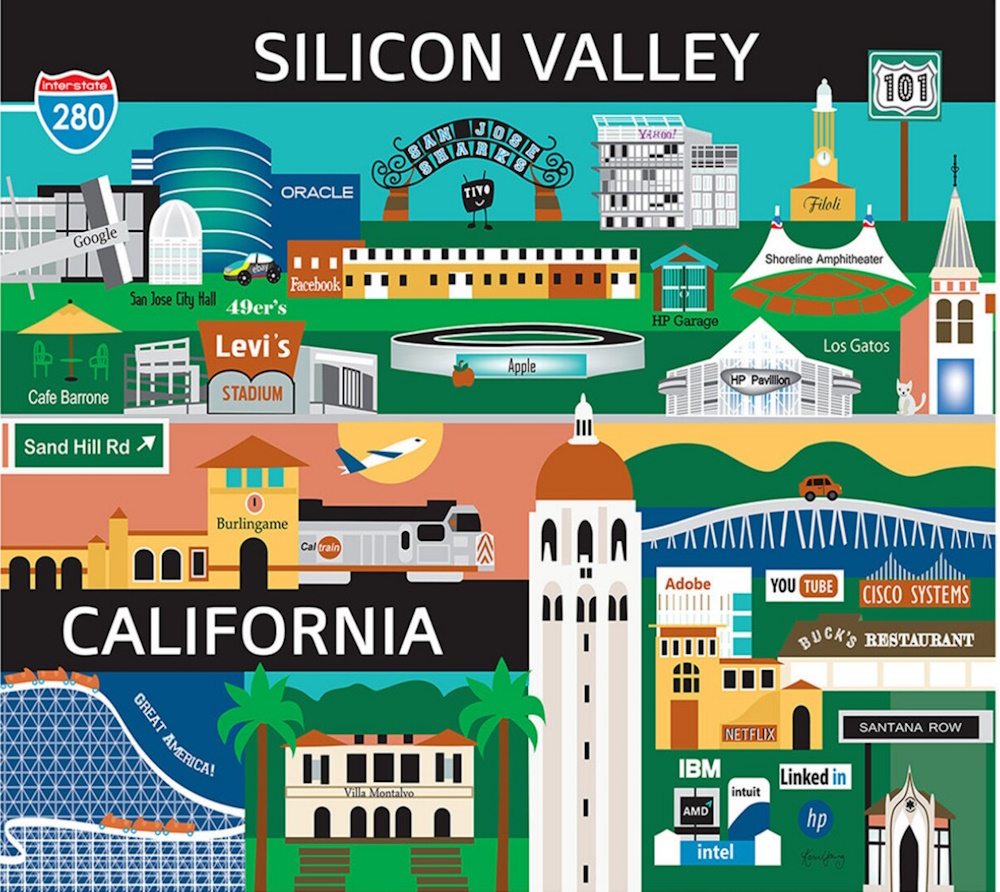
Given the legacy of the Dartmouth Conference, New England could rightfully lay claim to the title "birthplace of AI", but Silicon Valley quickly took the mantle cross-country from the Atlantic Coast to the Pacific Coast. South of the City by the Bay lies Silicon Valley; a flat, basin-like region framed by coastal mountains to the West and the San Francisco Bay to the East. Also known as the Santa Clara Valley, in its former life it was a rich agricultural area renowned for growing prunes, apricots, cherries, peaches, pears, strawberries, and nectarines. The valley features warm days, cool nights, and well-drained soils. It is fed by the Guadalupe River and a number of artesian wells. And in its fruit orchard heydey it had the nearby Southern Pacific railroad to rapidly ship the abundant fruit crop nationwide. With the post-war westward migration to California, orchards were replaced over time by suburbs, offices, and highways.
In the midst of Silicon Valley lies one of the greatest institutions of higher learning in the world, Stanford University. Stanford was the catalyst that transformed the Santa Clara Valley from farmland into the world's tech capital. It has been ground zero for AI research since the field's inception, producing innovations, companies, and leaders who shaped Silicon Valley.
Stanford has been the cradle of AI innovation since the beginning. Its unique blend of academia, entrepreneurship, and Silicon Valley synergy ensures it remains at the forefront.
Here's a list of famous Stanford tech alumni who founded or led major companies, with their graduation years and key contributions:
Founders of Tech Giants
-
Larry Page (MS '95) and Sergey Brin (MS '95) - Co-founded Google (1998).
-
Elon Musk (Dropped out, PhD '95-97) - Founded Tesla, SpaceX, Neuralink.
-
Peter Thiel (BA '89, JD '92) - Co-founded PayPal, first investor in Facebook.
-
Reid Hoffman (MA '90) - Co-founded LinkedIn.
-
Jerry Yang (MS '90) - Co-founded Yahoo!
-
Mike Krieger (BS '04) and Kevin Systrom (BS '06) - Co-founded Instagram.
-
Evan Spiegel (Dropped out '13) - Co-founded Snapchat.
Semiconductor and Computing Pioneers
-
William Hewlett (BS '34, MS '36) and David Packard (MS '39) - Founded HP.
-
Gordon Moore (PhD '54) - Co-founded Intel, formulated Moore's Law.
-
Vinod Khosla (MS '80) - Co-founded Sun Microsystems, now VC at Khosla Ventures.
-
Jensen Huang (MS '92) - Co-founded NVIDIA.
AI and Software Leaders
-
Fei-Fei Li (PhD '05) - AI pioneer, created ImageNet, co-director of Stanford HAI.
-
Andrew Ng (PhD '02) - Founded Google Brain, Coursera, led AI at Baidu.
-
Marissa Mayer (MS '97) - Early Google employee, later CEO of Yahoo!
Venture Capital and Investors
-
Don Valentine (BS '52) - Founder of Sequoia Capital (backed Apple, Cisco).
-
Marc Andreessen (Did not graduate) - Co-founded Netscape, Andreessen Horowitz.
-
Mary Meeker (MBA '86) - "Queen of the Internet," VC at Bond Capital.
Aerospace and Futurists
-
Sally Ride (PhD '78) - First American woman in space (NASA astronaut).
-
Sebastian Thrun (Former professor) - Founded Google X, Udacity, Kitty Hawk.
Recent Unicorn Founders
-
Patrick Collison (Dropped out '09) - Co-founded Stripe.
-
Alex Karp (PhD '92) - CEO of Palantir.
-
Anne Wojcicki (BS '96) - Co-founded 23andMe.
One name that's not on the list is John McCarthy. That's because McCarthy was not a Stanford student--he received his Ph.D. at Princeton--but joined Stanford University in 1962 as an Assistant Professor, leaving MIT where he developed LISP, and subsequently transformed Stanford into a global epicenter of AI research.
Ever the organizer, McCarthy founded the Stanford AI Lab (SAIL) in 1963. SAIL occupied the former Stanford Department of Electrical Engineering's D.C. Power Lab, a quirky building in the foothills above the campus. The AI Lab had a unique culture that fostered a creative environment where researchers were able to work all hours. The Lab had "beer bashes" every Friday afternoon to encourage collaboration, teamwork, and have a little fun after a long work week. Decor included a Jimi Hendrix poster and a disassembled car engine. SAIL was not merely a research lab; it was a community of hackers, dreamers, and graduate students who ran experiments late into the night.
SAIL maintained a "hands-off" management style that empowered young researchers. It was primarily supported by DARPA (Defense Advanced Research Projects Agency), with McCarthy securing the initial $500,000 grant, reminiscent of his prior work securing funding from the Rockefeller Foundation for the Dartmouth Conference.
McCarthy's 1960s work at Stanford didn't just create a research lab; it established an entire paradigm for how artificial intelligence would be studied and developed for generations. The questions he posed and approaches he developed continue to shape AI research, making the decade of the 60s one of the most productive and influential periods in the history of computer science.
Stanford and DARPA
AI's origin story in the Silicon Valley region begins with two institutional forces whose partnership shaped the next seventy years of technological acceleration, Stanford University and DARPA, the Defense Advanced Research Projects Agency. This chapter traces how an academic enclave and a government research agency seeded the soil that would grow into the global capital of artificial intelligence.
Stanford's Foundational DNA: Engineering the Future
Stanford University has always been less ivory tower, more engineering workshop. From its earliest decades, the institution cultivated a culture of invention, a sense that solving problems was more important than publishing papers. This ethos laid the groundwork for AI long before the term "artificial intelligence" existed. Stanford played host to some of the earliest and most influential AI projects in the United States.
John McCarthy's SAIL lab became ground zero for exploring machine reasoning, robotics, symbolic logic, and early natural language processing. Here, researchers built Shakey the Robot, the first AI-controlled mobile robot, early chess and theorem-proving software, and experiments in computer vision decades ahead of commercial viability. The atmosphere was "Dartmouth Conference meets California counterculture." The belief was that intelligence is computable, and it was only a matter of time before machines would demonstrate it.
DARPA: The Invisible Hand Behind the Valley
If Stanford provided the talent, DARPA provided the money, urgency, and national mission. DARPA, created in 1958 in the shadow of Sputnik, had a mandate to ensure the United States never again fell behind in technology. This mission led it to fund cutting-edge research, often long before its applications were clear. AI appealed to DARPA because cognitive automation promised strategic military advantages. Machine reasoning and planning had applications in defense logistics. Robotics had obvious value for reconnaissance and battlefield operations. Thinking machines aligned with Cold War fears of Soviet breakthroughs. DARPA's support created entire fields, such as the ARPANET, precursor to the internet. Autonomous vehicle research that later enabled Waymo and Tesla. Speech recognition and NLP that eventually led to Siri, Alexa, and ChatGPT. Semiconductor and computing infrastructure that made large-scale AI possible. DARPA's approach was unique. The philosophy was to fund risky, long-shot ideas, but at massive scale. Many AI researchers have said some version of, "If DARPA hadn't paid us to try, we never could."
What made the Stanford-DARPA partnership so powerful was the unique ecosystem it created, one where research flowed naturally into industry. Established in 1951, Stanford Research Park placed cutting-edge companies directly next to university labs. The effect was explosive. Faculty became founders. Students became employees. Government-funded research became commercial products. This proximity also helped AI evolve from a theoretical field into a practical one. The flow looked like this:
1. DARPA funds risky academic projects.
2. Stanford researchers make
breakthroughs.
3. Startups commercialize the breakthroughs.
4. Venture
capital pours fuel on the fire.
5. The next generation of students joins
the process.
This cycle is still the basic architecture of Silicon Valley today.
The AI Winters and Why Stanford Survived
AI famously suffered two major "winters", periods when funding dried up after early promises went unfulfilled. Yet Stanford weathered these winters better than most institutions because there was a consistent DARPA support for robotics, vision, and speech. A culture that encouraged long-term thinking. A pipeline of talent that could shift to other domains until AI returned. The Valley never lost its appetite for audacious ideas.
From the 1980s to the 2010s: The Seeds of the AI Boom
The AI boom of the 2010s did not appear suddenly. Its foundations were laid by:
-
Stanford's work on autonomous systems: (Sebastian Thrun, the Stanford Racing Team, the DARPA Grand Challenge)
-
The Stanford NLP group: (Christopher Manning's research directly shaped modern LLMs)
-
Google's and Facebook's hiring pipelines from Stanford: reinforcing a feedback loop between academia and industry.
When deep learning exploded, thanks to Stanford and DARPA, Silicon Valley already had the talent, culture, compute infrastructure, venture model, and research history to capitalize on the moment.
Why the Stanford-DARPA Connection Still Matters Today
The story isn't just history. The 2020s AI boom from OpenAI, Google DeepMind, and Anthropic, stands on the same roots. DARPA is now funding AI red-teaming and alignment programs, high-assurance machine learning, autonomous systems for land, sea, and air, next-generation semiconductors for AI, and novel architectures like neuromorphic computing and quantum-AI hybrids.
Stanford is now home to the Institute for Human-Centered Artificial Intelligence (HAI), cutting-edge labs for multimodal intelligence, ethics programs shaping national policy, and AI-specific entrepreneurship tracks seeding a new wave of startups. The partnership that began during the Cold War still shapes America's leadership in AI.
The Legacy: Why Silicon Valley Became Ground Zero for AI
Silicon Valley's dominance in AI is not accidental. It is the product of decades of intertwined forces:
-
Stanford's culture of invention
-
DARPA's willingness to fund the impossible
-
The valley's unique acceptance of risk
-
A pipeline linking research to commercialization
-
A national security mindset that valued technical superiority
No other region--Boston, Austin, Beijing, or London--has replicated this precise combination of university, government, capital, and culture. The result is the modern AI landscape with startups at hyperspeed. Companies valued in the hundreds of billions. Computing clusters consuming entire power stations. A global race for AGI. Add to all that an entire world shaped by the innovations born from a parking lot of labs and orchards outside Palo Alto.
The Root System Beneath the Boom
Silicon Valley's AI boom did not begin with Silicon Valley. It began with ideas that intelligence could be engineered, that universities could be launchpads, that government could seed innovation, and that risk was not something to be feared but embraced. Stanford and DARPA together created the intellectual and institutional root system that allowed artificial intelligence to grow from a speculative concept in the 1950s into the defining technology of the 21st century. The AI revolution may spread across the world, but its true story begins here.

Rise of Tech Giants and AI Experimentation
The Silicon Valley of the 2020s, with its massive GPU clusters, multibillion-dollar AI labs, and global influence over policy, is the result of decades of experimentation by a handful of tech giants that treated artificial intelligence like a frontier waiting to be conquered. These companies did not simply adopt AI; they scaled it, commodified it, industrialized it, and sometimes even broke it. Their experiments, whether successful, failed, reckless, or visionary, defined the trajectory of AI long before the world realized how central it would become.
This chapter explores how Silicon Valley's giants--Google, Apple, Amazon, Meta, Microsoft, Tesla, and their ecosystem--became the engines of the AI boom.
 Google: The Company That Bet the Future on AI
No corporation shaped early AI more than Google. In 2012, when a neural network in Google's X Lab identified a cat from unlabeled YouTube frames, the company declared: "Neural networks work at scale." And from that moment forward, Google became an AI-first company.
Google's AI milestones included:
-
Google Brain, a research powerhouse that pioneered large-scale deep learning
-
TensorFlow, which democratized machine learning frameworks
-
DeepMind acquisition (2014), a pivotal moment in AI history
-
AlphaGo, AlphaFold, and AlphaZero, which set global benchmarks for machine intelligence
-
TPUs, Google's custom chips for AI compute
These systems did more than advance research, for they created a blueprint for how industry could pursue AI with near-limitless resources.
Google's central insight was More compute + more data = more intelligence. That equation guided Silicon Valley's AI strategy for the next decade.
 Meta (Facebook): The Social Graph Meets AI
Meta's AI journey began with a simple goal of understanding human behavior at scale. Its platforms (Facebook, Instagram, WhatsApp) generated oceans of social interaction data. And Meta realized early that machine learning could turn social patterns into predictions.
Meta's AI experiments drove:
-
The News Feed ranking algorithms
-
Facial recognition (later reined in due to public backlash)
-
Recommendation engines that personalized content at a planetary scale
-
Large language models like LLaMA, which shifted the entire industry toward open-source AI
-
Generative tools for the metaverse and mixed reality
While Meta's pursuit of AI was sometimes controversial, it played a foundational role in building the concept of AI-mediated social life.
 Apple: The Quiet AI Giant
Apple is often portrayed as a latecomer to AI, but beneath the surface, its AI ecosystem has quietly transformed consumer technology. Apple's bet was not on massive models; it was on on-device intelligence:
-
Siri (launched 2011, long before modern assistants)
-
Neural Engine chips built directly into iPhones
-
Personalization models that run privately on-device
-
Vision Pro's spatial AI, built for real-time environment understanding
Apple avoided the data-intensive, cloud-dependent approach of competitors. Instead, it focused on privacy, user experience, and seamless machine intelligence that users barely perceive. The result was a subtle form of AI embedded into everyday life, often invisible but deeply influential.
 Amazon: AI as Industrial Infrastructure
If Google built the brain of AI and Meta shaped its social behavior, Amazon built the factory. Amazon's AI experiments served two masters of retail efficienc.y and cloud domination. Inside its warehouses, AI powered:
-
Robotic picking and sorting
-
Predictive logistics
-
Supply chain optimization
-
Dynamic pricing systems
Amazon Web Services (AWS) became the world's largest AI infrastructure provider, offering compute clusters, pretrained models, developer tools, and enterprise AI pipelines. Amazon's insight was transformative: AI is not a product, it is a utility. And like electricity, it would become essential for every industry.
 Microsoft: The Phoenix Rises Through AI
For much of the 2000s, Microsoft was considered a shadow of its former self. But AI changed everything. Microsoft's strategic pivot under Satya Nadella transformed the company from a legacy software vendor into a leading AI ecosystem. Key moves included:
-
Early investment in OpenAI, which reshaped the global AI race
-
Integration of GPT-based models into Bing, Office, GitHub, and Windows
-
Azure's evolution into a high-end AI compute platform
-
Copilot, which put AI directly into productivity tools used by billions
Microsoft didn't just experiment with AI, it re-anchored itself around it, becoming one of the most influential forces in the field nearly overnight in the process.
 Tesla: The First Consumer Robot Company
Tesla's role in Silicon Valley's AI evolution centers on one domain: autonomy. Tesla treated its vehicles not as cars, but as sensory robots. Autopilot and Full Self-Driving required:
-
Massive neural networks
-
Real-time sensor fusion
-
Edge computing under extreme conditions
Tesla created one of the largest video datasets on Earth, processed by its custom Dojo supercomputer. And later, the company extended its AI aspirations with Optimus, a humanoid robot. Tesla's experiment was radical: What if AI could replace not just digital labor, but physical labor? This question would redefine robotics in the 2020s and 2030s.
The Experimental Era: When Silicon Valley Tried Everything
Between 2010 and 2025, Silicon Valley's giants conducted AI experiments at a scale no government or university could match. They tried voice assistants, autonomous drones, emotion recognition, predictive policing algorithms, medical diagnostic systems, real-time translation, hyper-personalized advertising, and generative models for art, code, and language. Some experiments became billion-dollar businesses, while others ended in headlines, lawsuits, or regulatory reform. The common thread: Silicon Valley learned by building things, and sometimes breaking things.
The Hardware Arms Race
Once neural networks scaled, hardware became the bottleneck. Tech giants shifted from software companies to semiconductor strategists. This era produced Google's TPUs, Apple's Neural Engine, Amazon's Inferentia and Trainium chips, Meta's custom GPUs for recommendation systems, and Tesla's Dojo. Silicon Valley had reinvented not just AI algorithms, but the physical machinery of AI.
Silicon Valley's dominance in the AI boom came from several structural advantages:
-
A concentration of talent
-
Enormous compute budgets
-
A culture that rewards experimentation
-
Global data access
-
Deep integration between research and product teams
-
A venture ecosystem that funded risky moonshots
Most importantly, Silicon Valley treated AI not as a discipline, but as a platform, something to embed across every product, service, and workflow.
The experiments of Google, Meta, Apple, Amazon, Microsoft, Tesla, and others created the foundation for today's AI-driven world. Their research open-sourced frameworks, trained foundation models, redesigned chips, and constructed the global cloud infrastructure. They sparked:
-
The generative AI revolution
-
The AGI debate
-
The ethics and safety movement
-
New forms of creative expression
-
Entire industries built on automation
Without these experiments, and the companies bold enough to run them, the AI boom likely would not have ignited.
The Giants Built the Playground
Artificial intelligence in its modern form is not the result of a single breakthrough or a single company's vision. It is the cumulative outcome of a decade of wild experimentation by Silicon Valley's largest firms. They poured trillions of compute cycles into neural networks. They built the data centers, chips, models, and tools. And they took the risks and sometimes the blame.
The AI boom is, in many ways, the story of tech giants learning how to build machines that learn. And as the next era of AI unfolds, their experiments remain the foundation upon which the future will be built.
 Links
Links
AI in America home page
Biographies of AI pioneers
External links open in a new tab:
- en.wikipedia.org/wiki/Timeline_of_artificial_intelligence
- businessinsider.com/silicon-valley-history-technology-industry-animated-timeline-video-2017-5
- blogs.uoregon.edu/artificialintelligence/ai-timeline
- livefromsiliconvalley.com/evolution-of-silicon-valley-a-comprehensive-timeline
- coursera.org/articles/history-of-ai
- forbes.com/sites/timbajarin/2024/11/05/silicon-valleythe-epicenter-of-artificial-intelligence-innovation
- siliconvalleygradient.com/100-year-timeline-of-ai-767c41c2f57f