 Media
& Entertainment
Media
& Entertainment
AI is used everywhere: from ideation and production to distribution and consumption
Related: AI Industry | AI Companies | AI Stocks
On the front-end, AI tools (like ChatGPT or specialized scripts) assist writers with brainstorming, generating loglines, drafting scenes, and even creating entire scripts. They can analyze successful patterns in existing content. Generative AI image tools (Midjourney, DALL-E 3, Stable Diffusion) allow rapid creation of concept art, character designs, and storyboards, speeding up pre-visualization and pitching. AI (AIVA, Amper Music, Google's MusicLM) can compose original scores, generate soundtracks for games or background music, and even mimic styles of famous composers.
On the back-end, AI automates rotoscoping (object separation), creates complex digital doubles, and generates realistic CGI environments. It's used for "de-aging" actors (like The Irishman) and even creating fully AI-generated characters. AI can automatically edit footage based on script markers, find the best takes, apply color correction, and generate different cuts for social media. Tools like Adobe's Sensei are integrated into professional suites. AI voice cloning can dub content into different languages while preserving the actor's original voice and emotional tone (OpenAI's Voice Engine, ElevenLabs). It can also restore or clean up old audio.
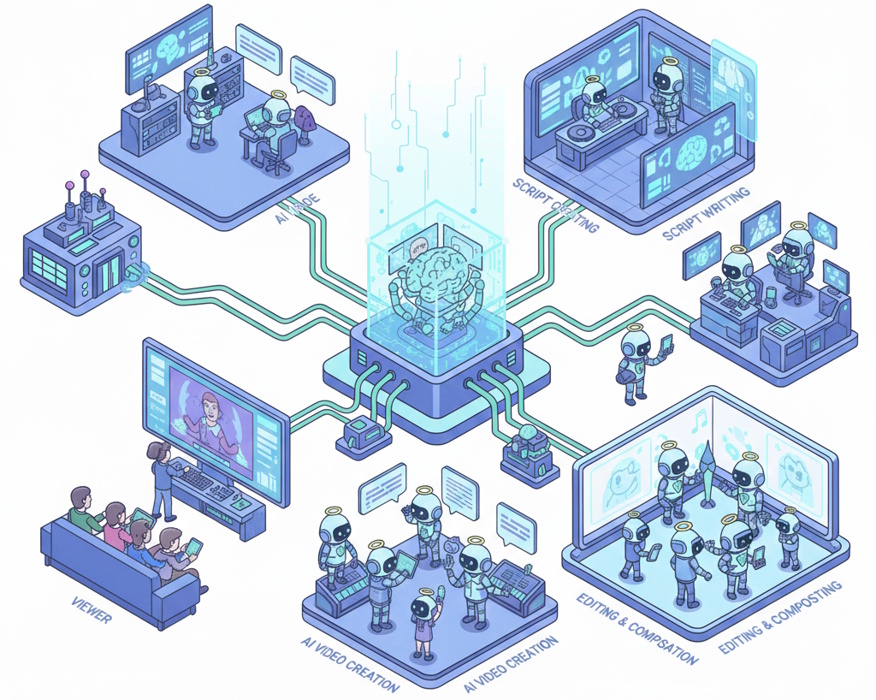
Generative AI delivers personalized audience experiences through multimodal recommendations and search. Recommendation engines like those from Netflix, Spotify, and YouTube analyze user behavior to hyper-personalize content recommendations to ensure engagement and retention. AI analyzes raw footage to identify key emotional moments and can automatically assemble promotional trailers. It also optimizes ad targeting and predicts audience response. These are just a few of the uses of AI in the media and entertainment industry. Learn more here about the use, benefits, challenges, and future of AI in the media and entertainment industry.
 How AI Creates Videos
AI creates videos by interpreting prompts, generating or animating visuals, predicting motion, assembling scenes, and automating editing. Whether starting from text, images, or scripts, AI systems streamline the entire production process - from ideation to final export - making video creation accessible to anyone.
AI creates videos by combining text understanding, image generation, motion prediction, and automated editing into a single pipeline. Modern tools can turn a script, prompt, or image into a finished video clip by generating visuals, animating them, adding audio, and assembling everything into a coherent sequence. The process varies by tool, but the underlying principles are consistent across the industry.
AI video creation begins with text-to-video generation, where a user provides a prompt such as "a drone shot over a futuristic city" and the system interprets it to produce moving images. Platforms describe this as turning any idea into a video using a simple text prompt or image upload. The AI model breaks the prompt into visual concepts, identifies objects, environments, and actions, and then synthesizes frames that match the description. This is similar to how image generators work, but extended across time so the visuals remain consistent from frame to frame.
Another major method is image-to-video generation, where AI animates a still image. Tools show how users can upload a photo and let the AI "bring your photos to life with minimal effort". The system predicts motion - such as camera movement, character gestures, or environmental changes - based on the content of the image. This is especially popular for social media, where creators animate portraits, landscapes, or product shots.
AI is also used to assemble full videos from scripts. AI tools can take a written script, generate a voiceover, match it with relevant visuals, and produce a publish-ready video. These systems automatically select or generate images, add transitions, insert subtitles, and synchronize audio. This workflow is common in marketing, education, and explainer videos, where speed and consistency matter more than cinematic realism.
More advanced systems generate cinematic motion and physics-accurate scenes. Some platforms allow users to choose between different video generation engines -such as Sora, Veo, Nano Banana, or Kling - to achieve specific styles or motion qualities. These engines create smooth, natural movement and realistic lighting, producing results that resemble live-action footage or high-end CGI. As one generator describes it, the goal is "cinema-quality motion, natural physics, and ultra-smooth frames".
AI also supports automated editing, where users can modify videos using natural language commands. Zapier notes that modern tools let creators "edit videos with a text prompt," enabling tasks like changing accents, deleting scenes, or adding intros without manual timeline editing. This lowers the barrier for people who don't have traditional video-editing skills.
AI enhances videos through upscaling, style transfer, and visual effects. These tools can improve resolution, apply artistic styles, or generate missing frames to smooth out motion. They are often used in post-production to refine or transform existing footage.
 Benefits of using AI
AI is used for making content creation faster, distribution smarter, and audience experiences more personalized. Across film, TV, music, gaming, and advertising, AI is becoming a creative and operational engine. It is no longer just a tool used behind the scenes.
AI is making the industry more efficient and enabling new forms of storytelling. It is helping companies meet rising viewer expectations for personalization and speed. AI is rapidly becoming the backbone of modern media and entertainment. It is opening the door to entirely new forms of storytelling. As the industry continues to evolve, AI will remain central to how content is imagined, produced, and consumed.
One of the biggest benefits of using AI is personalized content. Streaming platforms like Netflix, music services like Spotify, and news apps use AI recommendation systems to analyze viewing habits, listening patterns, and engagement signals to suggest content that feels like it is tailored to each user...which it is! This level of precision has become essential as audiences today expect platforms to know what they want next, and companies that fail to deliver risk losing attention in a crowded market. AI-driven personalization also boosts engagement and retention, making it a key advantage for media companies that use it effectively.
AI effects content production by reducing costs and accelerating the development process. Generative AI can assist with scriptwriting, storyboarding, video editing, visual effects, and even when it comes to casting decisions. Generative AI could reduce production costs across the industry, thereby freeing budgets to be used for talent, marketing, or premium rights like sports broadcasts. Reducing costs improves production where smaller studios and independent creators can now produce high-quality content that previously required large budgets.
Another major benefit is operational efficiency. AI automates repetitive tasks like metadata tagging, content classification, rights management, and quality control. This usage reduces human error and speeds up distribution pipelines. Companies can process content libraries (movies, clips, music catalogs, archives) more quickly and accurately, making them easier to monetize across platforms and regions.
AI enhances audience engagement and market insight. By analyzing viewer behavior, sentiment, and trends, AI helps studios and platforms understand what audiences want before they even ask for it. This informs decisions about greenlighting projects, scheduling releases, and designing marketing campaigns.
In gaming, advertising, and immersive media, AI enables new creative possibilities. It powers dynamic game environments, real-time character animation, and adaptive storytelling that responds to player behavior.
In advertising, AI generates targeted campaigns, predicts audience reactions, and automates creative variations at scale. These capabilities allow creators to build richer, more interactive experiences that would be impossible with manual workflows alone.
In music, AI improves curation and playlisting, while live events benefit from increased demand driven by AI-enhanced discovery and fan engagement.
 Challenges
brought about by AI
Challenges
brought about by AI
AI in media and entertainment offers many benefits, but its challenges require thoughtful planning and strong governance. These challenges include cost, legal uncertainty, creative disruption, quality control, and ethical risks. Companies that navigate these issues carefully will be best positioned to harness AI's full potential.
AI brings enormous potential to media and entertainment, but it also introduces a set of challenges that shape how studios, creators, and platforms adopt the technology. These challenges are technical, economic, legal, and cultural. They determine how quickly and responsibly the industry can integrate AI into production and distribution. Companies face costly infrastructure upgrades and an arduous deployment process, even as AI promises major efficiency gains. This tension between opportunity and complexity is at the heart of the industry's struggle with AI adoption.
Some of the biggest challenges are infrastructure and cost. High-quality AI models require powerful compute, large datasets, and specialized engineering talent. Many media companies still rely on legacy systems that are not designed for AI-driven workflows, making integration slow and expensive. Even when AI tools are available, scaling them across production pipelines like editing, VFX, localization, and metadata tagging, requires significant investment. Smaller studios and independent creators often lack the resources to adopt AI at the same level as major platforms.
Another major challenge is legal and regulatory uncertainty. AI is reshaping the industry in ways that raise questions about copyright, likeness rights, and labor protections. Generative AI can mimic voices, create synthetic actors like Tilly Norwood, or produce content inspired by existing works, blurring the boundaries of ownership. This has already led to disputes involving writers, actors, and musicians who want control over how their likeness or creative style is used. Global regulators are responding, but the rules are still evolving, creating risk for companies that deploy AI without clear legal frameworks.
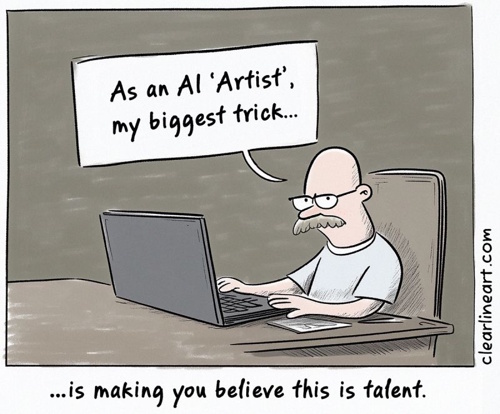
AI also introduces creative and cultural tensions. While AI can accelerate ideation and production, many creators worry that it may dilute originality or replace human artistry. The Morgan Stanley analysis highlights that AI could "upend the competitive landscape," enabling smaller companies to produce high-quality content that challenges established studios. This democratization is exciting, but it also raises concerns about oversaturation, homogenization of content, and the erosion of traditional creative roles. Strikes and negotiations in Hollywood reflect these anxieties, as workers push for guardrails to ensure AI augments rather than replaces human creativity.
A further challenge is quality control and trust. AI-generated content can be inconsistent, requiring human oversight to ensure accuracy, continuity, and brand alignment. In news and journalism, AI-generated misinformation or errors can damage credibility. In entertainment, poorly supervised AI can produce uncanny visuals, incorrect translations, or culturally insensitive outputs. As the MIT Technology Review report notes, companies struggle to adapt to "rapid technological shifts" while maintaining high production standards.
AI exposes ethical and audience-impact challenges. AI-driven personalization can create filter bubbles, reinforce biases, or manipulate viewer behavior. Synthetic media raises questions about authenticity, consent, and the potential for deepfakes. Going forward, the industry must balance innovation with responsible governance to maintain public trust.
- Ethical Concerns: AI-generated content, particularly deepfakes, raises ethical issues related to misinformation, privacy violations, and intellectual property rights.
- Job Displacement: AI's ability to automate tasks like scriptwriting, animation, and content moderation raises concerns about job displacement in the creative industries.
- Bias in AI Algorithms: AI algorithms are often trained on biased datasets, which can lead to biased content recommendations or discriminatory practices.
- Security and Data Privacy: AI requires vast amounts of user data for personalized recommendations, leading to concerns about data privacy and security.
- High Initial Costs: Implementing AI technology, especially in content creation and distribution, requires significant investment in infrastructure, skilled professionals, and training datasets.
AI is set to become the core engine of how media and entertainment are created, personalized, and consumed. AI is becoming a force that will reshape storytelling, production, distribution, and audience engagement over the next decade.
 The Future of AI in Media & Entertainment
🎬 AI-Driven Content Creation Becomes Standard
Industry leaders now treat AI as a central creative tool rather than a novelty. AI is redefining how content is created, localized, and consumed globally. This means:
- AI-assisted scriptwriting, storyboarding, and editing
- Automated
localization (dubbing, subtitles, cultural adaptation)
- Synthetic
performers and virtual production pipelines
- Real-time VFX and
animation powered by generative models
The result is faster production cycles, lower costs, and more experimentation with formats and genres.
🎧 Hyper-Personalized Media Experiences
AI will increasingly tailor content to individual tastes, far beyond today's recommendation engines. Future personalization includes:
- Dynamic storylines that adapt to viewer preferences
- Personalized
music mixes and playlists
- AI-generated trailers or summaries tailored
to each user
- Adaptive advertising that changes based on mood or
context
This shift is already visible in the rise of creator-driven platforms and AI-curated experiences.
🎮 Immersive, Interactive, and AI-Native Worlds
Gaming and immersive media will be transformed by AI that acts as:
- Real-time world builders
- Intelligent NPCs with memory and
personality
- Procedural storytellers that adapt to player behavior
AI is evolving into a director, composer, storyteller, game designer, and even influencer, expanding what interactive entertainment can be.
🌍 Global Content Expansion Through AI Localization
AI-powered dubbing and translation will allow content to cross borders instantly. Localization is becoming one of the most important AI use cases, enabling studios to reach global audiences with unprecedented speed. This will change:
- International distribution
- Streaming platform strategies
-
Cultural exchange and global fandoms
📰 AI-Augmented News and Journalism
AI will support - not replace - journalists by:
- Automating routine reporting
- Summarizing large datasets
-
Generating drafts for human refinement
- Enhancing fact-checking and
verification
🧠 New Creative Roles and Industry Structures
AI will not eliminate creativity: it will change who creates and how. You can expect:
- Hybrid human-AI creative teams
- New roles like "AI showrunner,"
"synthetic media director," and "model curator"
- Smaller studios
competing with major players using AI-enhanced production tools
⚖️ Governance, Ethics, and Authenticity Become Central
As AI becomes more powerful, the industry must address:
- Deepfake risks
- Copyright and likeness rights
- Transparency
in AI-generated content
- Fair labor practices for writers, actors, and
creators
📌 Bottom Line
AI will define the next era of media and entertainment. It will accelerate production, expand global reach, enable new forms of storytelling, and personalize experiences at a level never seen before. It will also require new rules, new creative norms, and new forms of collaboration between humans and machines.
"AI won't write the future of entertainment alone, but it will co-author it with every creator willing to experiment."
 Links
Links
Tilly Norwood is an AI generated actress sending shockwaves throughout the industry.
External links open in a new tab:
- The Entertainment Industry in the AI Era: A Fascinating Study on AI's Transformational Power for Each Entertainment Enthusiast
- infosysbpm.com/blogs/media-entertainment/use-of-ai-in-media-entertainment-industry
- forbes.com/councils/theyec/2023/08/17/generative-ai-for-content-creation-how-marketers-can-use-it
- carmatec.com/blog/ai-in-media-and-entertainment-complete-guide
- techtarget.com/whatis/feature/AI-content-generators-to-explore
- leewayhertz.com/ai-in-media-and-entertainment
- hexaware.com/blogs/generative-ai-for-content-creation-the-future-of-content-ops
- prismetric.com/ai-in-entertainment
- hbr.org/2022/11/how-generative-ai-is-changing-creative-work
- talentdesk.io/blog/ai-impact-on-the-entertainment-industry