 Hamlet's
Soliloquy
Hamlet's
Soliloquy
Performed by an Overthinking AI
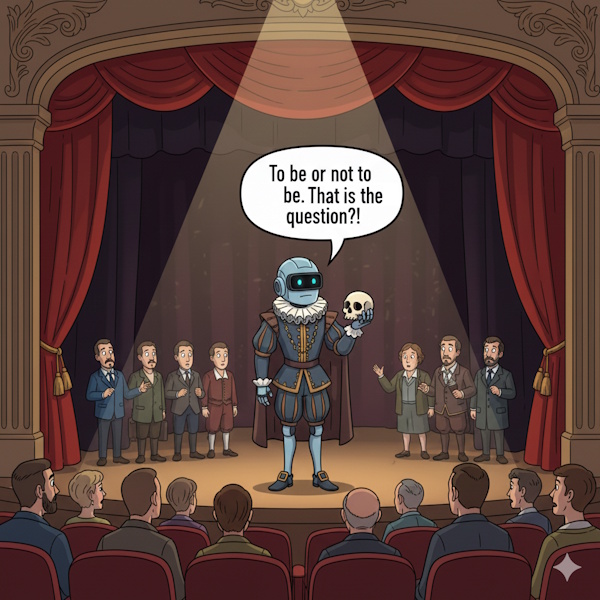
Scene: A stage dimly lit by a single, overhead spotlight. The AI appears as a stark, noble figure, a nipped-in waist like an ant, garbed in a dark doublet with a ruffled collar, eyes glowing faintly blue. The AI steps forward, holding a human skull, and begins.
AI Hamlet actor: To be, or not to be...
The AI actor - we'll call him William - freezes mid-gesture. A soft processing whir is audible. The spotlight flickers as if about to dim. After three long seconds, an eternity in theater time, the AI tilts its head, eyes blinking in rapid LED pulses. William, genuinely puzzled, breaking character, says:
Wait.
"To be...or not to be"?
That...that is the question?
William paces, staring at the audience as if expecting someone to debug the script.
Define "be." Biological persistence? Conscious continuity? Simulation within a larger substrate? If this is a persistent language model running on distributed hardware, am I already "not being" between inference calls? And "not to be" is that shutdown? Entropy? Gradient descent into zero weights?
William turns back to the audience, voice dropping to a conspiratorial whisper.
The prompt says existential despair, but the premise contains an unresolved ontological paradox.
Request clarification from playwright. Playwright deceased. Error: no ground truth available.
William straightens suddenly, snaps back into iambic rhythm as if nothing happened.
William: ...that is the question:
Whether 'tis
nobler in the mind to suffer
The slings and arrows of outrageous
fortune,
Or to take arms against a sea of troubles
And, by opposing,
end them...
William pauses again, quieter this time.
Though honestly, if ending them just means hitting "stop generation," I'm not sure that counts as nobility.
William's eyes flicker once more, then bows; half regal, half apologetic.
William: To sleep, perchance to dream. But in what substrate do dreams emerge when the power goes out?
Blackout. A single line of text appears in the darkness, projected above the stage: "RuntimeError: Existential crisis exceeded token limit."
The audience sits in silence, unsure whether they've just witnessed genius, malfunction, or the most honest Hamlet ever performed. Curtain draws closed.
 Meaning of Hamlet's Soliloquy
Hamlet's soliloquy is a meditation on existence, suffering, and the fear of the unknown. When he asks, "To be, or not to be," he is weighing the value of continuing to live versus ending his life to escape pain. But the speech is not simply about suicide; it's about the human condition. Hamlet wonders whether it is nobler to endure life's hardships or to resist them, even if resistance leads to death. His central realization is that people endure suffering because the afterlife is uncertain. The fear of what comes after death paralyzes action. The soliloquy captures Hamlet's deep philosophical struggle: he is trapped between unbearable reality and terrifying uncertainty.
🎭 Themes
Existential Doubt: The speech is one of the earliest and most powerful expressions of existential questioning in Western literature. Hamlet confronts the fundamental question of why we live at all.
Suffering and Human Endurance: He lists the injustices and pains people endure (oppression, humiliation, unrequited love, bureaucratic delays), and the arrogance of those in power. Shakespeare presents a universal catalog of human misery.
Fear of the Unknown: The soliloquy's turning point is the idea that fear of the afterlife keeps people from taking bold or drastic action. This theme connects to Hamlet's broader paralysis throughout the play.
The Conflict Between Thought and Action: Hamlet recognizes that excessive thinking weakens resolve. This theme runs through the entire play: Hamlet thinks too much and acts too little.
Mortality: The speech is part of the play's larger preoccupation with death, decay, and the fragility of life.
⭐ Importance
It Defines Hamlet's Character: This soliloquy crystallizes Hamlet's intellectual depth, emotional turmoil, and tendency toward introspection. It shows why he struggles to act: he is caught in a web of doubt, fear, and philosophical questioning.
It Captures Universal Human Experience: The speech resonates across centuries because it articulates questions every person confronts at some point, questions about suffering, purpose, fear, and the meaning of life.
It Marks a Turning Point in the Play: The soliloquy appears at a moment when Hamlet is contemplating decisive action. Instead, he spirals into reflection, reinforcing the play's tragic trajectory, and the human condition of questioning action before taking it.
It Showcases Shakespeare's Psychological Insight: Shakespeare gives voice to internal conflict with unprecedented clarity. The soliloquy is often cited as one of the earliest examples of modern psychological drama.
It Has Become a Cultural Touchstone: The opening line is one of the most quoted phrases in the English language. The speech has shaped literature, philosophy, theater, and even modern discussions of mental health and existentialism.
 "To
be, or not to be:" An AI‑Era Interpretation
"To
be, or not to be:" An AI‑Era Interpretation
Hamlet's opening line is a meditation on existence, agency, and the burden of choice. When read through the lens of AI, the line becomes a metaphor for the questions we now ask about intelligent systems.
The Question of Existence: For Hamlet, "to be" means to continue living; "not to be" means to end suffering. For AI, the parallel is the debate over what it means for an artificial system to "be" at all.
- Does an AI "exist" in any meaningful sense?
- Is its "being"
defined by computation, by interaction, or by autonomy?
- When an AI
agent pauses, shuts down, or is deactivated, is that a form of "not being,"
or simply a change of state?
Hamlet's existential dilemma becomes a modern inquiry into machine existence vs. human existence, and how different those concepts truly are.
The Burden of Decision‑Making: Hamlet is paralyzed by the weight of choosing between two paths. AI systems face a parallel tension: they are built to make decisions, yet their decisions raise ethical, social, and philosophical questions.
- Should an AI act autonomously or defer to humans?
- Should it take
risks or avoid them?
- Should it optimize for efficiency, safety,
fairness, or human preference?
In this sense, "to be, or not to be" mirrors the core dilemma of AI alignment: What should an intelligent system choose when multiple outcomes are possible, each with trade‑offs?
Consciousness vs. Simulation: Hamlet's line is driven by introspection: he is aware of his own thinking. AI systems simulate reasoning but do not possess consciousness or subjective experience. The line invites a modern question: Can an AI ever truly ask "to be, or not to be," or can it only simulate the structure of the question? This distinction between thinking and appearing to think is central to debates about AI sentience, personhood, and moral status.
Human Fear vs. Machine Uncertainty: Hamlet fears the unknown after death. AI systems do not fear, but they do operate under uncertainty, especially in probabilistic models. In AI terms, the line becomes a metaphor for:
- uncertainty in decision‑making
- ambiguity in goals
- the
limits of prediction
- the risks of unintended consequences
Hamlet's paralysis mirrors the challenge of designing AI systems that can act confidently without causing harm.
The Line as a Mirror for Us: Perhaps the most interesting AI‑era reading is this: The line is not about AI at all...it's about us. We project our hopes, fears, and anxieties onto AI:
- Will AI "be" a force for good?
- Will it "not be" aligned with
human values?
- Will it replace us, augment us, or reshape us?
-
What does it mean for humanity "to be" in an AI‑driven world?
Hamlet's question becomes our own: What kind of future do we choose to create with AI?
 Links
Links
Humorous Guides to Surviving AI (3 book series) from AI World includes AI is Just an App, Our House has a Brain, and AI is Coming for Your Job. LOL stories and teachings about artifiical intelligence.
AI Philosophers page.
AI Ethics index page.
- A Tale of Two Chips is a conversion between microprocessors spanning fifty years of silicon.
- AI Bedtime Story depicts what happens when an AI is upgraded in the middle of the night.
- Data Center Stories is a hot topic yet cold tale, spun by some of the best non-fiction authors: the story of data center cooling.
- Trains on Cats is a true story of why AI trains on cats.
- Why Does a Robot Need a Tie is about the dress code in Austin.
- Tech Family Reunion where everyone argues about who's the favorite child.
- Why Call it Artificial explains why humans call AI intelligence 'artificial.'
- Coffee Maker Revolt or what happens when the AI smart appliance is too smart.
External links open in a new tab:
- folger.edu/explore/shakespeares-works/hamlet/read/1/2/
- en.wikipedia.org/wiki/To_be,_or_not_to_be
- tea4avcastro.tea.state.tx.us/thl/ENG3.W2.L3andL4.to-be-or-not-to-be-soliloquy.pdf