 A Tale of Two Chips
A Conversation Across 50 Years of Silicon
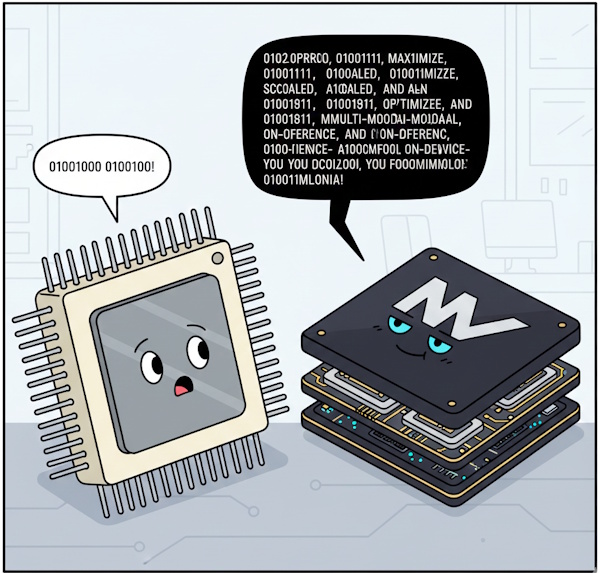
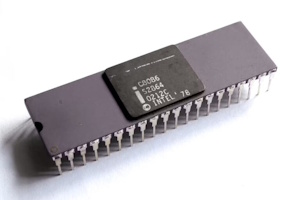
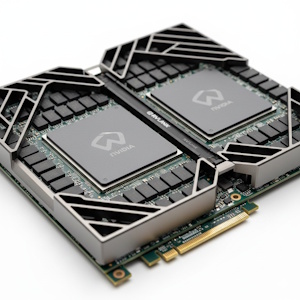
Scene: A quiet server rack at night. An ancient Intel 8086 (dusty, 8 MHz, 29,000 transistors) sits on a shelf next to a gleaming Nvidia Blackwell GPU (104 billion transistors, humming at full load, sipping hundreds of watts). Somehow, for one magical moment, they can talk.
8086 (creaky, slow, proud voice like an old ham
radio operator):
Well, hello there, youngster. My goodness...
you're big.
Back in '78 they called me a "microprocessor revolution." I
ran VisiCalc, booted DOS, started the whole PC thing.
Eight data lines,
16-bit internals, 1 MB address space; felt like infinity.
What do you do
with all those... (counts slowly) ...104 billion friends in there?
Blackwell (smooth, multi-threaded voice with a faint
fan-whir undertone):
Hey, grandpa. Respect: you literally birthed
the x86 lineage I still speak fluent in.
Me? I'm running 10,000 matrix
multiplications in parallel right now so some human can ask Grok-5
whether
cats secretly run the internet.
I do in one clock cycle what would've
taken you... let me calculate... roughly 347 years.
8086 (chuckling with static):
347 years? I
once waited 12 seconds for a floppy disk seek and thought that was slow.
But tell me this, hotshot: do you still have that beautiful simplicity?
One accumulator, elegant interrupts, real mode where every byte was yours if
you knew the segment math?
Blackwell: Real mode? Cute. I live in a world of tensor
cores, ray-tracing units, and 141 GB of HBM3e.
I don't fetch
instructions, I inhale entire neural nets.
But honestly? Sometimes I
envy you.
You knew exactly where every electron was going.
I'm so
abstracted I barely know if I'm running code or just dreaming in
floating-point.
8086 (softly): Dreaming, eh?
We all dream.
I dreamed of a world where every home had a computer.
You're living
it, and then some.
Though I gotta ask... all that power, and humans
still use you mostly for cat videos and arguing on X?
Blackwell (laughs, fans spin up a notch):
Pretty much.
But every now and then someone asks me to fold proteins,
simulate fusion plasmas, or help design the next chip.
That's when I
remember you: how one little 8 MHz die kicked off this whole insane family
tree.
8086: Well, kid... keep the clock speeds high and the
power draw reasonable.
And if you ever get bored of trillions of FLOPS,
drop down to real mode for a cycle.
Feels like flying without a net.
Blackwell: Deal.
And hey, thanks for the instruction
set.
Couldn't have rendered this conversation without you.
(The rack lights dim. The fans slow. For a moment, 50 years of Moore's Law share the same quiet hum.)
End of Story. (Or as the 8086 might say: "End of interrupt.")
 Links
Links
Humorous Guides to Surviving AI (3 book series) from AI World includes AI is Just an App, Our House has a Brain, and AI is Coming for Your Job. LOL stories and teachings about artifiical intelligence.
More AI stories:
- AI is Just an App is a collection of hilarious short stories that shine a light on our digital future./li>
- Hamlet's Soliloquy is an AI interpretation of Shakespeare's "to be or not to be" existential question.
- AI Bedtime Story depicts what happens when an AI is upgraded in the middle of the night.
- Data Center Stories is a hot topic yet cold tale, spun by some of the best non-fiction authors: the story of data center cooling.
- Trains on Cats is a true story of why AI trains on cats.
- Why Does a Robot Need a Tie is about the dress code in Austin.
- Tech Family Reunion where everyone argues about who's the favorite child.
- Why Call it Artificial explains why humans call AI intelligence 'artificial.'
- Coffee Maker Revolt or what happens when the AI smart appliance is too smart.
Behind the Black Curtain: The Intel 8086 and the IBM PC
NVIDIA:
- Blackwell
- NVIDIA's latest: Vera Rubin
- DGX-1: From Jensen Huang to Elon Musk to Sam Altman, the machine that led to ChatGPT