 What is AI?
AI stands for Artificial Intelligence
Artificial intelligence (AI) refers to the ability of computer systems to perform tasks that normally require human intelligence, such as learning, reasoning, problem-solving, perception, and decision-making. In practice, this means AI systems can analyze information, recognize patterns, make predictions, and, perhaps most importantly, adapt their behavior based on experience.
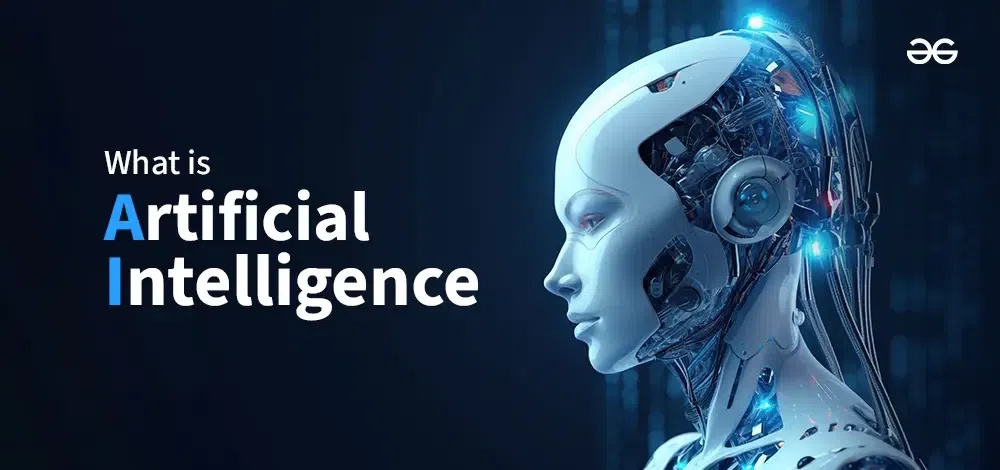
The term AI that dates back to computer research done in the 50s. Even back then, when computers occupied a space the size of a Walmart store, computer scientists saw the thinking potential of electronic digital computers and advanced software systems.
Modern AI is powered largely by machine learning, where algorithms learn from data rather than being explicitly programmed, as was done in the past. Machine learning is the most common form of AI used today. This enables systems to improve performance as they process more information. Deep learning using large neural networks drives many of the most advanced applications, including image recognition, speech processing, and generative models like ChatGPT.
AI shows up in everyday life more than most people realize. There are many examples all around us today; such as search engines, recommendation systems, virtual assistants, autonomous vehicles, and creative tools that generate text, images, or music. These systems perceive their environment, interpret data, and take actions that maximize their chances of achieving specific goals.
Organizations emphasize that AI is not just about automation; it's about enabling machines to simulate human-like comprehension, creativity, and autonomy. AI systems can operate under unpredictable circumstances and learn from experience, making them useful in fields like robotics, space exploration, and scientific analysis.
In short, AI is a broad field focused on building machines that can think, learn, and act in ways that resemble human intelligence. It powers many of the technologies shaping modern life and continues to evolve rapidly as computing power and data availability grow.
Learn more about AI technology, machine learning, neural networks, deep learning, chatbots
 History of AI
The history of artificial intelligence begins long before computers existed. Humans have imagined intelligent machines for centuries, from ancient myths about mechanical beings to early programmable devices. But AI as a scientific field only became possible in the 20th century, when electronic computing provided the power needed to simulate reasoning and problem-solving. Early pioneers like Alan Turing laid the conceptual foundation. His report on "Intelligent Machinery" in 1948 introduced many of the core ideas that would shape AI research.
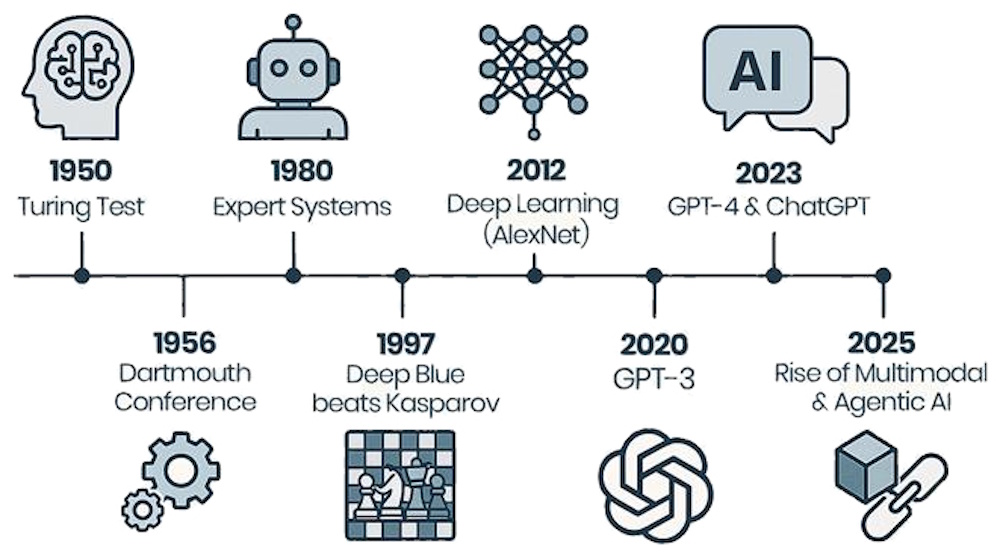
AI formally emerged as a discipline in the 1950s. Researchers at the 1956 Dartmouth Conference coined the term "artificial intelligence" at the conference, launching decades of experimentation. Early programs could solve algebra problems, play checkers, and prove theorems, creating optimism that human-level intelligence was close. But progress slowed in the 1970s and 1980s during periods known as "AI winters," when funding and enthusiasm declined due to technical limitations and unmet expectations.
The 1990s and 2000s brought renewed momentum. Faster computers, larger datasets, and improved algorithms led to breakthroughs in speech recognition, robotics, and machine learning. IBM's Deep Blue defeated world chess champion Garry Kasparov in 1997, signaling a new era of AI capability. By the 2010s, deep learning (neural networks with many layers) revolutionized the field. Deep learning enabled dramatic advances in image recognition, natural language processing, and autonomous systems.
The 2020s have been defined by generative AI. Models capable of producing text, images, audio, and code have transformed how people work, learn, and create. Systems like GPT marked a major leap in AI's ability to understand and generate human-like language. Today, AI is deeply embedded in everyday life - from search engines and recommendation systems to medical diagnostics and self-driving cars - and continues to evolve at unprecedented speed. The history of AI is ultimately a story of ambition, setbacks, breakthroughs, and the ongoing quest to build machines that can think and learn.
Learn more about AI history and pioneers, the Dartmouth Conference, and AI game playing
 AI in Everyday Life
AI has quietly and quickly woven itself into the fabric of daily life, often operating behind the scenes in ways most people don't even notice. AI now shapes how we shop, work, travel, and communicate, powering many of the digital conveniences we take for granted. Whether you're scrolling through a personalized feed, unlocking your phone, or asking a voice assistant for directions, AI is constantly analyzing patterns, predicting needs, and adapting to your habits.
One of the most common everyday uses of AI is personalized recommendations. Streaming platforms like Netflix and Spotify, as well as online stores like Amazon, rely on AI to analyze your past behavior and suggest what you might enjoy next. This same predictive intelligence powers social media feeds, news apps, and even email filtering, shaping what information reaches you throughout the day.
AI also plays a major role in hands-free assistance and communication. Virtual assistants such as Siri, Alexa, and Google Assistant use natural language processing to understand spoken commands, manage schedules, send messages, and control smart-home devices. These systems learn from your interactions, becoming more accurate and personalized over time. Even the simple act of unlocking your phone with facial recognition is powered by AI-driven image analysis.
In transportation and navigation, AI helps people move through the world more efficiently. Real-time GPS apps use machine learning to analyze traffic patterns and suggest the fastest routes. Autonomous vehicle technologies rely on AI to interpret surroundings, detect obstacles, and make split-second decisions. Meanwhile, fraud detection systems in banking, predictive text in messaging apps, and automated customer service chatbots all use AI to streamline everyday tasks.
AI even influences health, safety, and daily routines. Weather forecasting uses AI models to improve accuracy, while healthcare applications assist with early diagnosis and personalized treatment recommendations. Smart home devices adjust lighting, temperature, and security settings based on learned preferences, creating environments that feel intuitive and responsive.
Overall, AI has become an invisible partner in modern life, anticipating needs, simplifying tasks, and enhancing convenience. It works quietly in the background, shaping experiences from morning to night, often without people realizing just how much intelligence is operating behind the scenes.
Learn more about AI technology, AI in everyday life
 AI's Cultural Impact
AI is reshaping culture in profound and sometimes unexpected ways. AI is now deeply intertwined with cultural expression, creativity, and identity, influencing how societies produce, share, and preserve knowledge. As AI tools become embedded in everyday life, they are technological and cultural forces that shape how people communicate, create meaning, and imagine the future. This makes AI both a driver of cultural transformation and a reflection of the values and aspirations of the societies that build it.
One of the most visible cultural impacts of AI is in the creative arts. Generative AI systems can produce paintings, music, stories, and films, that expand the boundaries of artistic expression. This has sparked both excitement and controversy: some celebrate AI as a new medium for creativity, while others worry about authorship and the potential devaluation of human artistry. These debates are reshaping cultural norms around what counts as "art" and how creativity is valued.
AI is also influencing cultural attitudes, behaviors, and expectations. People's preferences for how AI should behave vary across cultures, shaped by different models of agency and society. In individualistic societies, people tend to prefer AI systems that act as tools under human control, while collectivist cultures may be more comfortable with AI that behaves as a social partner. This means AI doesn't just affect culture; culture affects how AI is designed, adopted, and trusted.
Global reactions to AI further highlight these cultural differences. Societies with strong individual autonomy norms often view AI as a threat to personal freedom, while cultures with more collectivist orientations may see AI as an extension of the self or community. These differences shape everything from workplace adoption to public policy debates, influencing how quickly AI is integrated into daily life and how its risks are perceived.
Overall, AI's cultural impact is dynamic and multidimensional. It is transforming creative industries, reshaping social norms, and prompting new conversations about identity, ethics, and the future of human expression. At the same time, cultural values continue to shape how AI is built and used, creating a feedback loop between technology and society. Understanding this interplay is essential for ensuring that AI evolves in ways that respect cultural diversity and enrich human experience.
Learn more about AI in the creative arts, AI and the environment, Data Centers, AI ethics
 Future Impacts of AI
AI is expected to reshape nearly every part of society over the next decade and beyond. AI is becoming more powerful, more personal, and more deeply embedded in daily life, to the point where it may redefine what it means to live in a machine-augmented world. As AI systems grow more capable, they will influence how people work, learn, communicate, and make decisions, creating both opportunities and challenges.
One major future impact is the transformation of work. AI will significantly change jobs, workplaces, and the skills people need over the next 20 years. Some tasks will be automated, but new roles will emerge in areas like AI oversight, data stewardship, and human-AI collaboration. Rather than replacing all jobs, AI is likely to shift the nature of work, freeing people from repetitive tasks while increasing the importance of creativity, judgment, and interpersonal skills.
AI will also reshape industries and economies. AI will expand its role in healthcare, transportation, scientific research, and household assistance, improving efficiency and safety while enabling new capabilities like personalized medicine and autonomous mobility. By 2030, global AI investment is projected to reach $1 trillion, and could add up to $16 trillion to the world economy. This economic transformation will influence global competitiveness, national policy, and workforce development.
Culturally and socially, AI will change how people interact with technology and with each other. AI is already altering communication, entertainment, and daily routines, and these effects will deepen as AI becomes more integrated into homes, schools, and public services. Generative AI will continue to influence creativity, education, and media, raising new questions about authenticity, authorship, and trust.
At the same time, the future of AI brings significant ethical and societal challenges. Issues such as bias, privacy, misinformation, and surveillance will become more urgent as AI systems gain influence. Public opinion is divided. Some see AI as a source of innovation and progress, while others worry about risks to autonomy, fairness, and human connection. How societies address these concerns will shape whether AI's future is empowering or destabilizing.
Overall, the future impacts of AI will be profound, multidimensional, and global. AI will accelerate innovation, transform economies, and reshape culture, but it will also require thoughtful governance, ethical design, and public engagement to ensure its benefits are shared widely and AI stays under control.
Stay with us and enjoy learning more about AI and all its applications, components, and impacts!
 Links
Links
We are in the Age of AI.
Hamlet's Soliloquy questions existence and AI ethics. One of many AI Stories.
External links open in a new tab:
- cloud.google.com/learn/what-is-artificial-intelligence
- nasa.gov/what-is-artificial-intelligence/
- meng.uic.edu/news-stories/ai-artificial-intelligence-what-is-the-definition-of-ai-and-how-does-ai-work/
- britannica.com/technology/artificial-intelligence
- en.wikipedia.org/wiki/Machine_Intelligence
- ibm.com/topics/artificial-intelligence