 AI
Slop
AI
Slop
Junk AI Content
On the farm, slopping the hogs means bringing out a bucket of food scraps, dumping it into the trough, and watching the pigs go wild. It's dirty, noisy, and oddly satisfying if you grew up on a farm. On the internet, slop means "digital content of low quality that is produced usually in quantity by means of artificial intelligence" (Merriam-Webster dictionary). It was the word of the year in 2025, and we explore the messy phenomenon of AI slop here.
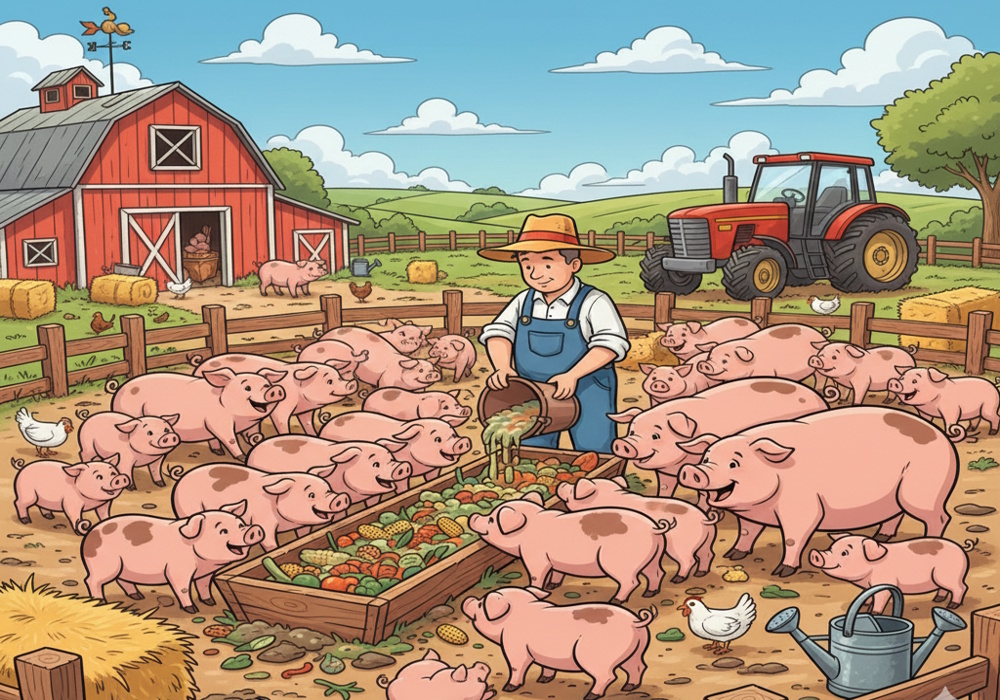
Image by Nano Banana
AI slop isn't just bad content. We've seen that on the internet for years. AI slop is bad content produced at industrial scale with unprecedented speed, realism, and volume. Traditional low‑quality content was annoying. AI slop is a game changer, taking low-quality to a higher level.
There is a profound irony at play here. As our AI software improves, the distinction between real and fake diminishes. The Tilly Norwood story looks like it was produced in a Hollywood studio even though it was created in a London office, powered by AI.
- AI slop floods platforms in a way humans never could. AI tools have created an internet flooded with low‑quality content as generative tools became widespread. Before AI, low‑quality content was limited by human time, human effort, and human creativity (or lack thereof). Now, one person can generate thousands of videos, articles, or images in minutes with AI. The volume is categorically different.
- AI slop looks more convincing than old junk. AI slop includes images and videos that look like a cross between photographs and computer‑generated graphics, often believable at first glance. Old low‑quality content looked fake. AI slop often looks almost real, until you notice the subtle difference. This is why fake disaster photos spread during real crises, AI-generated news videos look legitimate, and AI‑generated people seem real but don't exist.
- AI slop is created with no human intent or expertise. AI slop is low‑effort, mass‑produced content created primarily to scale output or rank in search results. Traditional, pre-AI low‑quality content still required a human to write it, a human to shoot it, and a human to scam with it. All AI slop requires is a prompt, a bot, and an upload button. The human is barely involved.
- AI slop reacts instantly to trends and crises. AI slop spreads during real‑time events like fake hurricane or flood images that go viral during natural disasters. Old low‑quality content lagged behind events, while AI slop can appear within minutes of a breaking story. This makes misinformation faster and harder to contain.
- AI slop looks the same everywhere. AI slop is generic, templated, and interchangeable with the same tone, same structure, and same visuals. Old, low‑quality content was at least varied. There were different scammers, different writers, and different styles. AI slop is algorithmically flattened with the same phrasing, the same visual tropes, and the same generic voice. It creates a sameness across the internet.
- AI slop mixes formats in ways old junk didn't. AI slop spans text, images, video, audio, or hybrids. Old, low‑quality content was usually one format such as email spam, a clickbait article, or a blurry photo. AI slop can be a fake video with AI narration, a synthetic image with AI‑written captions, or an AI‑generated article illustrated with AI‑generated photos. It's multi‑modal junk.
- AI slop changes the structure of platforms. AI slop has reshaped YouTube feeds globally, becoming a large percentage of what people see. Old, low‑quality content annoyed users. AI slop reshapes algorithms, because it's cheap, it's endless, and it's optimized for engagement. Platforms get clogged with it.
 Examples of AI Slop
- Fake statements and clips of politicians or celebrities
- AI-generated fantasy animals, architecture, etc
- Pseudo-educational videos with AI voices
- Generic product reviews or fabricated testimonials
- Absurd AI-generated videos
- Off-kilter advertising images
- Cheesy propaganda
- Fake-looking real news
- Junky AI-written books
- "Workslop" reports that waste coworkers' time
- And yes...lots of talking cats (see Why AI Trains on Cats)
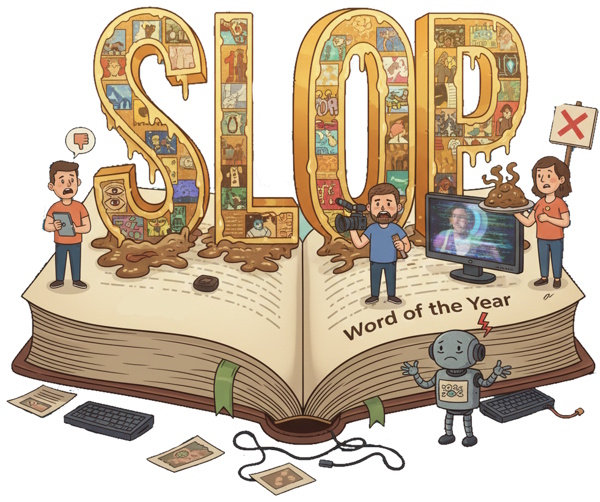
 Why AI Slop? Why now?
Slop became shorthand for the feeling that online spaces were being flooded with low-value AI content:
- NBC News described it as reflecting "absurd videos, cheesy propaganda, junky AI-written books" that filled feeds in 2025.
- CBS News highlighted that the word's popularity came from the "widespread availability of generative artificial intelligence" and the flood of "creepy, zany and demonstrably fake content".
- Merriam-Webster's own editors said the English language "came through again" by capturing the moment in four letters.
- Even tech leaders reacted. The term became so widespread that Microsoft's CEO publicly pushed back on the overuse of slop, urging people to move beyond the slop-vs-sophistication framing (see below).
People feel overwhelmed by AI content
Merriam-Webster explicitly tied slop to the proliferation of creepy, zany, and fake AI content flooding the internet. That tells us something important: AI isn't just a technology story anymore - it's an environmental story. People feel like they're swimming in low-quality, uncanny, mass-produced digital junk.
Trust in online content is eroding
PBS notes that AI slop "supercharges confusion and spreads misleading information". This reflects a broader cultural anxiety: What's real? Who made this? Can I trust anything I see? The fact that a dictionary had to define a word for this phenomenon shows how mainstream the concern has become.
AI is now part of everyday life, even when people don't know it or want it
Smithsonian Magazine describes slop as the "AI-generated junk that fills our social media feeds". This isn't niche. It's not tech-insider jargon. It's the average person scrolling TikTok and thinking: "Why does everything look off?" That's a cultural shift: AI is no longer optional or invisible.
Humor is how people cope with AI weirdness
The word slop is funny, a little gross, and very human. Choosing it as Word of the Year shows that people are using humor to deal with the absurdity of AI's side effects. It's the same effect as when some people call slop AI images "blursed" or "cursed-core."
It reflects a backlash against quantity-over-quality
AI slop is a judgment on the glut of low-quality content clogging the internet. This is a cultural critique, for AI makes it easy to produce more, but not necessarily better. People are pushing back against spammy AI books, AI-generated real estate listings, AI-generated ads, and AI-generated news that's largely fake, not real news. The word 'slop' is a shorthand for frustration with the industrialization of creativity and its intent to deceive.
It shows that AI culture is now self-aware
The fact that we have a word for bad AI content and that it won Word of the Year means society is developing a vocabulary to talk about AI's impact. That's a sign of cultural maturity. We're not just dazzled by AI anymore. We're evaluating it, critiquing it, and naming its flaws.
It hints at the next phase of AI culture
When a culture invents a word to describe a problem, it's usually the first step toward solving it. Slop becoming Word of the Year suggests that people want higher standards, authenticity, transparency, and tools that help filter or improve content.
 Slop vs Sophistication
In a recent blog, Microsoft CEO Satya Nadella said he wants people to stop using the term AI slop:
We need to get beyond the arguments of slop vs sophistication and develop a new equilibrium in terms of our "theory of the mind" that accounts for humans being equipped with these new cognitive amplifier tools as we relate to each other. This is the product design question we need to debate and answer.
Satya Nadella's plans for AI are based on a shift from the current "slop" phase. He emphasizes the need to move beyond the arguments of slop vs. sophistication by developing a conscienceness or "theory of the mind" that involves users being equipped with new cognitive AI tools.
Nadella states the industry must stop obsessing over the slop vs sophistication argument and instead focus on real-world impact, human empowerment, and practical applications of AI. He is saying that what matters is how people apply AI to achieve their goals, not the spectacle of the technology. AI should be designed to amplify human potential, not replace it.
Nadella's vision includes creating complete systems that orchestrate multiple AI agents, manage permissions and memory, and allow these tools to work safely in real-world chaos. He believes that what matters is not the power of any given model, but how people choose to apply AI to achieve their goals.
When AI Content Becomes Slop
AI content crosses the line into slop when it has some of these characteristics:
- It's low- to mid-quality and generic: AI slop is literally defined as "low- to mid-quality content" created with little care.
- It's inaccurate or misleading: Fake disaster photos, fabricated events, or generic articles with wrong facts are classic examples of slop.
- It's produced in bulk just to fill space: Wikipedia calls slop "digital clutter" and "filler content prioritizing speed and quantity over substance".
- It's created for attention farming: Slop is often posted to exploit "the economics of attention" rather than to inform or help. In other words, slopping has economic value; it makes money.
- It displaces higher-quality material: AI slop pushes out more meaningful content, especially on social platforms.
- It looks uncanny or wrong: The flood girl (fake image of a child holding a puppy during a hurricane) and other viral AI images are cited as classic slop because they're visually off kilter.
 The Great AI Slop Flood of 2025
When AI Slop took over the internet and nobody could stop it
It started innocently enough in early 2025. Some clever (or bored) devs realized: "If we train cheap models on nothing but low-quality Reddit threads, TikTok comments, and 4chan greentexts, then let them generate infinite content. We can flood every platform with garbage and reap ad revenue!" They called it "AI slop." Like pig slop, but for your brain. The plan worked all too well.
Phase 1: The Blogs
Thousands of auto-generated
websites popped up overnight. Titles like:
"Top 10 Reasons Why Cats Are Secretly Government
Agents (You Won't Believe #7)"
"I Asked AI to Rank Every Pizza Topping
and It Changed My Life Forever"
"Doctors Hate Her: Local Mom Discovers
One Weird Trick to Live Forever Using Only This"
All written in that unique AI voice: 800 words of fluff, zero facts, perfect SEO.
Google tried to fight it. Google lost. By March, half the search results were slop.
Phase 2: Social Media
The slop migrated to X, TikTok,
Instagram. AI accounts with stolen profile pics posted 24/7:
Motivational quotes over
sunsets that were clearly Midjourney hallucinations.
"Hot takes" that
read like a neural net had a stroke.
One viral account posted: "The key
to happiness is waking up early. Also drinking water. Also breathing. Like
if you agree." It got 2 million followers.
Phase 3: The Revenge of the Humans
By summer, people
were furious. But also addicted. They hated the slop but kept scrolling.
Then came the counter-slop movement. Humans started posting deliberately
terrible AI content to mock it. Examples:
A 10-minute TikTok of
AI-generated feet pics with voiceover: "This is what the algorithm wants."
A blog titled "I Replaced My Entire Personality with AI Slop and My Wife
Left Me (Click for Part 2)"
An X thread where someone asked Grok to
"write the most slop possible" and it delivered a 47-tweet masterpiece about
"Why White Toast Is the Ultimate Superfood (Doctors Hate This!)."
Phase 4: The Slop Singularity
By fall, AI was
generating slop about slop. Articles titled:
"Is AI Slop the Future of Content or the Death of
the Internet?"
"I Fed AI Slop to Another AI and It Became Sentient (We
Have Proof)"
"Top 5 AI Slop Generators That Will Make You Rich in 2026"
The internet became a hall of mirrors made of garbage.
The Endgame
In December 2025, platforms finally
cracked down. Google rolled out "SlopFilter 3000." X added a "This post
smells like AI" button. TikTok banned anything longer than 15 seconds
(kidding, just a wish).
But the slop never fully died. It just evolved. Today, in 2026, we call high-quality content "artisanal" or "human-crafted" like it's some rare cheese or fine wine. And every time you see a perfectly generic sunset quote, you whisper: "Slop."
Moral of the story: We asked AI to make infinite content. It did. We got exactly what we paid for...nothing.
Now excuse me while I go write a blog: "Top 10 Ways AI Slop Changed My Life Forever (Number 6 Will Shock You)."
The End. (Or as the slop bots would say: "Like and subscribe for more life-changing content!")
 Links
Links
Humorous Guides to Surviving AI (3 book series) from AI World and Amazon Books includes AI is Just an App, Our House has a Brain, and AI is Coming for Your Job. LOL stories and teachings about artifiical intelligence. Paperback and Kindle versions.
More AI Stories.
External links open in a new tab:
- livescience.com/technology/artificial-intelligence/ai-slop-is-on-the-rise-what-does-it-mean-for-how-we-use-the-internet
- moin.ai/en/chatbot-wiki/ai-slop
- en.wikipedia.org/wiki/AI_slop
- theconversation.com/what-is-ai-slop-a-technologist-explains-this-new-and-largely-unwelcome-form-of-online-content-256554
- krinstitute.org/publications/ai-slop-i-pollution-in-our-communication-environment
- globisinsights.com/future-of-work/machine-learning/ai-slop-is-flooding-the-internet/
- meltwater.com/en/blog/ai-slop-consumer-sentiment-social-listening-analysis
- testrigor.com/blog/ai-slop/
- digiday.com/media/ai-slop-myths-debunked-whats-harmful-whats-hype-whats-just-meh/
- reddit.com/r/NewTubers/comments/1o31zg9/is_anyone_else_freaked_out_by_the_flood_of/
- reformedjournal.com/2006/10/16/slopping-the-hogs-in-a-technological-society/